
AIFIND: Stabilizing Incremental Deepfake Detection via Semantic Anchors
AIFIND: Artifact-Aware Interpreting Fine-Grained Alignment for Incremental Face Forgery Detection
AIFIND is an Artifact-Aware Interpreting Fine-Grained Alignment framework for Incremental Face Forgery Detection (IFFD) that achieves state-of-the-art results without data replay. It anchors evolving visual forgery features to stable, invariant semantic descriptors (semantic anchors) using a Vision-Language Model (VLM) approach to prevent catastrophic forgetting.
TL;DR
Face forgery is an arms race. As new "Deepfake" methods emerge, detection models often forget how to catch old ones—a phenomenon known as catastrophic forgetting. AIFIND breaks this cycle by replacing traditional data replay with "Semantic Anchors." By aligning visual features with constant linguistic descriptions of artifacts (like "blurry edges" or "texture inconsistency"), the model maintains a stable memory of forgery types without needing to store old training data.
The Problem: The Drifting Latent Space
In Incremental Face Forgery Detection (IFFD), we want models to learn new forgery types (e.g., Diffusion-based) without losing the ability to detect old ones (e.g., GAN-based). Most current methods try to solve this by "replaying" a small subset of old images. However:
- Coarse Supervision: Using a simple "Fake" label is too vague. It doesn't tell the model why it's fake.
- Feature Drift: Without a fixed reference, the feature space "warps" every time new data is introduced, causing the boundaries for old classes to collapse.
Methodology: The Power of Semantic Interpretation
AIFIND introduces a paradigm shift: treating forgery artifacts as invariant semantic concepts.
1. Artifact-Driven Semantic Prior Generator (ASPG)
Instead of just pixels, the model looks for five specific dimensions: Blur, Color, Structure, Texture, and Boundary. Using tools like MediaPipe, it generates textual descriptions (e.g., "abnormal texture in the mouth region") that serve as "Semantic Anchors." These anchors are stable; while a new forgery method might look different, the concept of a texture anomaly remains a constant reference point.
2. Artifact-Probe Attention (APA)
How do we force the visual encoder to "listen" to these anchors? The authors use Artifact-Probe Attention. Visual tokens act as "queries" that probe textual artifact embeddings.
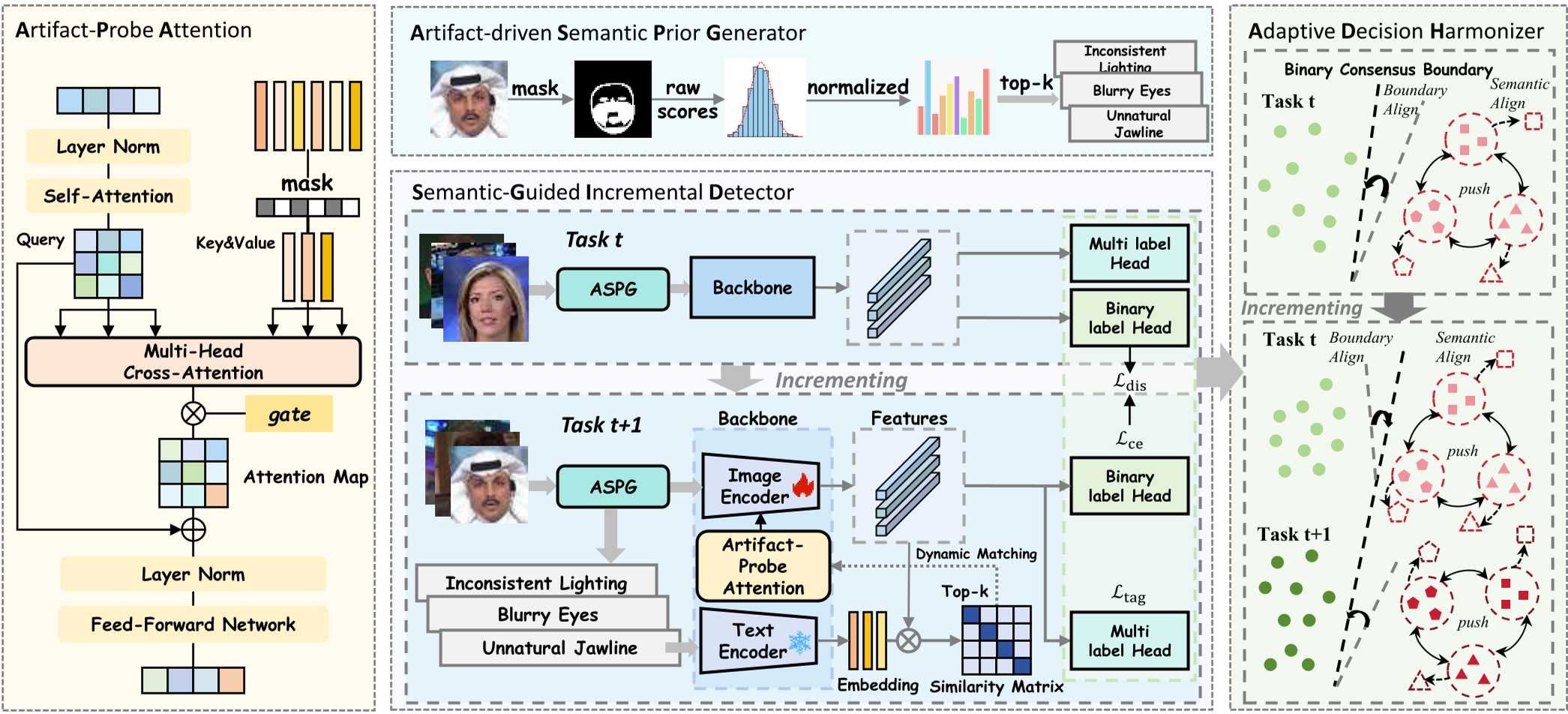 Figure 1: The AIFIND framework showing how ASPG generates anchors and APA injects them into the Transformer layers.
3. Adaptive Decision Harmonizer (ADH)
Even with good features, the classifier's head can still drift. ADH performs Spherical Semantic Alignment. It interprets the classifier weights as vectors on a hypersphere and ensures that as the model learns new tasks, the angular relationships between categories are preserved. This maintains "geometric consistency" across time.
Experiments: Proving the Replay-Free Superiority
The researchers tested AIFIND against heavyweights like SUR-LID and DFIL across multiple protocols.
Key Results:
- Protocol 1 (Cross-Dataset): AIFIND achieved an average AUC of 96.86%, outperforming methods that actually used replay buffers.
- Protocol 2 (Cross-Manipulation): It hit 97.69% AUC, demonstrating a remarkable ability to learn new forgery categories (Reenactment, Swapping, Synthesis) sequentially.
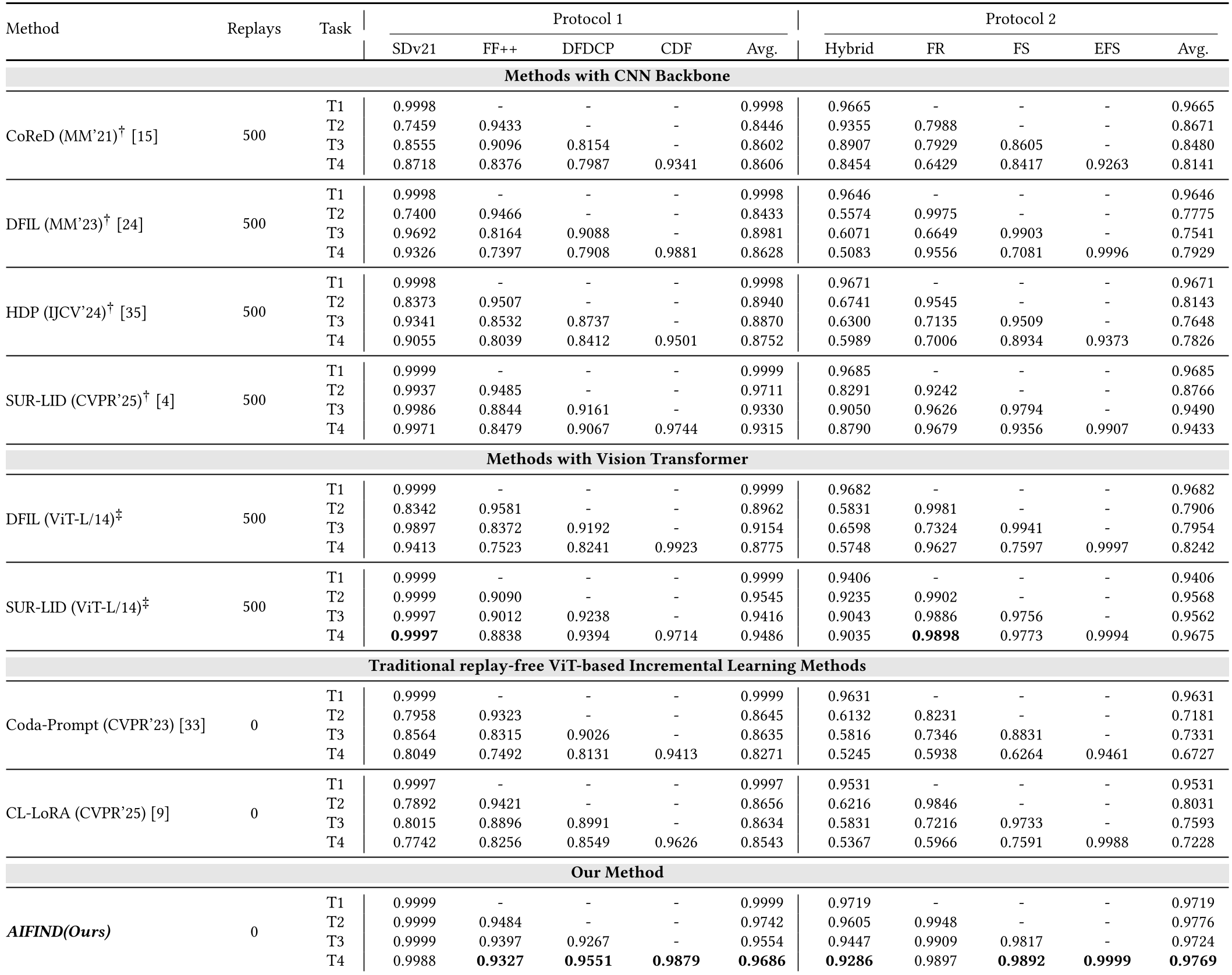 Table 1: Comparison of AIFIND against SOTA methods. Note that AIFIND uses 0 replays yet consistently yields higher Average AUC.
Deep Insight: Why it Works
The "Aha!" moment of this paper is the Visual-Textual Alignment. By using a VLM (CLIP-based) backbone, the model isn't just learning to separate "Real" from "Fake." It's learning a mapping between visual anomalies and human-interpretable concepts.
Grad-CAM visualizations (Figure 5 in the paper) show that while previous models had "scattered" attention, AIFIND focuses precisely on the eyes, mouth, and boundaries—areas where generative artifacts are most likely to appear.
Conclusion & Future Outlook
AIFIND proves that semantics are the ultimate regularizer for incremental learning. By anchoring volatile visual features to stable linguistic priors, we can achieve "data-replay-free" learning that is both high-performing and privacy-compliant.
Limitations: Currently, the artifact dimensions (Blur, Color, etc.) are manually defined. Future work leveraging Large Vision-Language Models (LVLMs) could potentially "discover" new artifact categories autonomously, making the system even more robust to "black swan" forgery techniques.
Senior Editor's Takeaway: This work represents a significant step toward "Open-World" forensics. The shift from data-driven replay to concept-driven anchoring is a template that other incremental learning fields (like medical imaging or autonomous driving) should closely observe.