
AIF: Aligning What VLMs See and Perceive via Adaptive Information Flow
Aligning What Vision-Language Models See and Perceive with Adaptive Information Flow
The paper introduces Adaptive Information Flow (AIF), a training-free inference-time method designed to align what Vision-Language Models (VLMs) "see" with what they "perceive." By adaptively modulating the causal mask to block attention from text tokens to irrelevant visual tokens, the method achieves SOTA performance across tasks like VQA, grounding, and OCR for models like LLaVA-1.5 and Qwen2.5-VL.
TL;DR
Even when a Vision-Language Model looks at the right object, it can still give the wrong answer. This "seeing-perceiving" gap is often caused by suboptimal information flow, where text tokens are "distracted" by irrelevant background pixels. Adaptive Information Flow (AIF) is a plug-and-play, training-free method that fixes this by dynamically blocking noisy attention paths during inference, yielding significant gains across VQA, OCR, and grounding tasks.
The "Distraction" Problem: Why VLMs Fail
In a standard Transformer-based VLM, every new text token generated can attend to all visual tokens. While this provides a global context, it introduces significant noise. Researchers found that instruction tokens often spread their attention mass across irrelevant background regions rather than concentrating on the evidence-bearing objects.
Current fixes usually involve:
- Retraining: Costly and requires massive datasets.
- Visual Cropping: Zooming into regions, which triples inference time and struggles with relational reasoning (e.g., "how many objects are in the whole scene?").
AIF takes a different path: don't change the image, change the way the model "thinks" about it.
Methodology: Measuring Importance via Token Dynamics
The core insight of AIF is that important visual tokens behave differently across layers compared to background tokens.
1. Token Dynamics & Entropy
The authors track "Token Dynamics"—the maximum attention value a visual token receives from text tokens across all layers.
- Important Tokens: Show distinctive activation spikes in specific "critical" layers.
- Irrelevant Tokens: Show irregular, "random" activation patterns across the entire depth of the model.
By applying Entropy as a metric for randomness, AIF can flag low-value tokens. High entropy = High randomness = Irrelevant.
2. Adaptive Causal Masking
Instead of deleting tokens (which might lose context needed for other steps), AIF modifies the Causal Mask. It blocks the text-to-image attention edges for high-entropy tokens while allowing image-to-image interactions to persist. This preserves the global visual structure while shielding the textual reasoning path from noise.
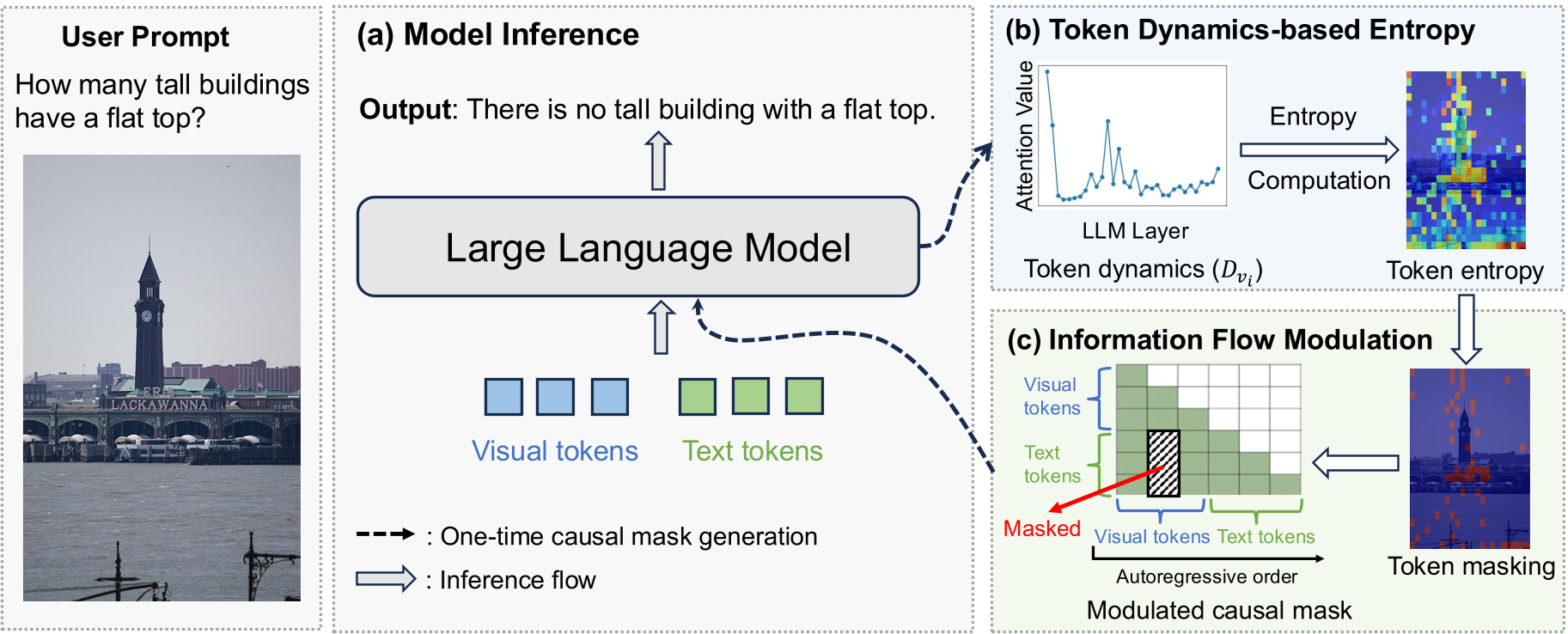 Figure: The AIF pipeline—from one-step decoding to entropy mapping and causal mask modulation.
Experimental Results: SOTA Performance
AIF was tested on foundational models like LLaVA-1.5 and Qwen2.5-VL. The results are striking:
- General VQA: On the MMStar benchmark, Qwen2.5-VL-7B saw a +7.0% absolute improvement.
- Visual Grounding: On RefCOCO, the method surpassed Grounding-DINO, a model specifically trained for localization, by effectively "clearing the fog" of background noise.
- Object Hallucination: By forcing the model to ignore irrelevant regions, AIF reduced hallucinations, improving POPE accuracy by several percentage points.
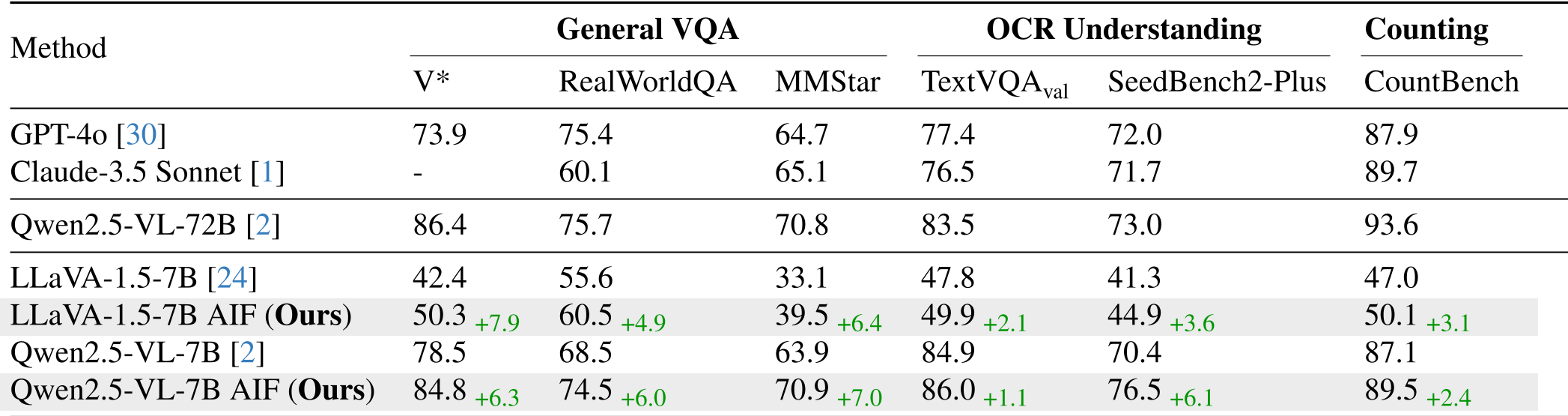 Table: Significant performance leaps across General VQA and OCR tasks.
Why it Works: Visualizing the Shift
When the model is asked "What company name is on the train?", the standard attention is scattered. After AIF masks the background (the sky, the tracks, the trees), the attention distribution centralizes on the text of the train.
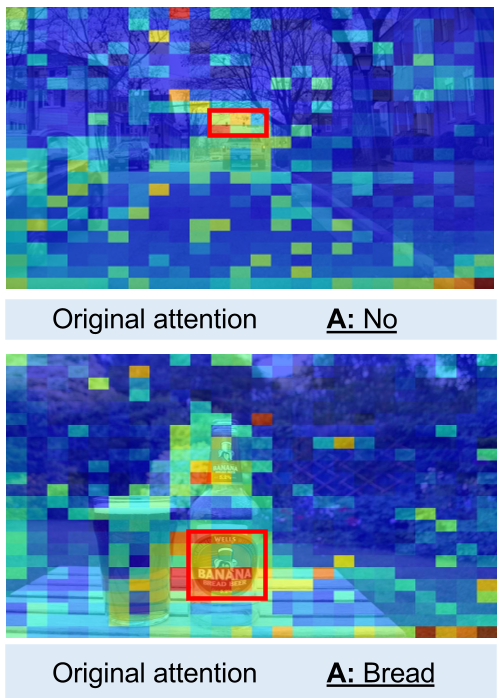 Figure: Comparison of attention before and after modulation. Note how the attention focuses purely on the traffic light/object of interest.
Critical Analysis & Conclusion
Takeaway: AIF proves that we don't always need more data or more parameters to make VLMs smarter. Sometimes, we just need to help them "focus" by pruning the internal pathways of information flow.
Limitations:
- Prompt Sensitivity: If the user prompt is extremely vague or metaphorical, the initial "one-step decoding" might fail to identify the correct important regions.
- Overhead: While efficient, it does require one initial decoding step to generate the entropy map, effectively adding the cost of one token's latency to the start of every request.
Future Outlook: This approach opens the door for "Inference-time Scaling Laws" where compute is spent not just on generating tokens, but on dynamically optimizing the model's internal attention structure for every specific query.