
Breaking the Rate-Loss Barrier: Overcoming the Single-Repeater Bound with Fast Classical Signaling
All-photonic quantum key distribution beyond the single-repeater bound
This paper introduces an all-photonic Measurement-Device-Independent (MDI) Quantum Key Distribution (QKD) protocol that surpasses the single-repeater bound without requiring ideal quantum memories. By exploiting the speed disparity between classical signaling (vacuum speed) and quantum signals (fiber speed), the method achieves a secret key rate scaling of approximately η^2/5 for multi-node configurations.
TL;DR
Researchers have unveiled an all-photonic QKD protocol that beats the fundamental "single-repeater bound" without the need for sophisticated, error-corrected quantum memories. The secret? Using the fact that classical information can travel faster than photons in a fiber, allowing "on-the-fly" corrections that eliminate the standard feedforward delay and reduce the reliance on long-term quantum storage.
The Motivation: Why the Speed of Light Matters
In the quest for long-distance quantum communication, we are fighting a losing battle against fiber loss. Twin-Field (TF) QKD was a breakthrough, changing the scaling from to , but it hit a wall at the "single-repeater bound."
Typically, to go further, you need quantum repeaters. But these require quantum memories—devices that can store a qubit without decoherence for milliseconds or longer—which are incredibly difficult to build. The authors of this paper noticed a loophole: Signal Latency. In standard silica fibers, light travels at roughly . If classical signals travel via free space or hollow-core fibers at nearly , the classical "correction" message can actually catch up to the slower quantum photon.
Methodology: The "Catch-Up" Architecture
The core innovation is a multi-node nested architecture. Instead of waiting for a quantum state to be stored while a classical signal crawls along, the nodes are positioned such that the classical feedforward signal and the quantum pulse arrive at the measurement station at the same time.
The Unified Architecture
The protocol utilizes a Node-Receives-Photon (NRP) setup. Alice and Bob send states to intermediate relays. Because the classical information moves faster, it configures the necessary Bell-state measurement (BSM) operations before the quantum states arrive.
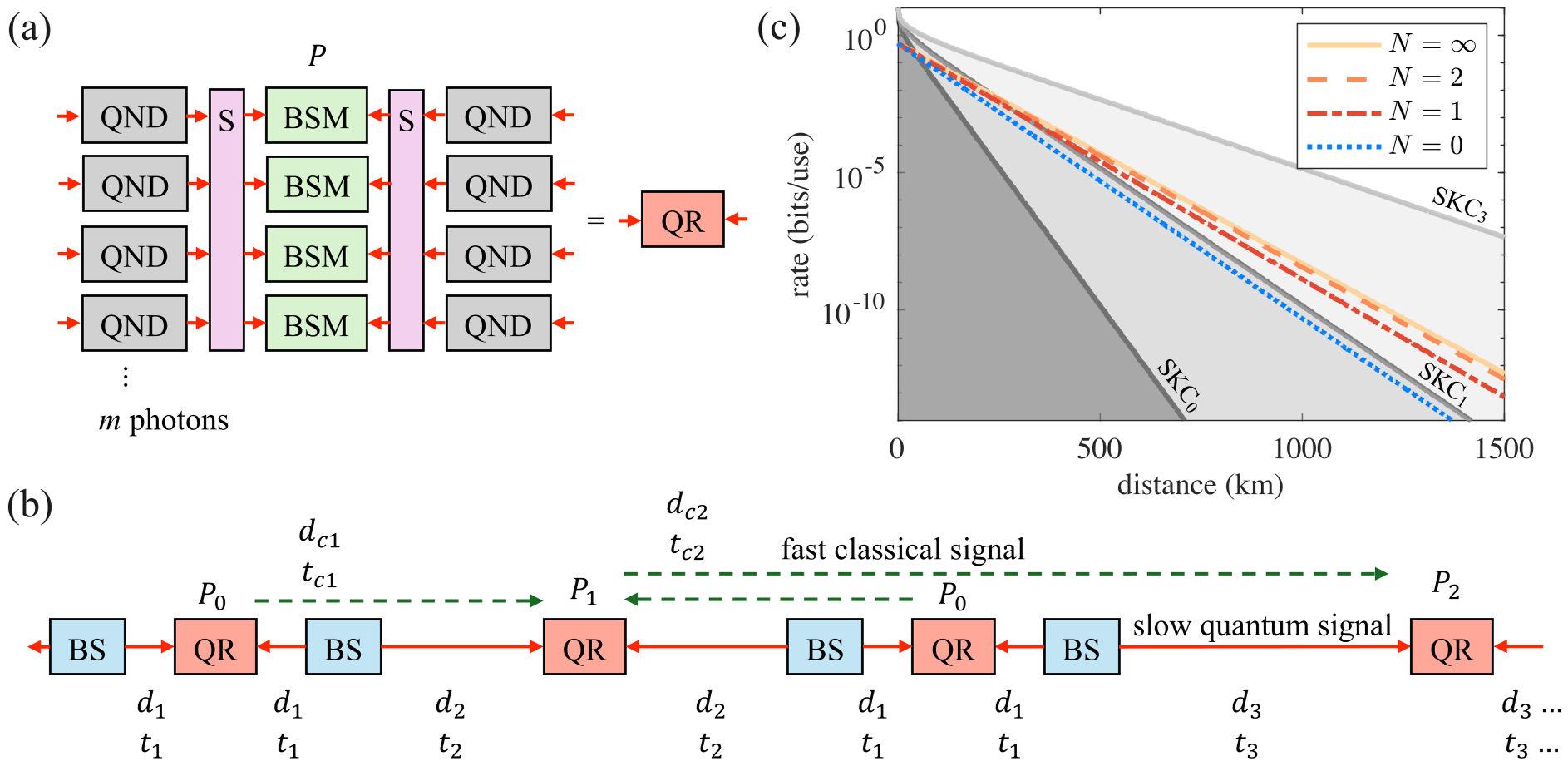 Figure 1: Comparison between standard MDI-QKD and the proposed nested multi-node protocol exploiting velocity differences ().
Single-Rail Implementation
To keep it practical, the authors moved from complex dual-rail qubits to single-rail temporal multiplexing. This uses single-photon interference (akin to TF-QKD) but extends it across nodes. The "memories" used here are just simple fiber loops (lossy buffers), which are much easier to implement than atomic or solid-state quantum memories.
Experiments and Scaling Results
The theoretical analysis shows that with enough nesting levels (), the secret key rate (SKR) scales as . For standard fiber (), this results in a scaling of .
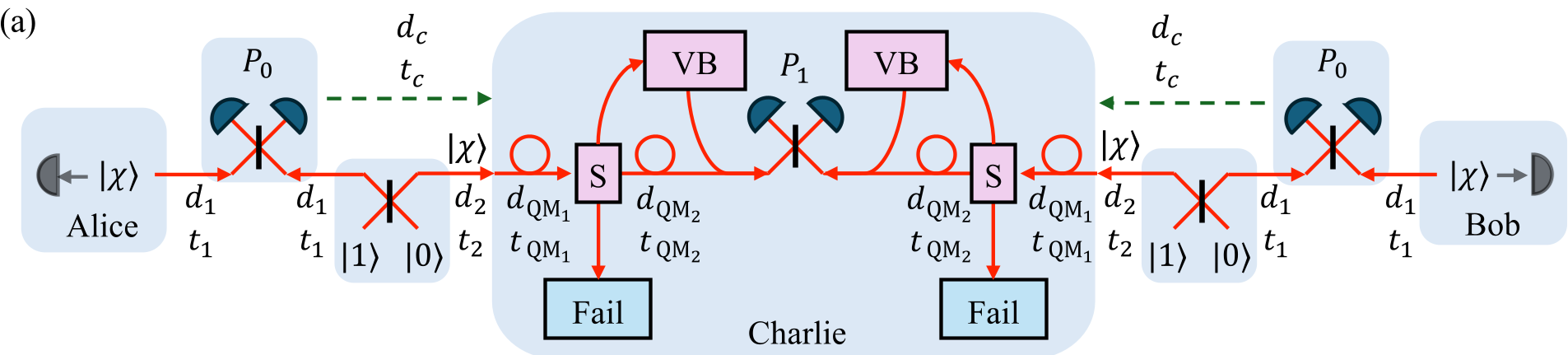 Figure 2: Secret key rate vs. distance. The protocol (solid lines) clearly breaks the single-repeater bound (dashed black line) and the TF-QKD limit.
Critical Insights
- The Break-even Point: The study identifies a "memory loss threshold." If your memory/buffer loss is too high, you're better off without it. They found the threshold to be around 0.057 dB/km.
- Buffer Efficiency: Even with lossy switches and imperfect buffers, the protocol maintains a significant edge over traditional TF-QKD systems at distances exceeding 400 km.
Critical Analysis & Conclusion
This work is a paradigm shift. It moves the focus from "how do we keep the qubit alive longer?" to "how can we use classical speed to make the qubit's life easier?"
Takeaways:
- Practicality: Since it uses linear optics and standard photonic components, this is much closer to deployment than any fault-tolerant repeater.
- Limitations: The protocol is highly sensitive to phase mismatch. Coordinating interference across multiple nested nodes requires extreme stability in fiber paths.
- Future Outlook: As hollow-core fibers (which allow for faster quantum propagation and lower loss) become more common, the parameters for this protocol will only improve.
By strategically using the speed disparity between quantum and classical channels, the authors have provided a viable blueprint for the next generation of the Quantum Internet.