
AnchorRefine: Solving the Action-Scale Mismatch in Robot Manipulation
AnchorRefine: Synergy-Manipulation Based on Trajectory Anchor and Residual Refinement for Vision-Language-Action Models
AnchorRefine is a hierarchical Vision-Language-Action (VLA) framework that factorizes robotic action generation into global trajectory anchoring and local residual refinement. By decoupling coarse transport from fine-grained execution correction, it achieves SOTA performance on benchmarks like LIBERO-Long and CALVIN, improving real-robot success rates by up to 18%.
TL;DR
AnchorRefine introduces a hierarchical approach to Vision-Language-Action (VLA) models by splitting action generation into two parts: a Trajectory Anchor (global "scaffold") and a Residual Refinement (local "correction"). This factorization prevents large movements from drowning out the subtle adjustments needed for grasping and contact, leading to an 18% success rate boost in real-world robot tasks.
The Core Challenge: Action-Scale Mismatch
Most current VLA models (like OpenVLA or RT-2) treat every dimension of an action—whether it's moving an arm 30cm or closing a gripper by 2mm—as equal. In reality, these signals operate at different scales.
The authors identify a specific failure mode: Action-Scale Mismatch. Because large motions dominate the loss function, the model fails to learn the high-frequency, low-magnitude signals required for precision-critical moments, such as the exact millisecond a gripper should close or the final micro-adjustment before a "click" connection.
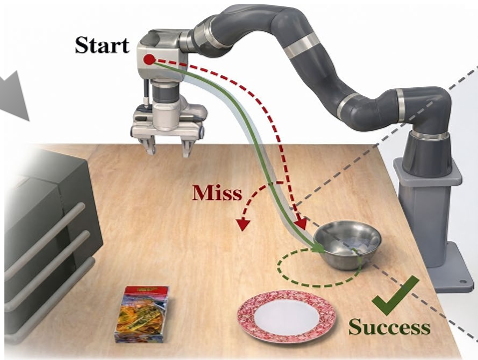 Figure 1: Comparison showing how human-like coarse-to-fine patterns minimize error covariance and the breakdown of gripper-related failures.
Methodology: Anchoring and Refining
AnchorRefine breaks the monolithic prediction into a structured, two-phase pipeline using shared multimodal contexts (Vision, Language, and Proprioception).
1. The Trajectory Anchor Planner
This module predicts the initial "executable motion scaffold" in the original action space. It focuses on the dominant trajectory—the "Macro" movement of getting to the object.
2. Residual Refine Module
Once the anchor is predicted, it is frozen. The Refine module then learns only the residual target: . Because the residual has a much smaller norm and lower variance, the optimization landscape becomes significantly "friendlier" for learning fine-grained adjustments.
3. Decision-Aware Gripper Refinement
Traditional models treat the gripper as a binary 0/1 regression. AnchorRefine instead uses a boundary-aware correction signal. It calculates whether the anchor's gripper decision was correct and applies a directional shift, ensuring the gripper closes with sufficient confidence at the precise moment of contact.
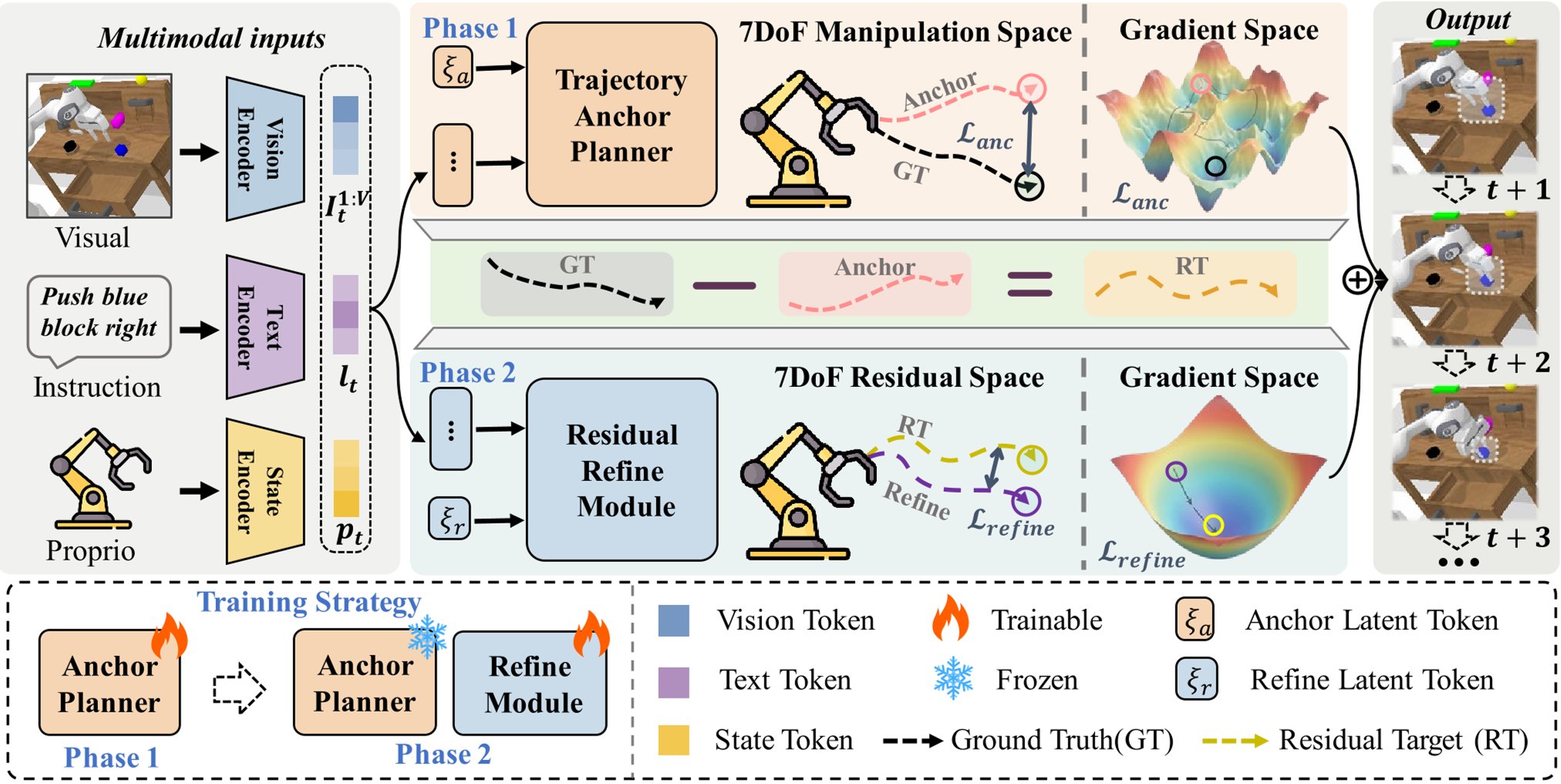 Figure 2: The AnchorRefine Architecture showing the two-phase training and the factorized action formation.
Experimental Validation
The authors tested AnchorRefine on two very different backbones: GR-1 (Direct Regression) and X-VLA (Diffusion/Denoising). The results were consistent:
- LIBERO-Long: An 82.3% success rate for the GR-1 version (up from 74.5%) and a near-perfect 97.4% for the X-VLA version.
- CALVIN ABC→D: Significant improvements in average sequence length, showing the model's ability to recover from small errors before they compound into failures.
- Real-World Deployment: Using a LeRobot SO101 arm, the system excelled at tasks requiring high terminal precision, such as "Stacking Blocks" and "Opening Drawers."
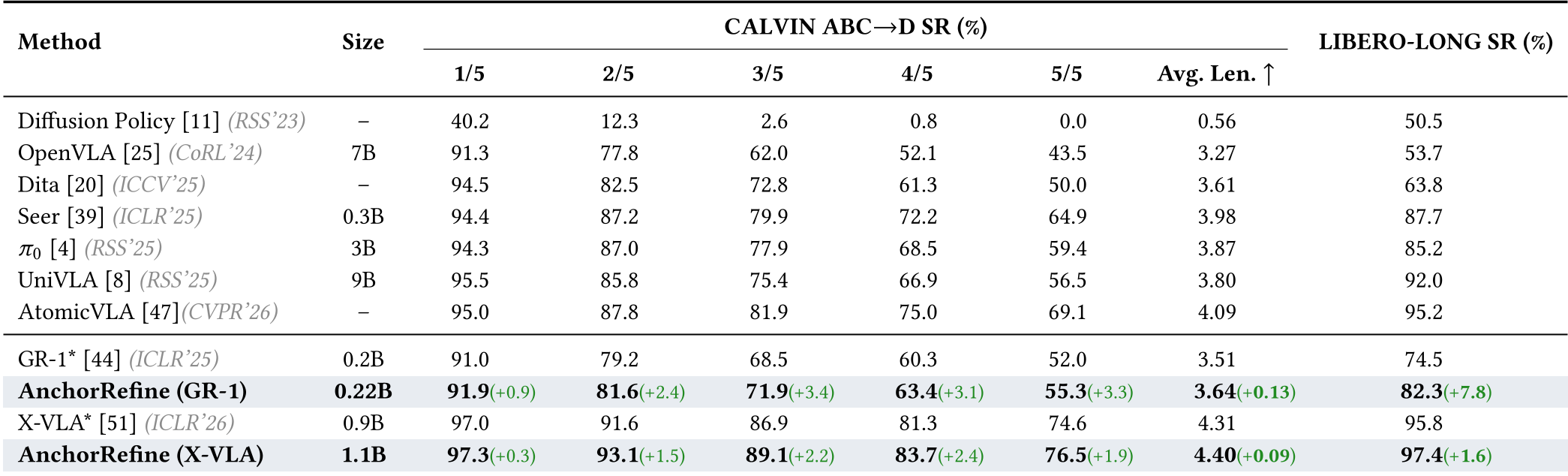 Table 1: Competitive results across CALVIN and LIBERO benchmarks.
Key Insights & Takeaways
- Residualization works: The residual target space has lower structural complexity, making it easier for the transformer to specialize in "correction" rather than "general movement."
- Implicit vs. Explicit Guidance: The paper finds that simply defining the loss relative to the anchor (implicit) works better than feeding the anchor's features back into the refinement module (explicit). This avoids "anchor bias," where the model simply copies the anchor's errors.
- Stability: The two-phase training ensures the anchor remains a stable scaffold, preventing the refinement stage from causing the entire policy to diverge.
Conclusion
AnchorRefine proves that "monolithic is not always better." By treating robot control as a synergy between a global planner and a local refiner, we can overcome the precision bottlenecks that have plagued general-purpose VLA models. This represents a significant step toward robots that are not just "smart" (understanding language) but also "dexterous" (performing precise physical work).