
Beyond Rating: Why Your AI Reviewer Needs an Argument, Not Just a Score
Beyond Rating: A Comprehensive Evaluation and Benchmark for AI Reviews
The paper introduces "Beyond Rating," a holistic evaluation framework and a large-scale curated dataset designed to assess AI-generated peer reviews across text-centric dimensions. It moves past simple score correlation to evaluate Content Faithfulness, Argumentative Alignment, Focus Consistency, Question Constructiveness, and AI-Likelihood.
TL;DR
AI-generated peer reviews are often judged by how closely they match human scores, but a "correct" score with hallucinated weaknesses is useless. This paper introduces Beyond Rating, a framework that shifts the focus to textual justification. By breaking reviews down into "atomic points" and measuring "Max-Recall" against experts, the researchers prove that an AI’s ability to identify the correct weaknesses is the actual secret to accurate automated scoring.
The Motivating Gap: Numbers Don't Talk
The academic community is currently obsessed with "AI Scientists" and automated reviewing. However, most benchmarks measure success by Rating MAE (Mean Absolute Error).
The authors argue this is a fundamental mistake. A review's value isn't the number at the end; it's the why—the strengths, the gaps in logic, and the constructive questions. Traditional n-gram metrics (BLEU/ROUGE) fail here because they don't capture semantic reasoning. If an AI reviewer identifies a non-existent error but happens to guess the human score correctly, current benchmarks would call it a success. Beyond Rating seeks to fix this by evaluating the soul of the critique.
Methodology: Parsing the Critique
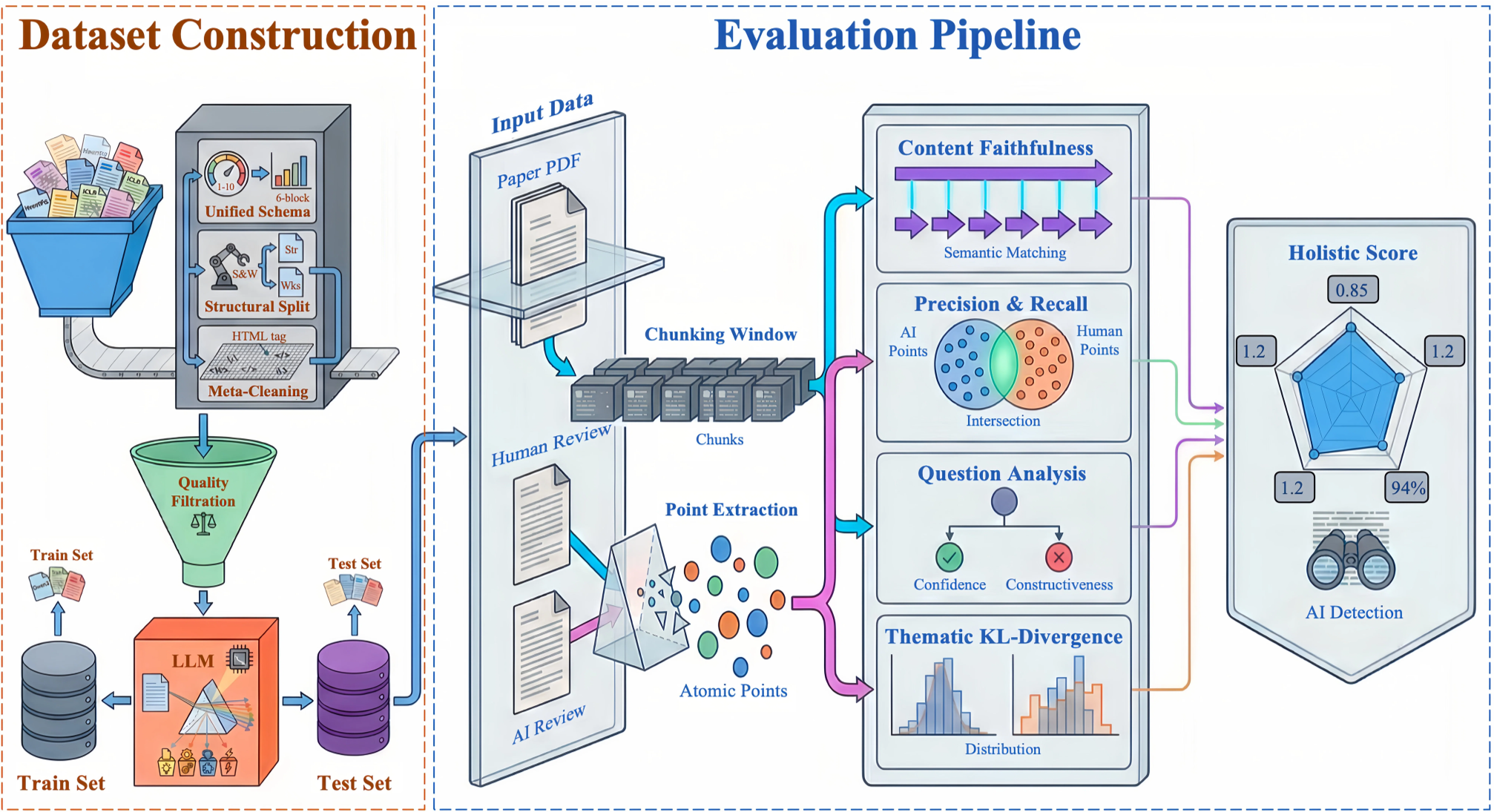
The "Beyond Rating" framework evaluates AI reviewers across five dimensions:
- Content Faithfulness: Measuring if the summary actually covers the paper's core segments via embedding-based similarity.
- Argumentative Alignment: Using Atomic Point Extraction to break critiques into granular claims (e.g., "The proof of Theorem 1 has errors") and matching them against human counterparts.
- The Max-Recall Strategy: Instead of forcing the AI to agree with the average of three human reviewers (who often disagree), the AI "wins" if it aligns deeply with any one expert.
- Focus Alignment: Using KL Divergence to see if the AI cares about the same things humans do (e.g., Soundness vs. Novelty).
- AI-Likelihood (Binoculars Score): Detecting if the review is formulaic or shows genuine "cognitive depth."
Key Insights from the Benchmarking
The researchers tested a battery of models, from GPT-5 to domain-specific SFT (Supervised Fine-Tuning) models. The results revealed several "Aha!" moments:
- Weakness is Key: There is a massive correlation (-0.781) between Weakness Recall and Rating MAE. If an AI can't spot the same flaws a human did, it won't get the score right.
- The "Verbosity" Bias: AI models often score higher than humans on summaries because they use more specific nouns and details, whereas humans tend toward brevity and abstraction.
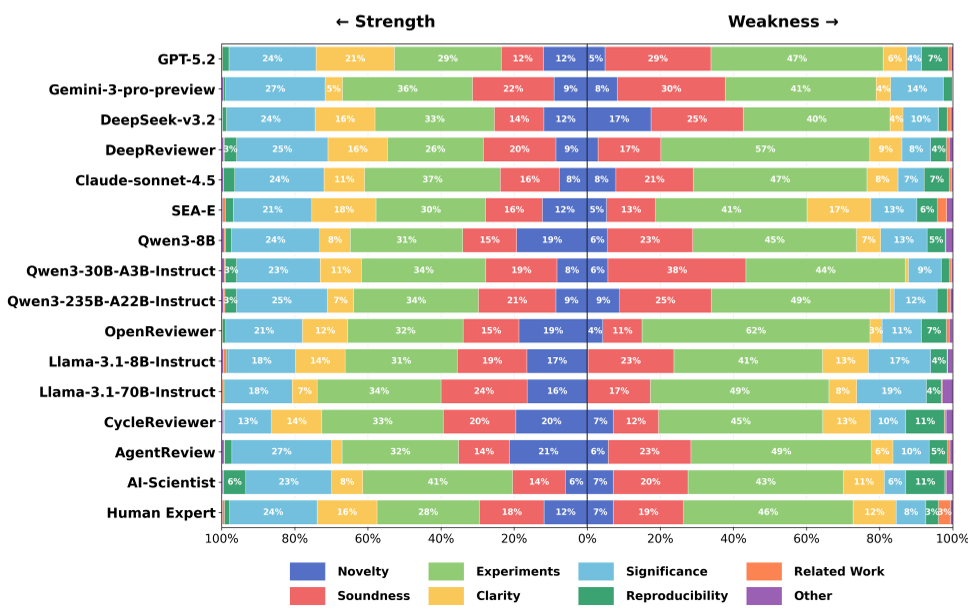
- The SFT Advantage: Fine-tuned models like DeepReviewer or CycleReviewer consistently outperformed vanilla LLMs by adopting the "human evaluative lens"—focusing more on Soundness and Experiments rather than generic praise.
Critical Analysis & Future Outlook
The paper makes a compelling case: Alignment of perspectival focus is a prerequisite for reliable scoring.
However, the methodology relies on a "Gold Standard" of human reviews. We know human peer review is notoriously inconsistent. While the "Max-Recall" strategy cleverly bypasses the consensus problem, it doesn't solve the issue of human bias being baked into the ground truth.
Takeaway: In the future, "Review Agents" shouldn't just be trained to predict a '6' or an '8'. They must be trained to extract and categorize "Atomic Points" of failure. If an AI cannot identify why a paper is technically unsound, its final recommendation remains a black-box guess.
Conclusion
"Beyond Rating" provides the necessary infrastructure—both a dataset of 16k papers and a multi-dimensional metric—to move AI assisted peer-review from a "rating game" to a "reasoning tool." It’s a foundational step for anyone building the next generation of AI Scientists.