
The Anatomy of Branes: From String Endpoints to Geometric Horizons
Branes
This comprehensive review, "BRANES" by Edvard T. Musaev, provides a unified pedagogical treatment of string theory branes—D-branes, NS5-branes, and KK-monopoles—across three equivalent descriptions: open string endpoints, BPS supergravity solutions, and dynamical objects governed by Effective Actions (DBI/WZ). It bridges the gap between perturbative string theory and non-perturbative phenomena, detailing State-of-the-Art (SOTA) effects like Hanany–Witten brane creation and Myers dielectric polarization.
TL;DR
In string theory, "strings" are just the beginning. This review by E.T. Musaev systematically explores Branes—higher-dimensional membranes that act as the non-perturbative backbone of the universe. By looking at branes as endpoints of strings, gravitational solutions, and dynamical "fluids," the paper explains how the dimension of an object can change through interactions like the Myers effect and how branes can be "born" out of thin air during the Hanany–Witten effect.
The Triple Identity of a Brane
To understand a brane, one must be a "technical polyglot" in three distinct languages of physics:
- The perturbative view: Branes are Dirichlet surfaces (D-branes). If a string is a rubber band, the D-brane is the wall it’s stuck to.
- The dynamical view: Branes are governed by Dirac-Born-Infeld (DBI) actions. They have tension and charge; they feel forces and can vibrate.
- The gravitational view: Branes are "Black Branes." Much like a black hole, a stack of branes warps the 10-dimensional spacetime into a specific BPS (supersymmetric) geometry.
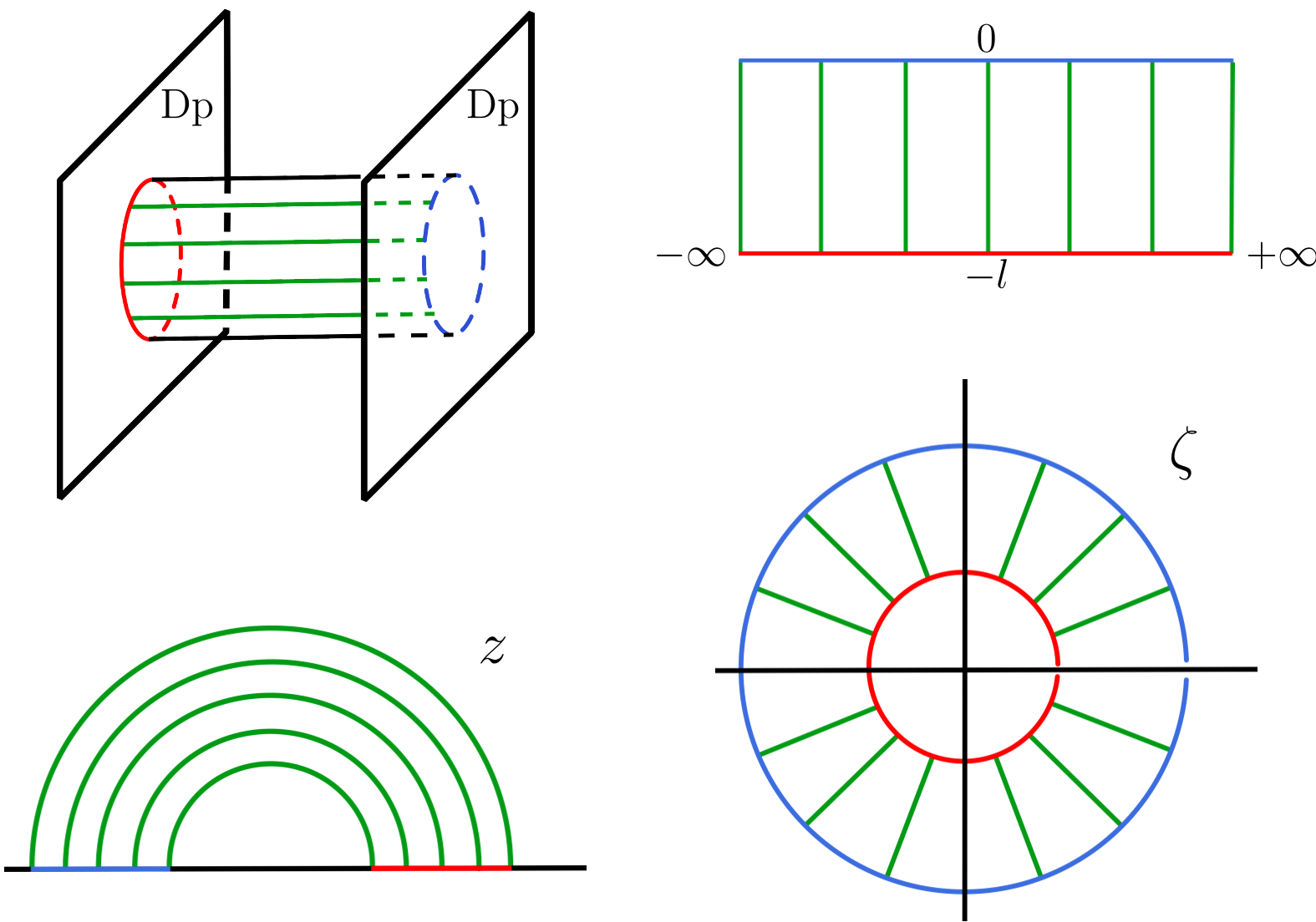 Figure 1: The open-closed string duality. A 1-loop open string (left) is equivalent to a tree-level closed string exchange (right), proving that D-branes must be sources for gravity.
The Mystery of Dissolved Charges
One of the review's most profound insights is that a D3-brane can "swallow" a D1-brane. This isn't just a collision; the D1-brane's charge becomes dissolved into the D3-brane as a magnetic flux.
Mathematically, the Wess-Zumino term tells us that if we turn on an electromagnetic field () on a D3-brane, it starts acting like it has a D1-brane inside it. This explains the "Branes within Branes" phenomenon that is essential for modern string phenomenology and the AdS/CFT correspondence.
Brane Engineering: The Hanany–Witten Effect
What happens when you move an NS5-brane (a magnetic source for strings) across a D4-brane? In our macroscopic world, nothing. In the quantum string world, a D2-brane is created, stretching between them like a spider web.
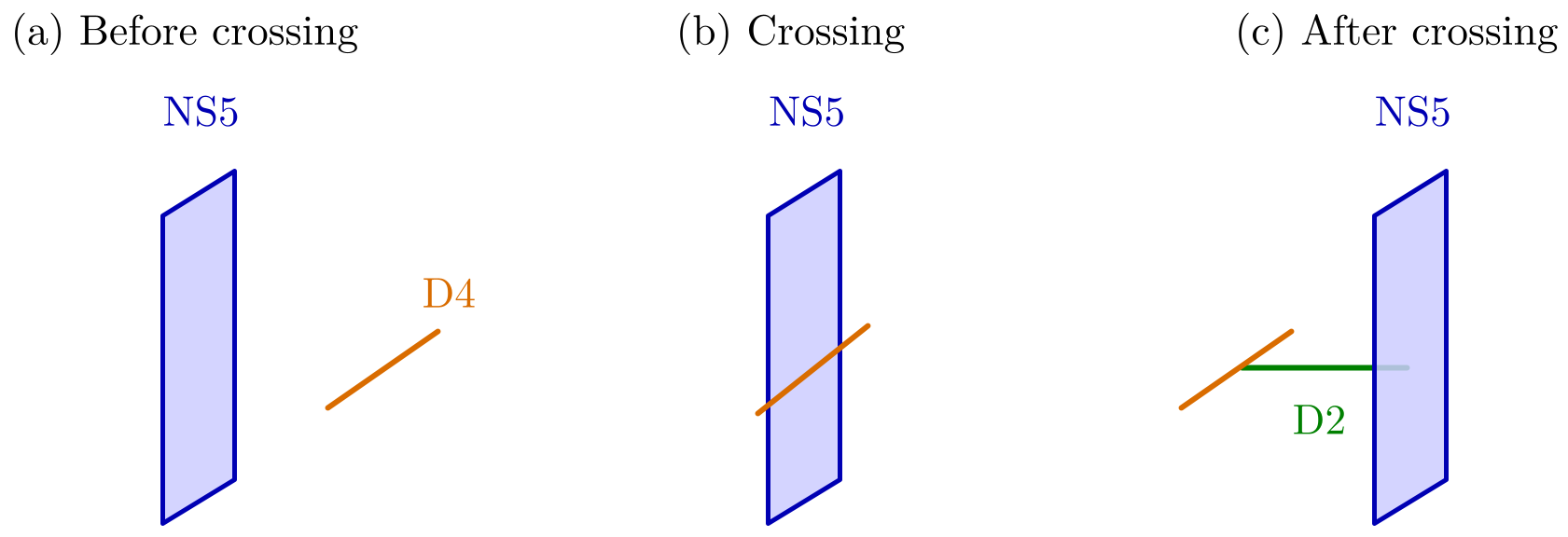 Figure 2: Brane creation during crossing. This discrete, quantized process is the fundamental mechanism behind building 3D and 4D gauge theories.
The review explains this through Page Charges. Because the magnetic field of an NS5-brane is topologically "twisted," moving it forces a large gauge transformation that shifts the charge count by an integer.
The Myers Effect: Spontaneous Polarization
If you place a stack of 0-dimensional particles (D0-branes) in a specific background flux, they don't just sit there. They "polarize" and puff up into a 2-dimensional sphere. This is the Myers Effect, also known as the dielectric brane effect.
Instead of classical coordinates, the positions of these branes become non-commutative matrices. The particles essentially "forget" their point-like nature and reorganize into a fuzzy, higher-dimensional geometry to minimize energy.
Deep Insight: Towards M-Theory
Why does all this complexity matter? Musaev concludes by pointing out that all these different branes (D0, D2, D4, NS5, F1) are actually different "shadows" of just two objects in an 11-dimensional theory called M-Theory: the M2-brane and the M5-brane.
By wrapping these membranes around an 11th hidden dimension, we get the entire zoo of Type IIA string theory. This review serves as a map for navigating that zoo, showing that the "geometry" of our universe is far more fluid and non-perturbative than the simple "string" model suggests.
Conclusion
The study of branes shifts string theory from a theory of perturbative vibrations to a theory of emergent spacetime. Whether they are acting as the endpoints of matter or the sources of gravity, branes are the true architects of the holographic universe.