
CoEvolve: Breaking the Static Data Barrier with Agent-Data Mutual Evolution
CoEvolve: Training LLM Agents via Agent-Data Mutual Evolution
The paper introduces CoEvolve, a closed-loop reinforcement learning framework for LLM agents that enables joint evolution of the agent's policy and its training data. By using feedback signals like "forgetting" and "uncertainty" to guide LLM-based task synthesis, CoEvolve achieves state-of-the-art performance on AppWorld and BFCL, significantly outperforming strong open-source baselines and even rivaling closed-source models.
TL;DR
Static training sets are the "glass ceiling" of current LLM agents. CoEvolve shatters this by introducing a closed-loop system where the agent and its training data evolve together. By detecting when an agent "forgets" a skill or struggles at a logic "boundary," the framework triggers an LLM to synthesize new, targeted tasks. The result? A 4B parameter model that outperforms GPT-4 on complex tool-use benchmarks.
The "Static Snapshot" Problem
Most current agents are trained via imitation learning on expert trajectories or static synthetic datasets. This paradigm suffers from two fatal flaws:
- Expensive Exploration: Real-world interactions take minutes of human expert time per trajectory.
- Blind Spots: Static data serves as a snapshot. As an agent's policy changes during RL, it might develop new weaknesses or forget previously mastered tasks—scenarios the original dataset cannot address.
Methodology: The Mutual Evolution Loop
CoEvolve moves away from unguided random exploration. Instead, it treats the agent's failures as features.
1. Signal Extraction: Hunting for Weakness
During training, the system monitors for three specific "Signal-Annotated Trajectories":
- Forgetting Signals: Tasks where the agent used to succeed but now fails (detecting policy regression).
- Boundary Signals: High-variability tasks where the agent succeeds in some runs but fails in others (detecting instability).
- Rare Signals: Systematic action patterns that are underexplored but recurring.
2. Signal-Guided Re-exploration
Once a weakness is found, a "teacher" LLM (e.g., Qwen3-Max) reflects on the failure. It doesn't just re-run the task; it performs multi-round and multi-step exploration to discover alternative paths and more complex variations of the failure mode.
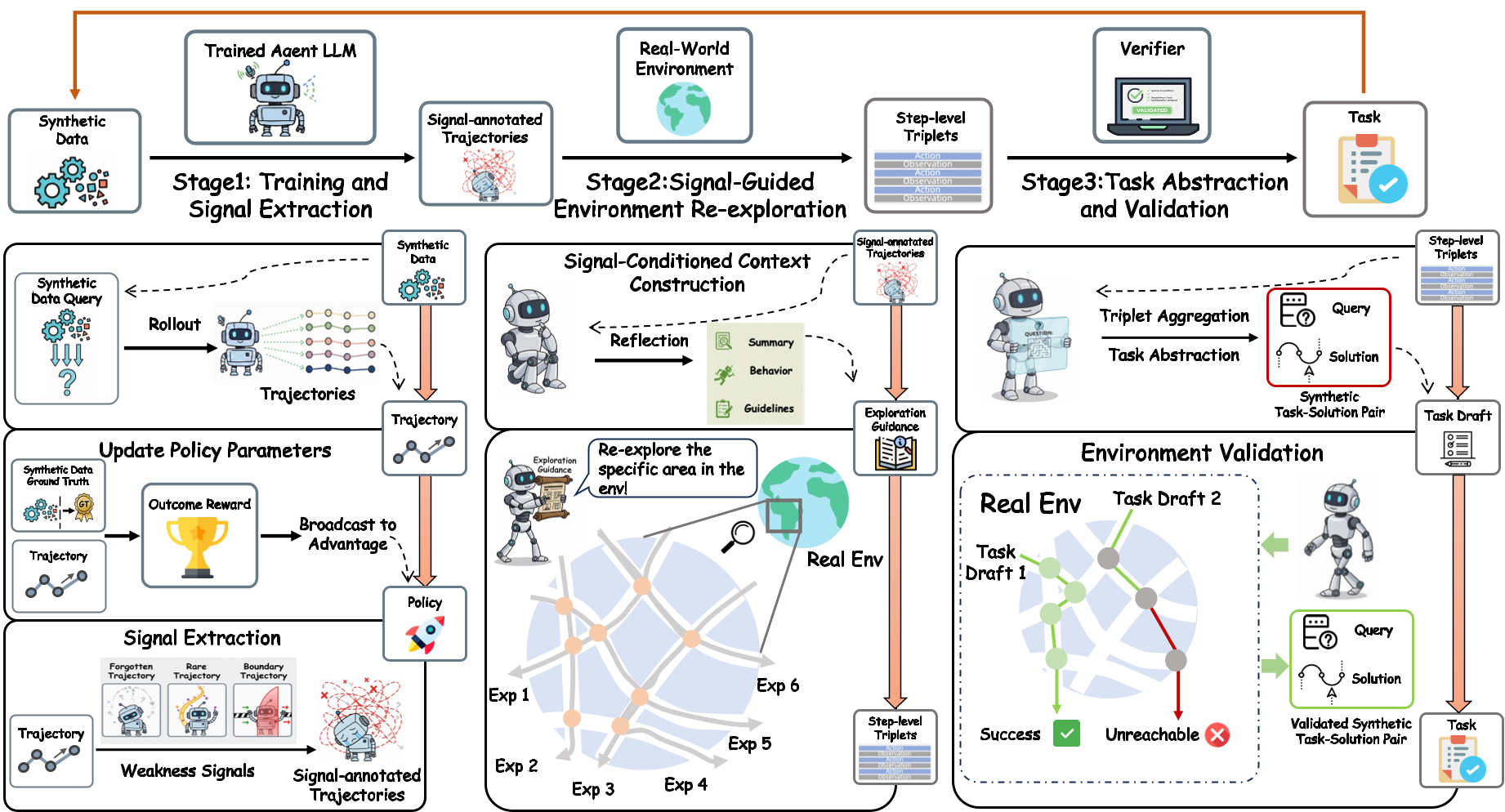
3. Abstraction and Validation
The raw interaction triplets are abstracted into high-level user intents (task queries). Crucially, these new tasks are validated in the environment. Only if a solution is proven to work is the task added to the training pool , evolving the data distribution for the next RL iteration.
Results: Efficiency Meets Scalability
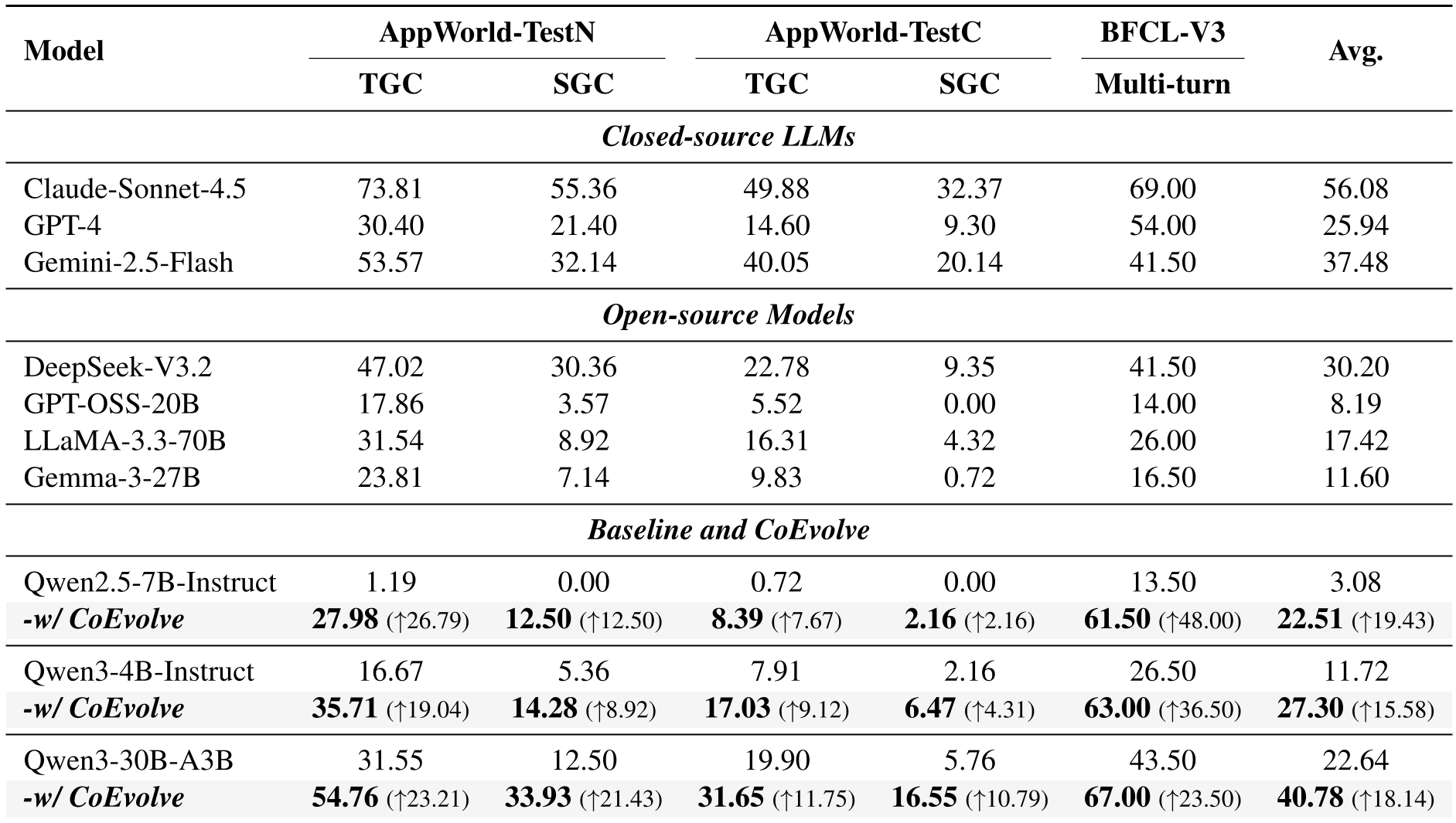
The results across AppWorld (digital service interactions) and BFCL (function calling) are striking.
- Closing the Gap: CoEvolve-trained mid-sized models (4B, 30B) consistently beat much larger open-source models like LLaMA-3.3-70B.
- Surpassing GPT-4: On the Berkeley Function Calling Leaderboard (BFCL), Qwen3-4B with CoEvolve reached a score of 63.00, significantly higher than GPT-4's 54.00.
- Sustainability: The extra cost of this "feedback loop" is minimal—only about a 10% increase in total training time for a massive jump in accuracy.
Deep Insight: Why It Works
The "Ablation Study" section of the paper reveals that Forgetting Signals are the most critical component. Without them, performance drops by nearly 4 points. This suggests that LLM agents are highly susceptible to "catastrophic forgetting" during the RL process. By dynamically re-injecting tasks that the model is beginning to lose a grip on, CoEvolve acts as a continuous "refresher course," stabilizing the learning trajectory.
Furthermore, the synthetic tasks generated are structurally more complex. While original samples were often linear, the evolved tasks involve conditional control and multi-step state dependencies.
Conclusion & Future Outlook
CoEvolve proves that we can stop relying on massive human-curated datasets for specialized agentic behavior. The future of AI agents lies in autonomous pedagogy—where the agent identifies its own ignorance and the system generates the curriculum to fix it.
Limitations to Watch: The system currently relies on the agent's own interaction history, which can be noisy in the early stages of training. Moving forward, more robust signal extraction under "low-competence" regimes will be the next frontier for autonomous agent evolution.