
CollideNet: Mastering the Rhythm of Accidents via Hierarchical Disentanglement
CollideNet: Hierarchical Multi-scale Video Representation Learning with Disentanglement for Time-To-Collision Forecasting
CollideNet is a novel two-stream hierarchical Transformer-based architecture designed for Time-To-Collision (TTC) forecasting. It integrates multi-scale spatial aggregation with a temporal stream that disentangles non-stationarity, trend, and seasonality, achieving new SOTA results on DAD, CCD, and DoTA datasets.
TL;DR
CollideNet is a breakthrough in Time-To-Collision (TTC) forecasting. By treating video as a multi-scale time series and disentangling it into Trend, Seasonality, and Non-stationarity, it achieves a massive 30% performance boost over previous SOTA on critical automotive safety benchmarks while maintaining higher parameter efficiency than standard Vision Transformers.
Problem & Motivation: The Complexity of "When"
Predicting if an accident will happen is a classification task (Traffic Accident Anticipation); predicting exactly when (TTC) is a far more grueling regression task. Current models struggle because:
- Spatial Scale: They miss the nuance between a tiny distant blinker (local) and the overall flow of a 4-lane highway (global).
- Temporal Complexity: Standard Attention has a "quadratic memory tax," making long video sequences expensive.
- Non-stationarity: Traffic scenes are "non-stationary"—their mean and variance change as a car moves from a quiet alley to a chaotic intersection, breaking the assumptions of simple neural networks.
Methodology: The Two-Stream Strategy
CollideNet splits the problem into two distinct streams: Hierarchical Spatial Modeling and Disentangled Temporal Modeling.
1. Spatial Stream (The Multi-Scale Eye)
Instead of fixed-resolution processing, CollideNet uses a hierarchical approach. Early stages attend to high-resolution local patches, while later stages pool information to capture global context.
2. Temporal Stream (The Disentangler)
This is where the magic happens. The model decomposes the frame embeddings () into:
- Trend (): Long-range, slow-moving background dynamics.
- Seasonality (): Short-range, repetitive, or foreground-specific patterns.
- Non-stationarity: It uses a normalization/denormalization trick to "stationarize" data for the Transformer, then re-applies the original statistical "envelope" (mean/variance) to the output.
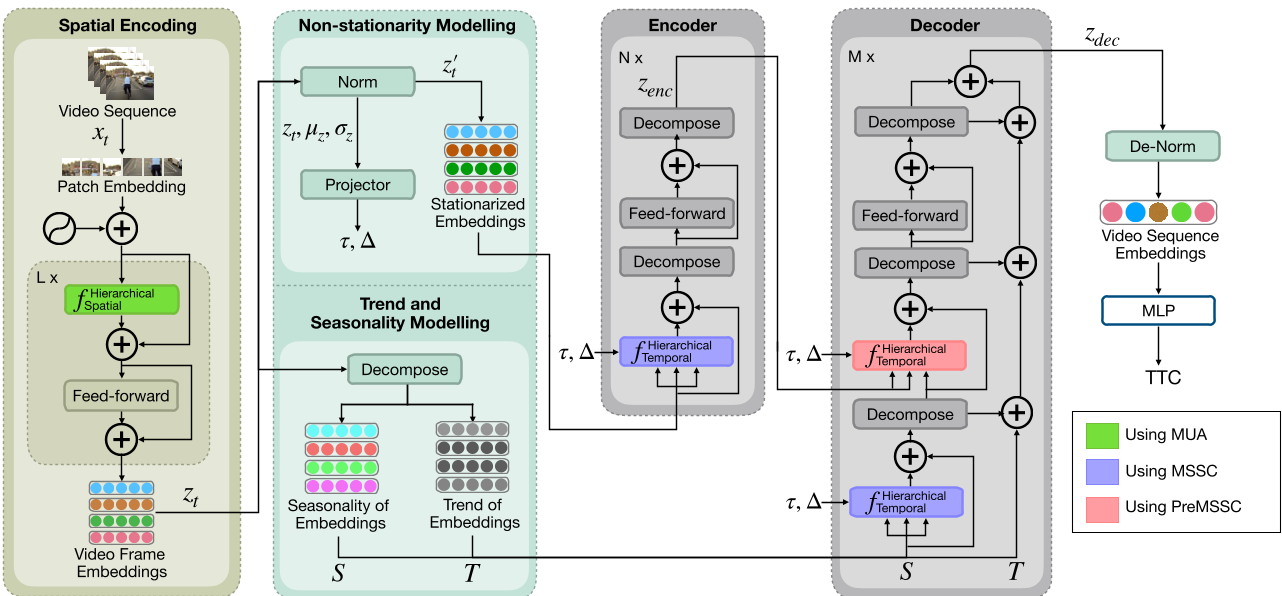
The architecture shows the dual-pathway: Spatial Transformer blocks feeding into a temporal Encoder-Decoder featuring Segment-wise Correlation (MSSC).
3. Efficiency via Segmented Correlation
To avoid the bottleneck, the authors use Multi-Scale Segment-wise Correlation (MSSC). Instead of comparing frame-to-frame, it splits the video into segments and correlates those segments, capturing dependencies across multiple time resolutions.
Experiments & Results: A New Benchmark
CollideNet was tested on the DAD, CCD, and DoTA datasets. The results are definitive:
- CCD Dataset: MSE dropped to 0.37, outperforming the previous best (VidNeXt) at 0.53.
- Cross-Dataset Generalization: When trained on CCD and tested on DoTA, CollideNet still outperformed models trained specifically on DoTA, proving that its features are fundamentally more "transferable."
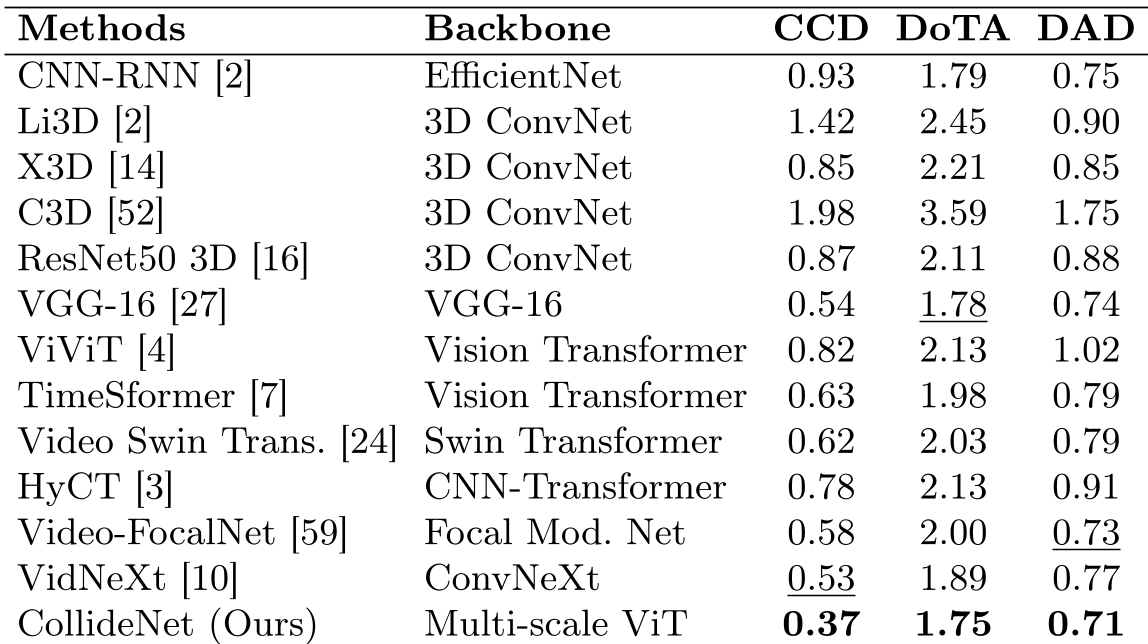
The quantitative comparison highlights CollideNet's consistent leads across all three benchmarks.
Critical Insights: Why It Works
The ablation studies reveal that the Multi-scale (MS) structure is the single most important component. However, the performance jump is compounded when disentanglement is added. Effectively, by separating "Trend" from "Seasonality," the model stops getting confused by background motion (like a moving sky) when it should be focusing on the accelerating car in the foreground.
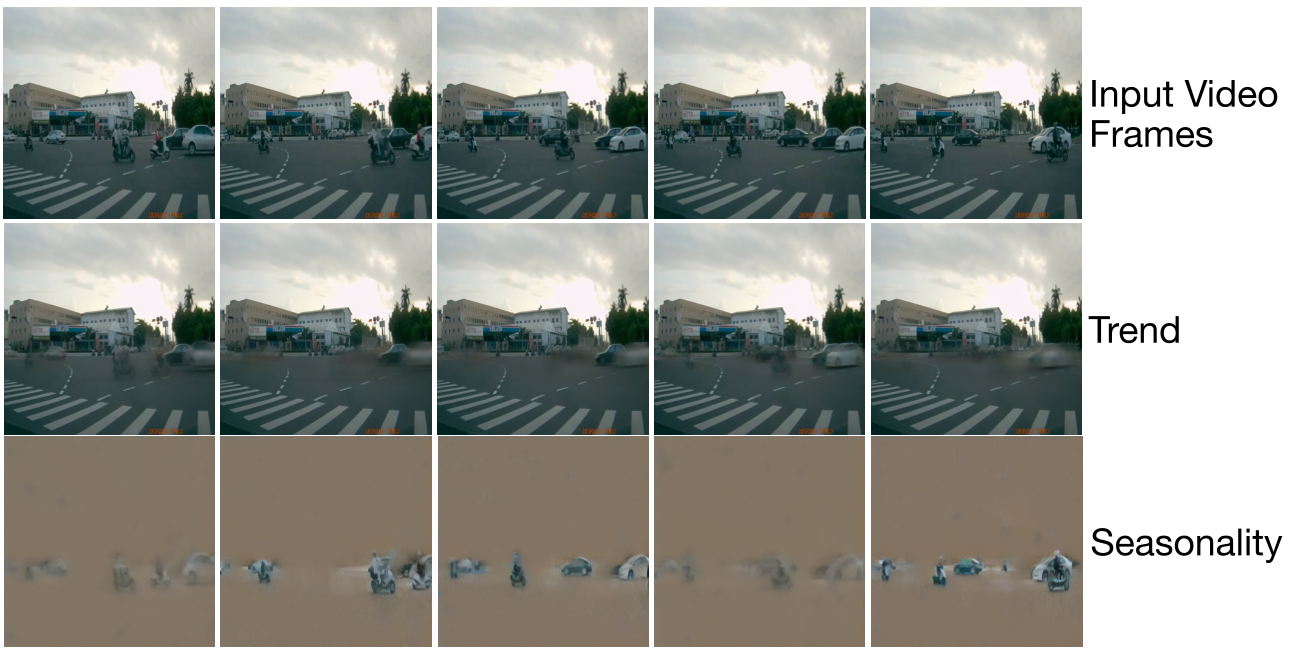 Visualizing the disentanglement: The Trend captures the "flow" of the road, while Seasonality isolates foreground objects like the crashing vehicle.
Conclusion & Future Outlook
CollideNet proves that for high-stakes regression tasks like TTC, we need more than just "bigger Transformers." We need structures that respect the physics of the data—specifically its hierarchical and non-stationary nature. While the model is slightly slower in latency than simple CNN-RNNs, its accuracy at longer time horizons makes it a superior candidate for real-world ADAS systems where a 0.5-second warning can prevent 60% of collisions.
Future Work: Integrating this with Multimodal Large Language Models (MLLMs) could allow a vehicle to not only predict when a crash will happen but explain why, enhancing human-AI trust in autonomous systems.