
Constraining the Pulsar Beaming Fraction: A New TeV Perspective on Neutron Star Geometry
Constraining the Pulsar Beaming Fraction with TeV-Selected Galactic Pulsar Wind Nebulae and unidentified TeV Sources
This study estimates the pulsar beaming fraction (fb) across radio, X-ray, and γ-ray bands using a geometry-independent method based on TeV-selected Pulsar Wind Nebulae (PWNe) and unidentified TeV sources. By utilizing the isotropic nature of TeV emission, the authors derived beaming fractions of ~0.1–0.3 and identified significant discrepancies between H.E.S.S. and HAWC/LHAASO surveys driven by selection effects.
Executive Summary
TL;DR: Research led by Takumi Shimasue uses the "isotropic glow" of Pulsar Wind Nebulae (PWNe) at TeV energies to bypass the century-old problem of pulsar beaming geometry. By treating unidentified TeV sources as pulsars whose "flashlights" are simply pointed away from Earth, the team discovered that the pulsar beaming fraction is not a fixed constant but likely shrinks as the pulsar ages.
Background Positioning: This work moves beyond theoretical modeling of the magnetosphere (like "Outer Gap" or "Slot Gap" models) and provides an observational anchor in the Galactic coordinate system. It bridges the gap between high-energy γ-ray astronomy and the statistical synthesis of the pulsar population.
Problem & Motivation: The "Flashlight" Uncertainty
Pulsars are essentially cosmic lighthouses. We only see them if their radio or γ-ray beams sweep across Earth. The beaming fraction () is the probability of this intersection.
For decades, we’ve relied on complex mathematical models of the pulsar magnetosphere to guess how wide these beams are. If our guess for is wrong, our estimate of the total number of neutron stars in the Milky Way is wrong. This has massive implications for Gravitational Wave (GW) astronomy: if we overestimate , we overestimate the number of Double Neutron Star (DNS) mergers, explaining why LIGO might see fewer events than predicted.
The authors' insight? TeV emission from PWNe is isotropic. Unlike the pulsar's beam, the nebula's glow shines in all directions. Using PWNe as a proxy allows us to count "dead" pulsars (unidentified sources) alongside "active" ones.
Methodology: PWNe as Isotropic Tracers
The team constructed a sample from TeVCat (TeV Source Catalog), dividing sources into:
- Identified PWNe: We see the nebula AND the pulsar (Beam hits Earth).
- Unidentified (Unid) Sources: We see the nebula-like glow, but NO pulsar (Beam misses Earth).
The core calculation is elegantly simple:
u} = \frac{N_{ u, \mathrm{PWN}}}{N_{\mathrm{PWN}} + N_{\mathrm{Unid}}}$$ They applied this across three major surveys: **H.E.S.S.** (high angular resolution), and **HAWC/LHAASO** (wide field of view). 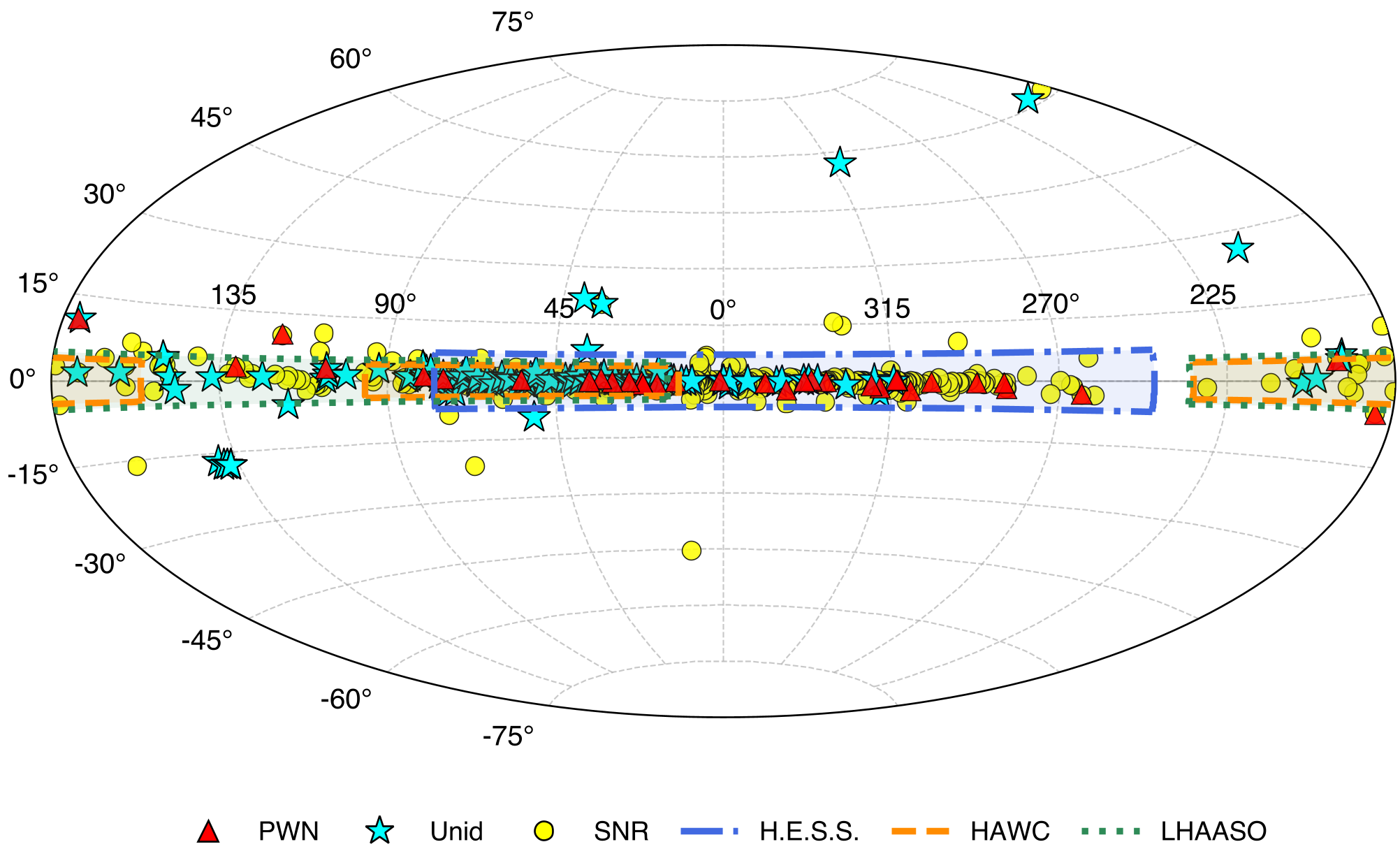 *Figure 1: The Galactic plane seen through TeV eyes, showing identified PWNe (red/blue) and a sea of unidentified sources (gray).* ## Results: The H.E.S.S. vs. HAWC Mystery The results revealed a startling discrepancy. H.E.S.S. data suggested a beaming fraction of **~0.3**, while HAWC and LHAASO suggested only **~0.1**. ### Why the difference? It isn't that the physics changes; it's the **selection effect**. * **H.E.S.S.** is like a microscope: It sees young, compact, energetic PWNe. These young pulsars have wider beams. * **HAWC/LHAASO** are like wide-angle lenses: They are better at seeing "TeV halos"—older, more extended nebulae. 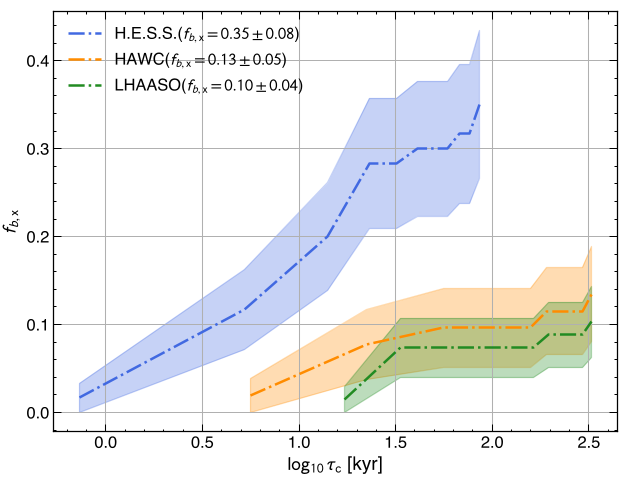 *Figure 4: Note how the beaming fraction drops as spin-down luminosity ($L_{sd}$) decreases, particularly in the wide-field surveys.* ## Deep Insight: A Unified Framework The authors used Monte Carlo (MC) population synthesis to prove that a **time-dependent opening angle** $\rho(t)$ explains everything. As a pulsar ages: 1. The magnetic inclination angle may align with the rotation axis. 2. The "Outer Gap" or "Polar Cap" regions physically contract or change current structures. The team found that the beam opening angle follows a power-law decay ($\rho \propto t^{-\beta}$), where $\beta \approx 1.3$ for radio. 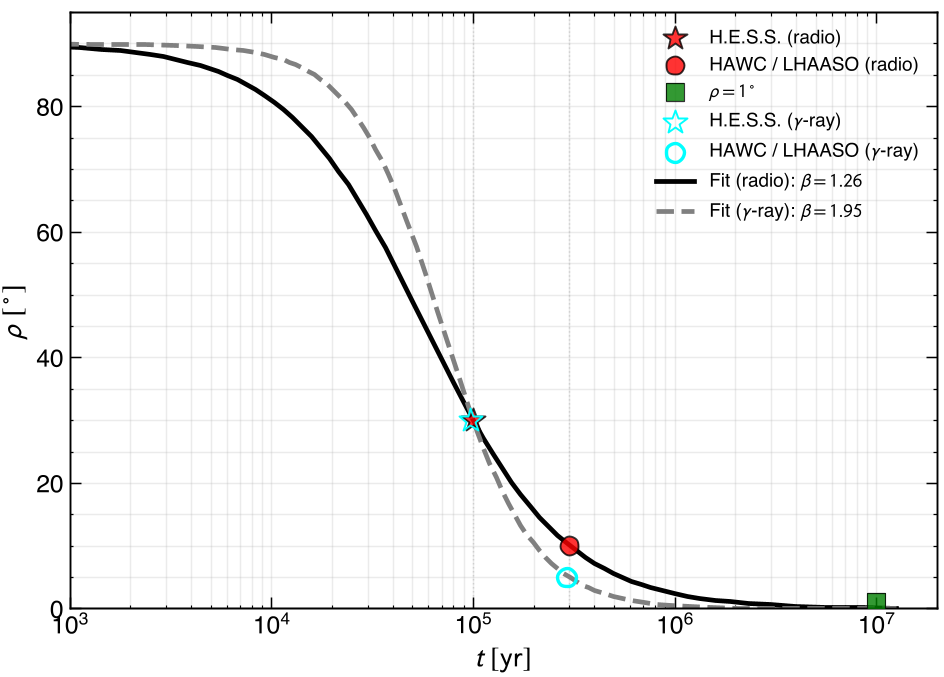 *Figure 10: Theoretical fit showing the narrowing of the pulsar "flashlight" beam over millions of years.* ## Conclusion: The Road to CTAO This study confirms that many unidentified TeV sources in our Galaxy are indeed "stealth" pulsars. The **takeaway** is clear: we cannot treat $f_b$ as a constant in our Galactic models. The upcoming **Cherenkov Telescope Array (CTAO)** will be the tie-breaker. With its superior resolution, it will resolve these unidentified sources, finally giving us a "census" of the Milky Way's neutron stars that doesn't depend on which way they are pointing.