
Aida vs. ChatGPT: Navigating the Future of AI in Computer Science Education
Investigating Conversational Agents to Support Secondary School Students Learning CSP
This paper investigates the use of conversational agents—specifically fixed-response (Aida) and generative (ChatGPT)—to support secondary school students in an AP Computer Science Principles (CSP) course. The study compares these agents against traditional Google search, achieving SOTA insights into how AI-driven exploratory search impacts learning effectiveness and student engagement.
TL;DR
As generative AI becomes the go-to resource for students, a critical question arises: is easier always better for learning? This study compares Aida (a custom, pedagogically-aligned chatbot) with ChatGPT and Google Search in a high school setting. While ChatGPT wins on popularity and efficiency, Aida excels in accuracy and curriculum adherence, revealing a tension between "quick answers" and "deep learning."
The "Search Problem" in the Classroom
For an AP Computer Science Principles (CSP) student, the internet is both a superpower and a minefield. When researching "Binary Search," Google might return complex Big-O notation or C++ implementations—topics explicitly excluded from the high school curriculum. This "Out-of-Scope" noise leads to cognitive overload and "lazy learning" where students copy-paste concepts they don't truly understand.
Methodology: Socratic Rigor vs. Generative Ease
The researchers developed Aida using Google DialogFlow. Unlike the free-form ChatGPT, Aida is a "Fixed-Response" agent. It follows a specific instructional design:
- Warm-Up: Asks an open-ended question to pique interest.
- Activity: Simulates a "Think-Pair-Share" session.
- Wrap-Up: Provides the formal definition only after the student has explored the concept.
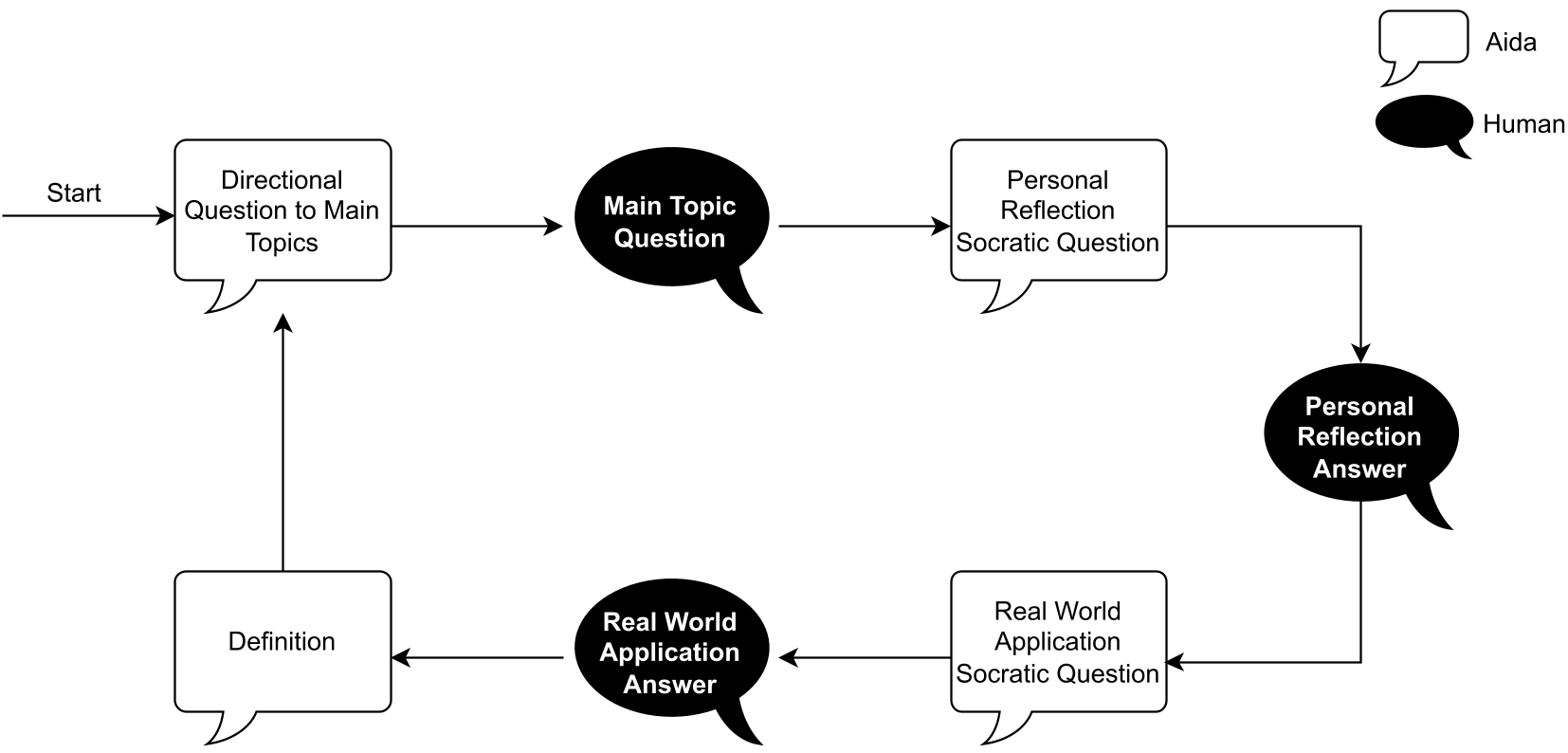
In contrast, the ChatGPT condition utilized a standard GPT-3.5 interface, allowing for unlimited flexibility but lacking any built-in pedagogical "guardrails."
Key Findings: Accuracy vs. Engagement
The results from 45 high school participants revealed a fascinating trade-off:
1. The Quality of Output
ChatGPT students produced the most complete answers. Because the LLM is excellent at summarizing, students could synthesize information quickly. However, Aida users had higher accuracy. Aida ensured that the students stayed within the bounds of the CSP curriculum, whereas ChatGPT often introduced college-level complexity (like Big-O notation) that confused learners.
2. The Interaction Paradox
Aida triggered significantly more exploratory actions (median of 10 vs. 4 for ChatGPT). Because Aida wouldn't give the answer immediately (the Socratic method), students had to work for it. Yet, students hated this. Survey data showed a massive preference for ChatGPT because it was "easier" and "felt more human."
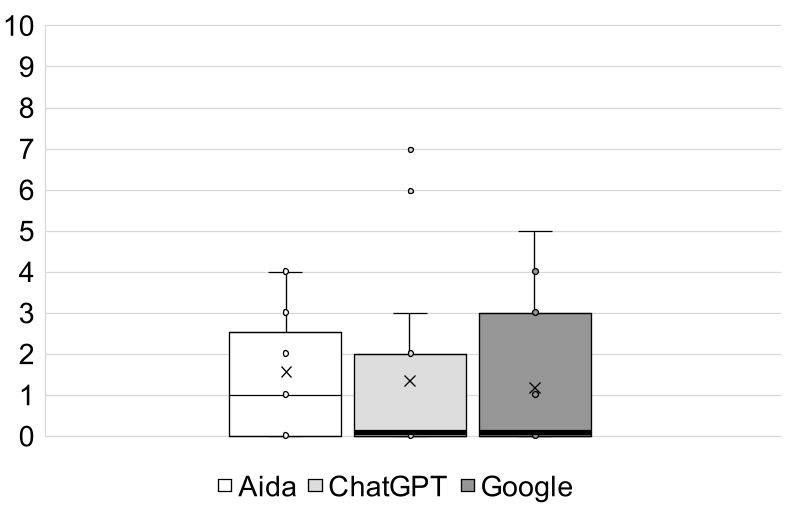
3. Curriculum Scoping
One of the paper's strongest contributions is the analysis of "Out-of-Scope" information. ChatGPT and Google frequently presented materials that were too advanced, potentially violating the AP exam's framework. Aida had a 0% out-of-scope rate.
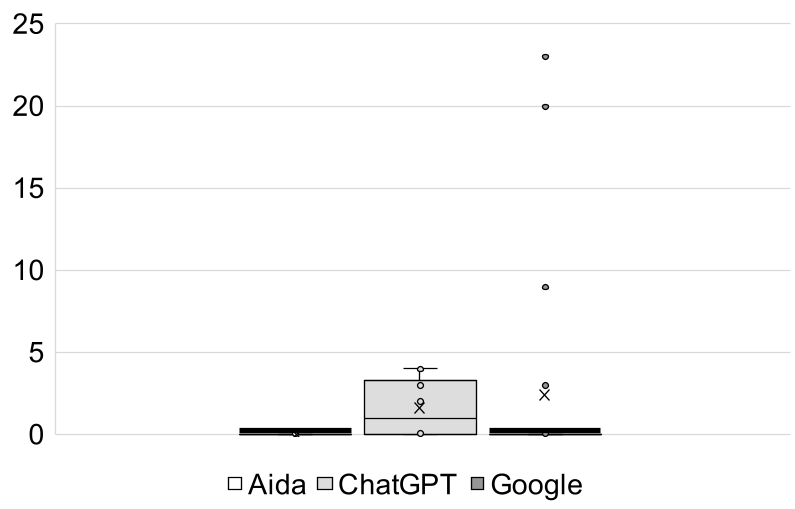
Critical Insight: The "Lazy Learner" Risk
The study highlights a looming pedagogical crisis. Students perceive "better learning" as "faster completion." ChatGPT allows students to bypass the struggle of discovery. If a student can get a perfect summary in 30 seconds, will they ever develop the persistence required for complex problem-solving?
Conclusion & Future Work
The authors suggest that the future is not choosing between Aida or ChatGPT, but creating a Hybrid-Domain Conversational Agent. We need the natural language fluency of an LLM paired with the strict pedagogical "intent design" of a tool like Aida.
Takeaway for Educators: Using ChatGPT in the classroom today requires explicit instruction in prompt engineering and information literacy to prevent students from becoming reliant on automated, out-of-scope answers.
Limitations: The study was a "point-in-time" field test. Longitudinal studies are needed to see if the "annoying" Socratic method of Aida actually leads to better exam scores in the long run compared to the "instant gratification" of ChatGPT.