
Decoupling BSM Physics from CP-Violation: New NSI Constraints from IceCube DeepCore
$δ_{\rm CP}$-free constraints on NSI parameters $\varepsilon_{eμ}$ and $\varepsilon_{eτ}$ using high-purity $ν_μ\,{\rm CC}$ events at IceCube DeepCore
This paper investigates Neutral-Current Non-Standard Interactions (NC-NSI) of neutrinos using a 7.5-year "golden" high-purity charge-current (CC) event sample from IceCube DeepCore. Utilizing the survival channel, the authors derive constraints on NSI parameters , , and that are remarkably free from the degeneracy typically found in appearance-based experiments.
TL;DR
Researchers have utilized 7.5 years of high-purity atmospheric neutrino data from IceCube DeepCore to set stringent limits on Non-Standard Interactions (NSI). By focusing on "golden" events, the team successfully derived constraints for flavor-violating parameters (, ) that are uniquely independent of the elusive Dirac-CP phase ().
Background: The NSI and the Degeneracy Trap
In the Standard Model, neutrinos interact with matter through well-defined W and Z boson exchanges. However, many Beyond Standard Model (BSM) theories suggest Non-Standard Interactions (NSI)—additional four-fermion operators that could alter how neutrinos oscillate as they traverse the Earth's dense core.
The primary hurdle in detecting NSI is the degeneracy. In most long-baseline experiments (like DUNE or NOvA), the appearance channel ( appearance) is used to hunt for NSI. Unfortunately, the signal produced by NSI parameters like can look almost identical to the signal produced by the standard CP-violating phase . This makes it nearly impossible to tell if you’ve found new physics or just a specific value of a known parameter.
The "Golden" Strategy: Why $
u_\mu u_\mu \rightarrow u_\mu$ survival channel**.
The mathematical intuition is simple: the effect of on survival is suppressed by a factor of roughly . By using a sample that is 80% pure CC interactions, the resulting constraints on NSI are inherently "clean"—they don't care what value takes.
Methodology & Architecture
The analysis utilizes the DeepCore sub-array, a more densely instrumented region of IceCube designed for GeV-scale neutrinos.
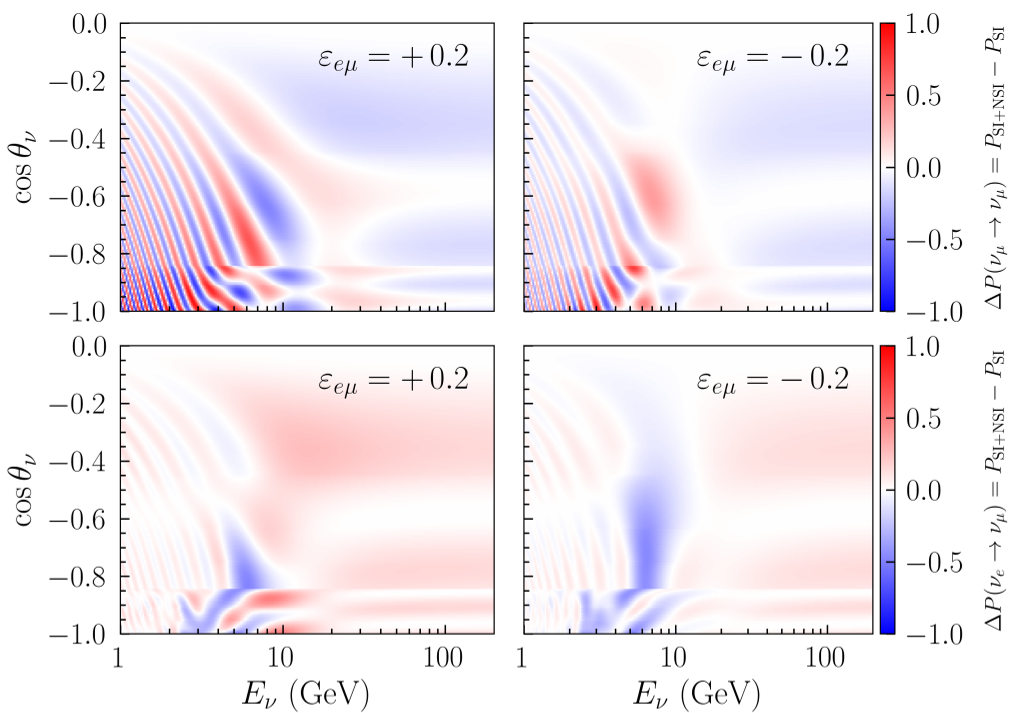 Figure 1: Visualizing how NSI parameter modifies the oscillation probability. The distinction between appearance and survival channels is key.
The paper employs the PISA (Photonics Interface for Statistics Analysis) framework to handle:
- Golden Event Selection: Selecting only Cherenkov photons that traveled "directly" to the DOMs without scattering in the ice.
- Systematic Profiling: 20 nuisance parameters covering everything from "Ice absorption" to "K+ meson yields" in the atmosphere.
Experimental Results: Pushing the BSM Frontier
The results show that the Earth’s atmospheric neutrino flux is perfectly consistent with standard Three-Flavor oscillations. While no "New Physics" was found, the resulting exclusion zones are significant.
| Parameter | 90% C.L. Bound (Real) |
|---|---|
| $ | \epsilon_{e\mu} |
| $ | \epsilon_{e au} |
| Sensitivity Limited |
The comparison with other experiments highlights the power of this "-free" approach. Despite using lower statistics than some global fits, the high-purity of the sample allows for a precision that rivals accelerator-based experiments.
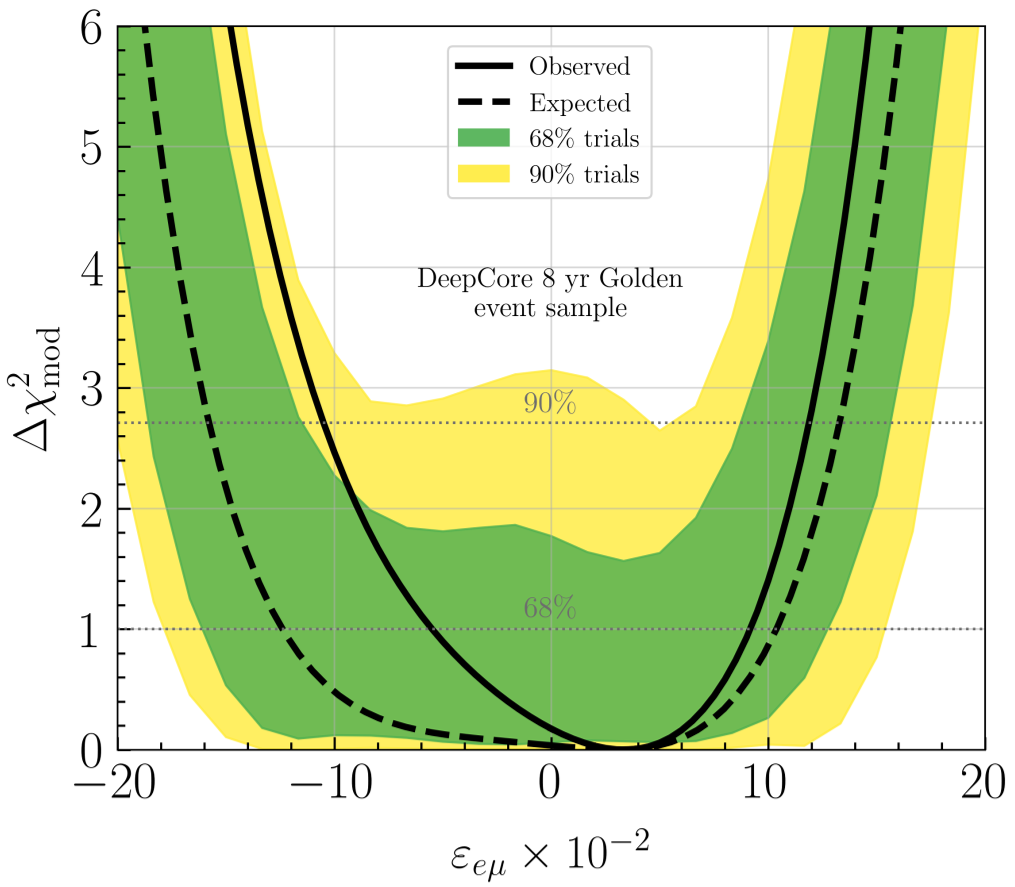 Figure 2: The profiles show a clear agreement between observed data (solid) and expected sensitivity (dashed), placing the best-fit near the Standard Model (zero).
Critical Insight & Future Outlook
The real value of this work is complementarity. While long-baseline experiments will eventually measure with high precision, they will always struggle to disentangle it from NSI. This IceCube analysis provides the "anchor" needed to break those degeneracies.
Limitations: The sensitivity to remains weak because this parameter primarily influences appearance, which is naturally suppressed in a sample optimized for tracks.
Looking ahead, the IceCube Upgrade and KM3NeT/ORCA will provide even higher statistics. When combined with the "golden event" methodology pioneered here, we are entering an era where BSM interactions in the neutrino sector will have nowhere left to hide.