
[CVPR 2026] Demystifying OPD: Solving the "Repetition Collapse" in LLM Training
Demystifying OPD: Length Inflation and Stabilization Strategies for Large Language Models
The paper introduces Stable-OPD, a framework designed to stabilize On-Policy Distillation (OPD) for Large Language Models. It identifies a critical failure mode where students enter "repetition saturation," causing rollout length inflation and training collapse, and fixes it using a combination of reference-based KL divergence constraints and mixture distillation.
TL;DR
On-Policy Distillation (OPD) is theoretical gold—it trains a student on its own distribution to avoid the "distribution shift" seen in offline KD. However, it often fails in practice due to Abrupt Truncation-Repetition Inflation. This paper identifies the mathematical root of this collapse and introduces Stable-OPD, a framework that uses Mixture Distillation and KL-regularization to boost math reasoning performance by up to 7.2%.
The Problem: The "Repetition Saturation" Loop
In standard OPD, the student generates a response, and a teacher model provides token-level rewards based on the reverse-KL divergence. The authors discovered a lethal pathology:
- Implicit Bias: Repetitive tokens (e.g., repeating the same reasoning step) often receive disproportionately large advantages from the teacher model.
- Self-Reinforcement: Because the student samples from its own policy, as it begins to repeat, it encounters more "repetitive states."
- Positive Feedback: These repetitive states dominate the gradient updates, "hacking" the distillation objective until the model only produces long, truncated, and useless noise.
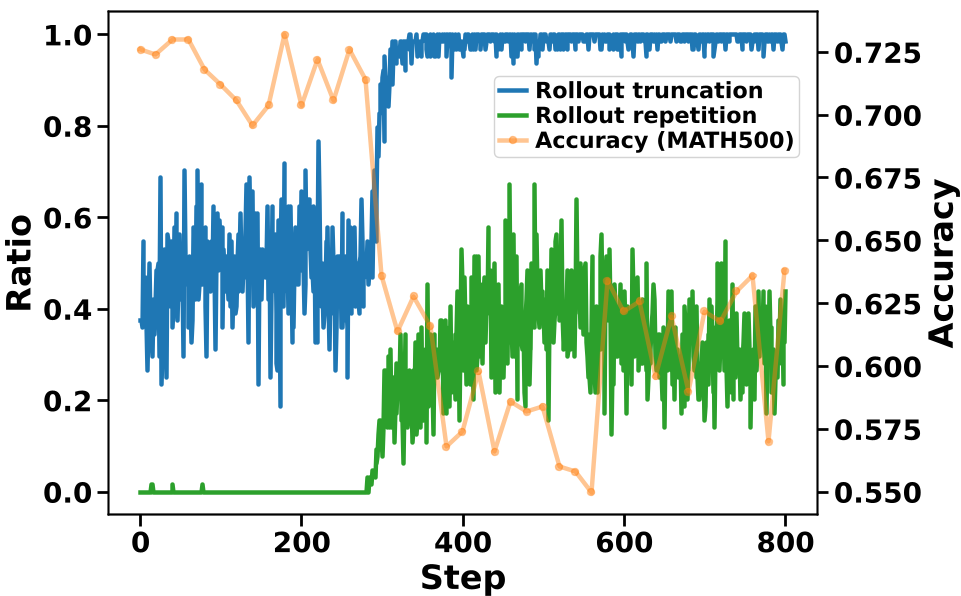 Figure 1: The sudden spike in rollout length and the corresponding drop in validation accuracy during standard OPD.
Methodology: Stable-OPD
To break this cycle, the authors propose a dual-anchor strategy:
1. Mixture Distillation
Instead of relying purely on the student's own (potentially degenerate) rollouts, the model is trained on a mixture of:
- On-policy student rollouts: To maintain the benefits of OPD.
- Off-policy "Golden" data: High-quality, human or strong-teacher-written solutions that are complete and non-repetitive.
This acts as a "distributional anchor," ensuring the gradient always sees what a "good" trajectory looks like.
2. KL-Regularized Constraints
The authors add a penalty for the student drifting too far from its original reference policy (). This prevents the "policy drift" that occurs when the student starts chasing the high rewards found in repetitive sequences.
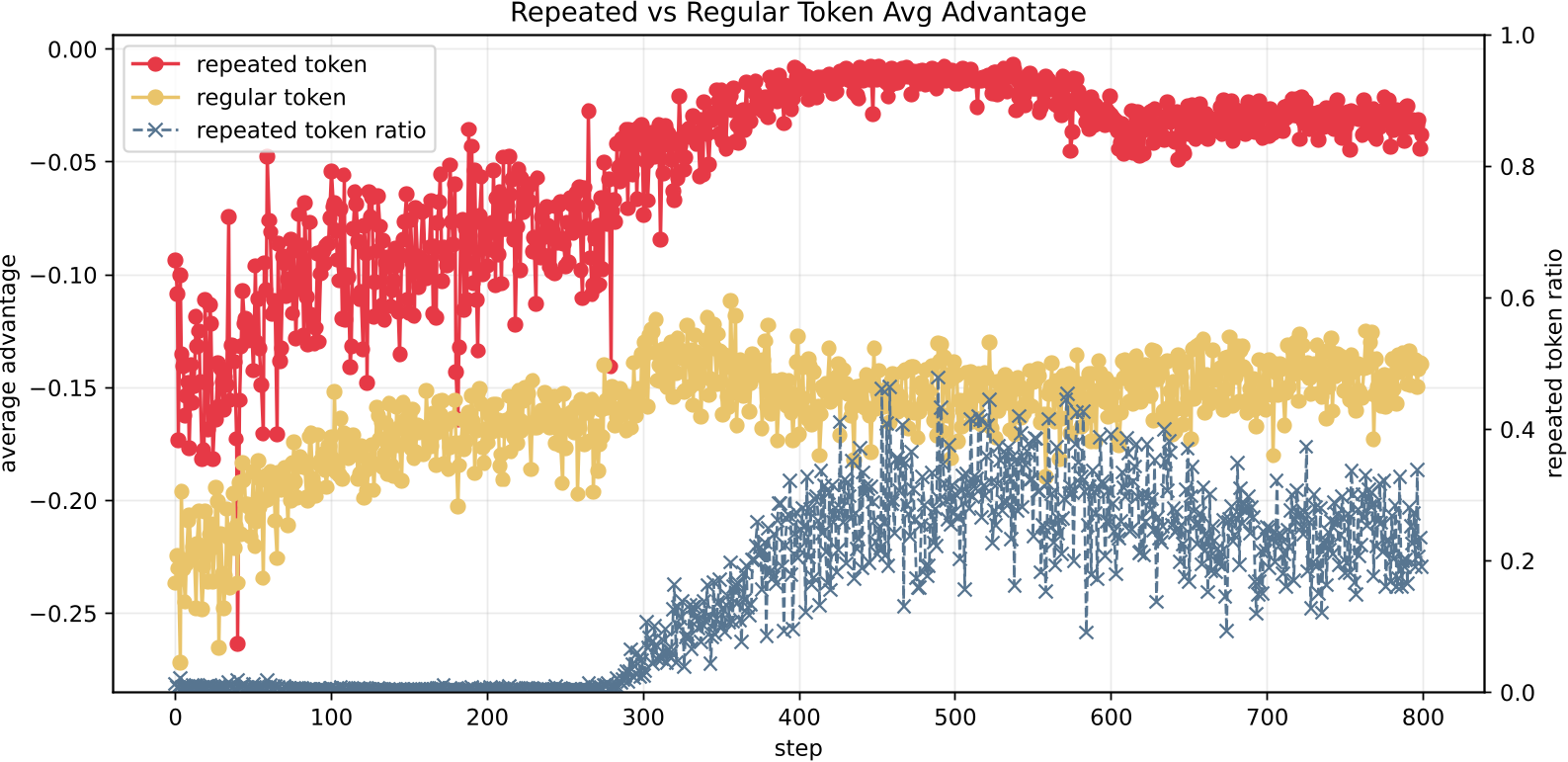 Figure 2: Empirical evidence showing that repetitive tokens systematically receive higher advantages in standard OPD, necessitating the Stable-OPD constraints.
Experiments & Results
Stable-OPD was tested on six mathematical benchmarks (AIME, MATH500, etc.) using Qwen2.5 backbones (1.5B and 7B).
- Stability: Unlike standard OPD, which collapses after ~30 steps, Stable-OPD remains stable throughout training.
- Performance: On the Qwen2.5-Math-7B backbone, Stable-OPD reached an average accuracy of 47.6%, outperforming competitive RLVR (Reinforcement Learning from Verifiable Rewards) methods like DeepSeek-style GRPO (45.5%) and PRIME-Zero (40.8%).
- Ablations: The authors found that Mixture Distillation is the primary driver of performance, while KL-regularization provides the necessary fine-grained stability.
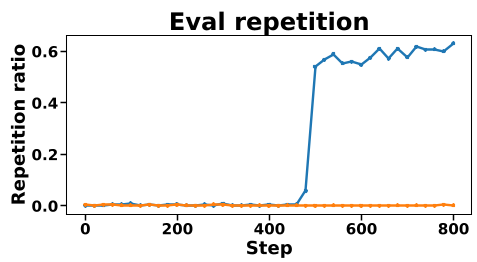 Figure 3: Contrast between OPD (collapse) and Stable-OPD (stable) across truncation and repetition rates.
Critical Insight & Conclusion
The real takeaway here is that On-Policy training is a double-edged sword. While it fixes distribution mismatch, it introduces a "feedback loop" that can amplify the slightest bias in a reward signal or a teacher's log-probability.
Stable-OPD proves that we don't need complex, multi-stage RL pipelines to get SFT-beating performance; we just need a robust way to anchor the student's exploration. For anyone building reasoning models, this paper provides a clear blueprint for using distillation without the fear of training collapse.