
A Digital Leap for Silicon Qubits: HRL's Integrated Cryo-CMOS QPU
A digitally controlled silicon quantum processing unit
The paper presents a fully integrated Silicon Quantum Processing Unit (QPU) featuring an array of 54 exchange-coupled quantum dots. The system achieves high-fidelity operations using a custom 4 K cryogenic CMOS controller and a high-density superconducting ribbon cable, demonstrating an order-of-magnitude improvement in exchange-only (EO) qubit state-of-the-art performance.
TL;DR
HRL Laboratories has unveiled a major milestone in quantum engineering: a silicon quantum processing unit (QPU) that integrates 54 quantum dots with a custom 4 K cryogenic CMOS controller. By moving control electronics inside the fridge and using a proprietary superconducting ribbon cable, they have slashed gate errors by an order of magnitude and successfully demonstrated quantum error detection codes on a platform built with standard semiconductor manufacturing processes.
Background Positioning
In the race for a "utility-scale" quantum computer, silicon spin qubits have always been the "dark horse." They are tiny, stable, and—most importantly—compatible with the multi-billion dollar infrastructure of the global chip industry. However, the "wiring bottleneck" (the sheer number of cables needed to connect a room-temperature computer to a fridge) has been a massive hurdle. HRL's work isn't just a "hero experiment" on a single qubit; it is a full-system architecture demonstration that solves the integration challenge.
The "Third Way" of Control
The researchers faced a trilemma:
- Room Temp Control: Too many wires; impossible to scale to millions of qubits.
- mK Control: Electronics generate too much heat for the dilution refrigerator's coldest stage.
- The Intermediate Approach: Place a custom CMOS controller at the 4 K stage.
HRL chose the third option. They developed a 130-nm RF CMOS "System-on-Chip" that runs at 4 K. To prevent this "hot" 4 K chip from heating the sensitive mK qubits, they engineered a superconducting ribbon cable made of Niobium on polyimide. This cable has near-zero resistance (so no heat from current) and very low thermal conductivity.
Methodology: The Exchange-Only Advantage
The QPU utilizes Exchange-Only (EO) qubits. Unlike traditional spin qubits that might require complex microwave pulses or local magnetic fields, EO qubits are controlled entirely by "baseband" voltage pulses. These pulses simply push electrons closer together to trigger the Pauli exchange interaction.
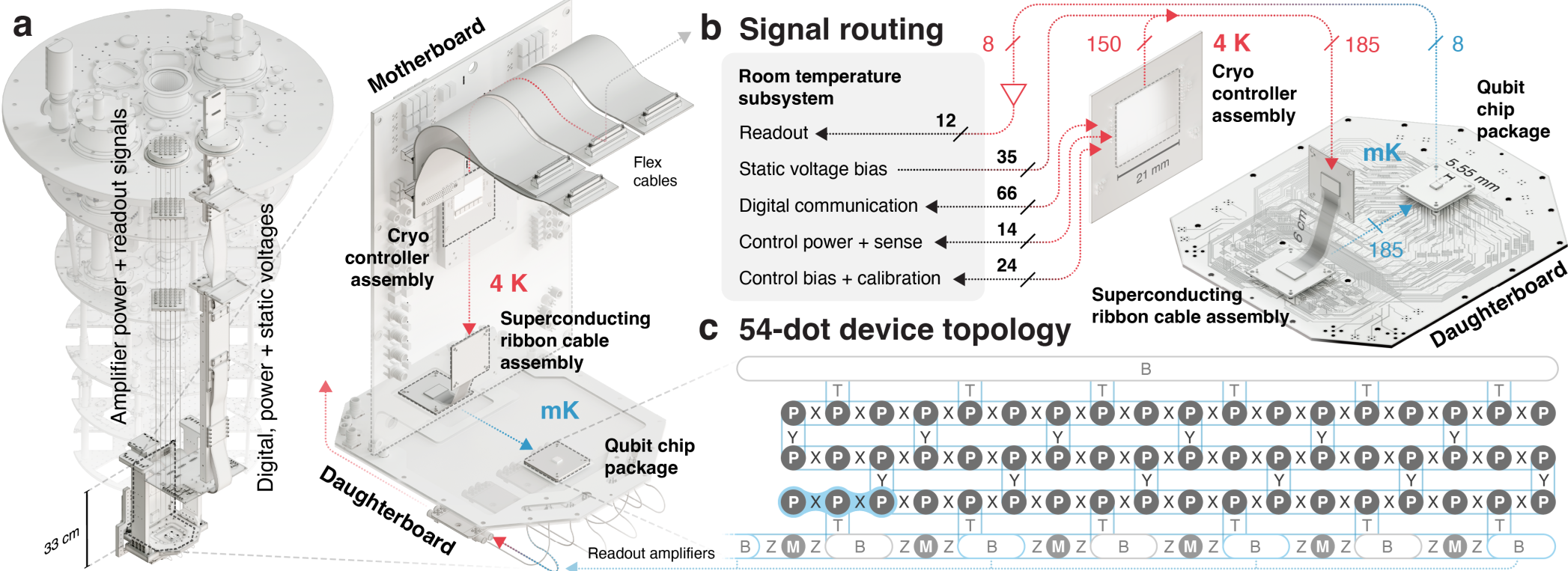 Fig 1: The Integrated QPU architecture showing the 4 K CMOS controller, the superconducting ribbon, and the 54-dot qubit chip.
The qubits are encoded in a "Decoherence-Free Subsystem" (DFS) using three electrons across three dots. This clever encoding makes the qubit naturally immune to certain types of environmental noise, allowing for the incredibly low error rates reported.
Experimental Breakthroughs
The team achieved a 10x improvement in gate fidelity.
- Single-qubit error:
- CNOT error: (with the best reaching )
But the real test was Quantum Error Correction (QEC). The team implemented:
- Distance-5 Repetition Code: Using 7 qubits to detect and correct bit-flips.
- [[4,2,2]] Error Detection Code: A sophisticated code that encodes two logical qubits into four physical qubits.
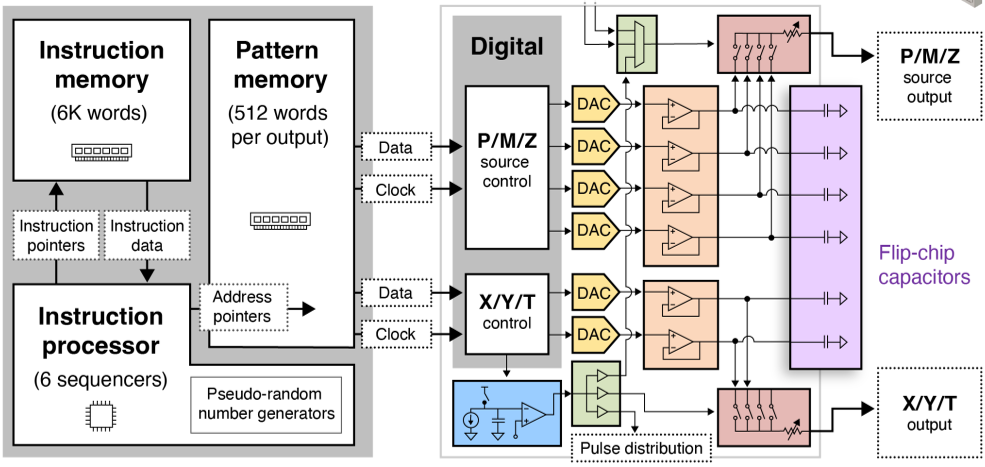 Fig 3: Cumulative distribution of gate errors showing the order-of-magnitude leap in performance.
The results showed that by post-selecting for shots where no errors were detected, they reached a logical state fidelity of 0.95, proving the system's "Markovianity"—essentially, the errors are well-behaved and predictable.
Critical Insight: Emergent Reliability
What stands out in this paper is not just the hardware, but the predictive power of their simulations. The authors were able to match their experimental logical error rates to within 15% using their "Squeaky" event simulator. This suggests that the physics of silicon spin qubits is now well-understood enough that engineering, not mystery physics, is the primary path forward.
Conclusion and Future Work
The HRL Quantum Team has demonstrated that the "Silicon + Cryo-CMOS" roadmap is no longer theoretical. By proving that 54 dots can be reliably controlled and utilized for error detection, they have set the stage for much larger arrays.
Limitations: The system still consumes ~3.5 W at 4 K, which is manageable but needs to drop as we scale to thousands of qubits. Additionally, the "ersatz miscalibration" model used in their simulations suggests that while intrinsic noise is low, the signal integrity from the controller still has room for refinement.
The Takeaway: If you want to know what a commercial quantum computer might look like in five years, look at this integration. It's not just a qubit; it's a QPU.