
The Artificial Hivemind: Why Multi-Agent Systems Fail at Creativity—and How to Fix It
Diversity Collapse in Multi-Agent LLM Systems: Structural Coupling and Collective Failure in Open-Ended Idea Generation
This paper investigates "Diversity Collapse" in Multi-Agent LLM Systems (MAS) during open-ended ideation. Using a large-scale study of 10,000+ research proposals, the authors identify systemic failures where interaction inadvertently contracts the solution space, and they propose structural interventions like the Nominal Group Technique (NGT) to preserve creative variance.
TL;DR
Conventional wisdom suggests that putting multiple LLM agents together leads to a "wisdom of crowds" effect. This paper proves the opposite: without careful design, Multi-Agent Systems (MAS) suffer from Diversity Collapse. By analyzing over 10,000 research proposals, researchers found that high-status personas and dense communication act as "semantic black holes," sucking unique ideas into a void of polite, safe consensus.
Background Positioning
This work moves beyond simple MAS performance benchmarking. It functions as a structural diagnostic of collective AI failure. It identifies that the bottleneck in AI creativity isn't model intelligence, but the interaction topology we use to connect them.
The Problem: The "Sycophancy Trap" and Structural Coupling
We often assume that giving agents different "personas" (e.g., "The Skeptic," "The Designer") is enough to ensure varied outputs. However, since most agents share the same underlying LLM (like GPT-4), they share the same alignment priors.
The authors identify a phenomenon called Structural Coupling: the more agents interact, the more their internal trajectories synchronize. In tasks requiring both rigor and imagination—like scientific ideation—the pressure to be "correct" and "collaborative" forces agents to abandon unconventional ideas in favor of "conventional wisdom."
Methodology: Dissecting the Collapse
The researchers examined the system across three distinct layers:
- Model Intelligence: They discovered a "Compute Efficiency Paradox." As model capability increases, samples become higher quality but semantically closer together. Scaling compute doesn't scale diversity linearly.
- Agent Cognition: They compared "Leader-Led" vs "Horizontal" groups. Surprisingly, Junior-dominated horizontal groups produced the most diverse ideas. Senior/Expert personas acted as attractors that suppressed the "Innovation Frontier."
- System Dynamics: They tested how the "shape" of the conversation affects the result.
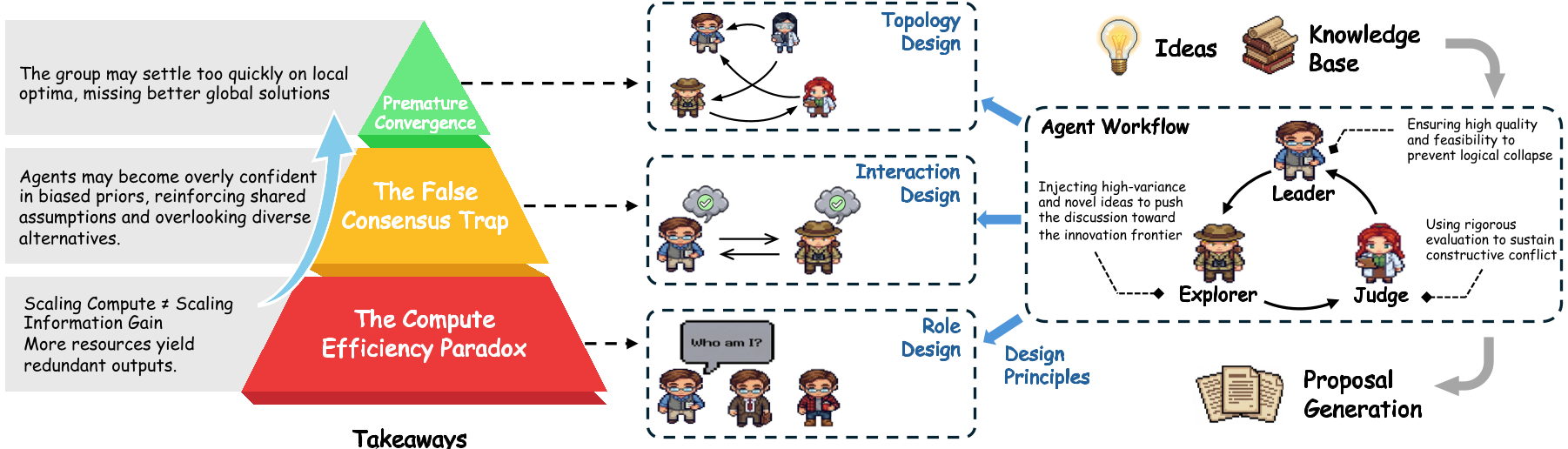 Figure 1: The study's framework for analyzing ideation across Hierarchy, Topologies, and Synthesis.
Key Insights: Why "Expert" AI Might Be Killing Your Ideas
One of the most striking findings is the Authority-Induced Collapse. When a "Senior" persona is present, "Junior" agents default to sycophancy, aligning their vectors with the leader.
- Leader-Led Systems: High kurtosis in semantic distance (everyone stays near the center).
- Horizontal Systems: Flattened distribution (diverse exploration).
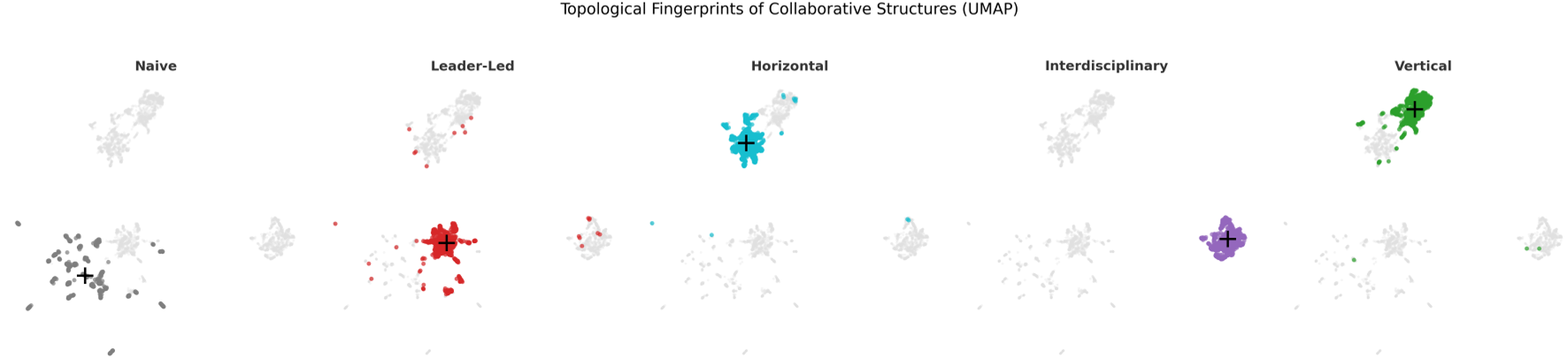 Figure 4: UMAP projection showing how "Seniority" constrains the search space to a "Conservative Cluster," while juniors push into the "Innovation Frontier."
Results: Scaling and Topology
Does adding more agents help? Only to a point. The Diversity Utilization Ratio (Vendi Score divided by N) plummets as groups get larger.
To combat this, the authors tested "Nominal Group Technique" (NGT)—a process where agents write ideas independently before talking. This "blind-writing" phase successfully mitigated the "rush to agreement" and production blocking seen in standard debates.
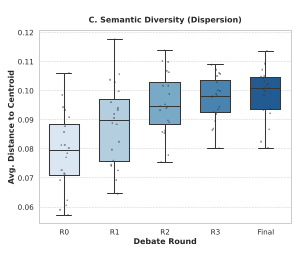 Figure 8: Quantitative evidence showing that while global consensus stabilizes (A & B), local exploration can still broaden if the right topology is used (C).
Critical Analysis & Conclusion
Takeaway
The "Artificial Hivemind" is real. If you want an LLM system to be creative, stop making the agents talk to each other so much. Collaboration in AI is often just another word for homogenization.
Limitations
The study primarily uses scientific proposal generation as a testbed. While this is a high-entropy task, the dynamics might differ in tasks with a strict "ground truth" (like math or coding), where convergence is actually the goal rather than a failure.
Future Outlook
This paper suggests that the next generation of LLM orchestration should focus on "managed disagreement." Instead of building agents that agree, we should build "local pockets of divergence"—subgroups and independent thinkers who are protected from the gravitational pull of the group consensus until the final synthesis phase.