
PBC: Rescuing Subseasonal Forecasts from the "Predictability Desert" with Probabilistic Bias Correction
Enhancing AI and Dynamical Subseasonal Forecasts with Probabilistic Bias Correction
The paper introduces Probabilistic Bias Correction (PBC), a lightweight machine learning framework designed to enhance subseasonal weather forecasts (2-6 weeks). By adaptively correcting systematic errors in forecast distributions, PBC achieved first place in the 2025 ECMWF AI Weather Quest, outperforming major operational dynamical and AI models globally.
TL;DR
Subseasonal forecasting—the 2 to 6-week window—has long been considered the "predictability desert" because modeling errors compound faster than physical signals can persist. This paper introduces Probabilistic Bias Correction (PBC), a machine learning framework that doesn't try to simulate the weather but instead learns to "fix" the systematic mistakes of existing models. The result? A system that placed first in the 2025 AI Weather Quest, doubling the skill of state-of-the-art AI models and significantly outperforming the world's best dynamical simulations.
The Problem: The Curse of Compounding Errors
In the first 14 days of weather forecasting, deterministic models (both physics-based and AI-driven) are remarkably accurate. However, beyond two weeks, the atmosphere's chaotic nature takes over.
The industry's current solution is probabilistic forecasting—running an "ensemble" of potential outcomes to capture uncertainty. But there is a catch: because these models work iteratively (predicting the next hour, then the next, and so on), even tiny errors in how they model cloud formation or ocean-land interaction add up over 30 days. This creates systematic bias. Current operational debiasing is too rigid to fix this, often leaving forecasters with data that is less reliable than a simple "climatology" (the 20-year historical average).
Methodology: The Dual-Stream Correction
PBC operates on a "Value-First" principle: instead of replacing expensive dynamical models, it treats them as high-quality but biased sensors.
1. The Schematic Architecture
PBC takes a raw ensemble of forecasts and processes them through two parallel machine learning modules:
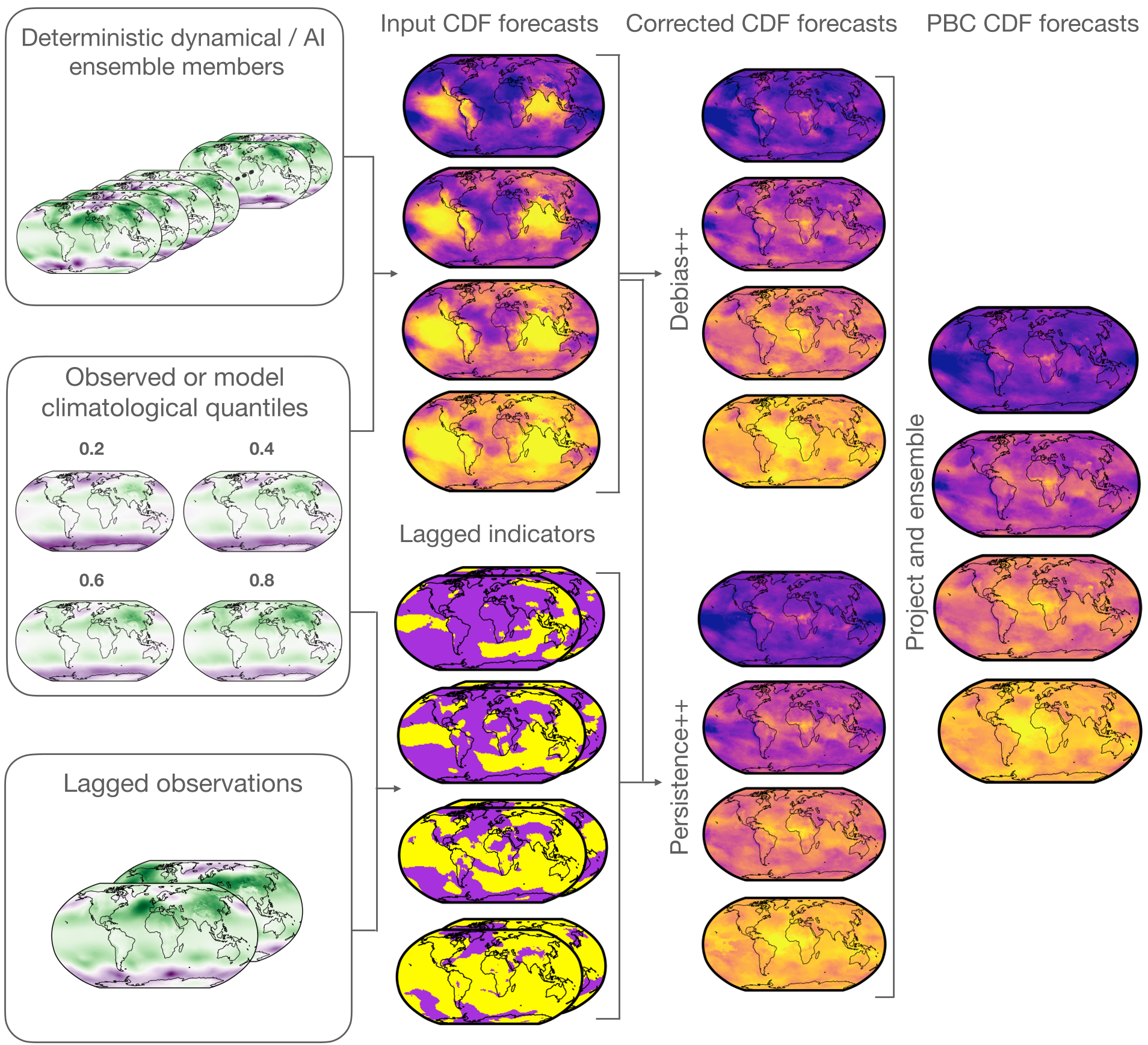
- Debias++: This module looks at the last 20 years of history for a specific location and date. It calculates the systematic offset between what the model predicted and what actually happened, then compensates for it.
- Persistence++: This module handles the "now." It regresses current model forecasts against very recent observations (lagged indicators) and historical climatology to ensure the forecast is grounded in current trends.
2. Isotonic Projection: Ensuring Physical Logic
A common problem in machine learning for probabilities is that a model might predict a higher chance of "heavy rain" than "any rain," which is physically impossible. PBC uses Isotonic Regression to project these predictions onto a valid Cumulative Distribution Function (CDF), ensuring the probabilities are mathematically consistent and monotonic.
Experiments and SOTA Results
The authors tested PBC against the "Gold Standard" of meteorology: the ECMWF integrated forecasting system.
Breaking the Climatology Barrier
For variables like precipitation, raw dynamical models often have negative skill (worse than a coin flip against history) at week 4. PBC consistently converts these into positive skill scores.
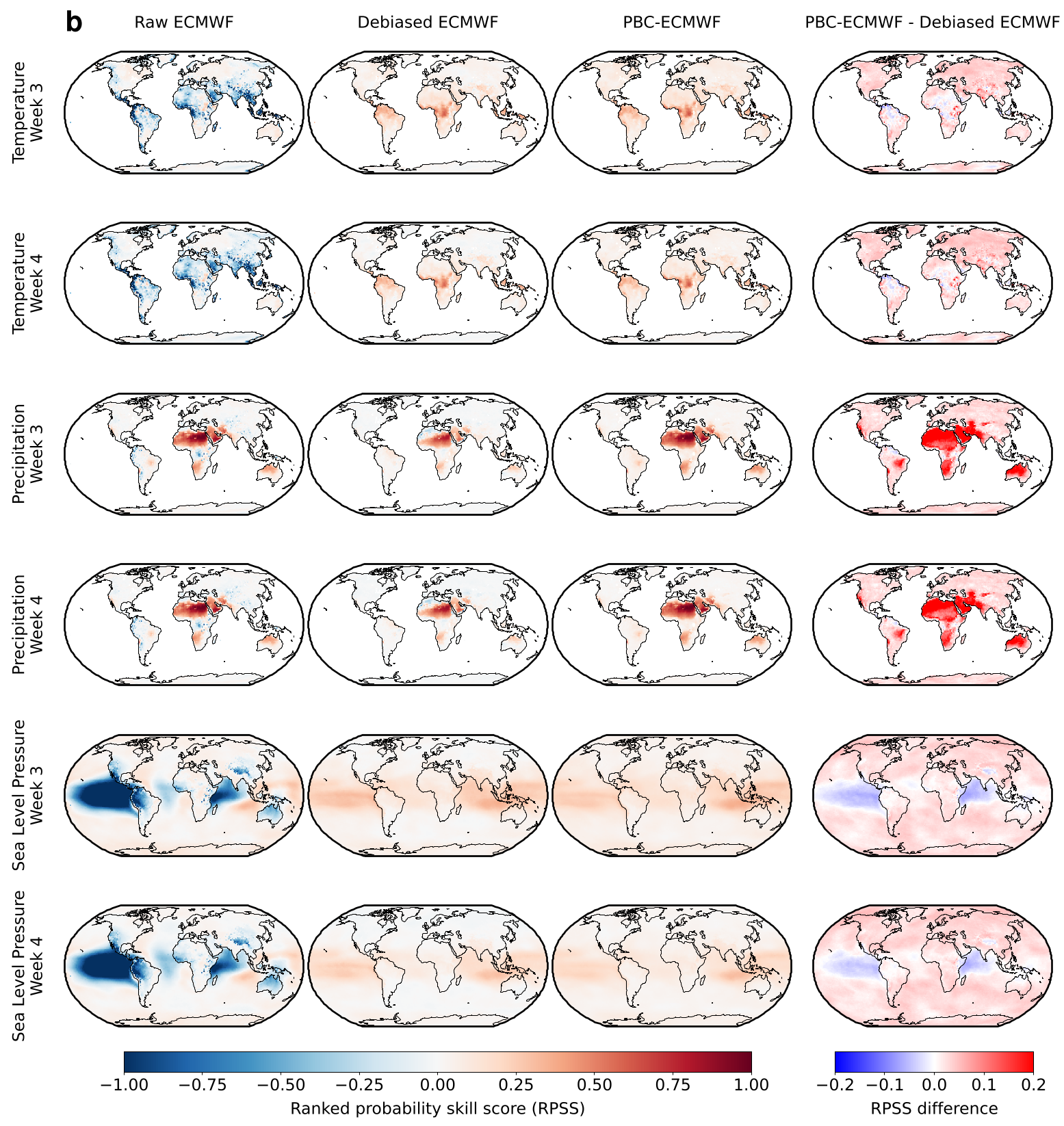
- 98% Coverage: In precipitation tasks, 98% of grid cells globally saw skill gains over traditional debiasing methods.
- Extreme Event Correction: Most importantly, PBC's ability to forecast "extremes" (top/bottom 20% quintiles) showed massive improvements. In flood forecasting tests from 2022–2024, PBC maintained positive Brier Skill Scores while standard models failed completely.
Real-Time Dominance: MicroDuet
Using a hybrid ensemble of PBC-corrected models called MicroDuet, the team entered the 2025 AI Weather Quest. They finished 1st worldwide across all variables and lead times, beating 34 teams and 6 major government meteorological centers.
Critical Insights: Why This Matters
The core insight of this paper is adaptive modularity. As dynamical models or AI foundation models (like GraphCast or AIFS) get better, PBC can simply be "plugged in" to make them even better. It is a "low-overhead" strategy: it costs far less to run a PBC correction than it does to run a massive 100-member ensemble of a dynamical model.
Limitations & Future Work
- Data Dependency: PBC requires 20 years of high-quality historical reanalysis data (like ERA5). In Regions with poor historical record-keeping, the "Debias++" module may struggle.
- Resolution: Currently tested at 1.5° resolution; future work needs to investigate if these probabilistic gains hold at the hyper-local hyper-resolution levels required for urban flash-flood planning.
In conclusion, PBC proves that the "predictability desert" is not a void of information, but a space where valuable signals are simply buried under predictable noise. By cleaning that noise, we gain weeks of lead time for disaster response and agricultural planning.