
Beyond Blind Imitation: Grounding VLA Models in Physical Feasibility
Can Explicit Physical Feasibility Benefit VLA Learning? An Empirical Study
The paper introduces a method to incorporate explicit physical feasibility supervision into Vision-Language-Action (VLA) models. By integrating a differentiable geometry-grounded feasibility objective (based on forward kinematics and signed distance fields) into a diffusion-based VLA policy (RDT-1B), the authors achieve significant improvements in obstacle avoidance and task success compared to standard imitation learning.
TL;DR
While Vision-Language-Action (VLA) models have mastered "what to do" through imitation, they often struggle with the "how to stay safe" part of robotics. This paper demonstrates that by adding a simple, differentiable geometric supervision signal during training, we can significantly boost the safety, accuracy, and data efficiency of state-of-the-art diffusion VLAs like RDT-1B without extra overhead at inference time.
The Problem: The "Implicit Geometry" Trap
Current VLA training is dominated by Imitation Learning (IL). We show the robot 10,000 videos of a task, and it learns to mimic the pixel-to-action mapping. However, physical feasibility—the requirement not to hit an obstacle or exceed a joint limit—is inherently geometric.
In standard pipelines, the robot must guess the geometry of the world. Because the loss function (usually MSE) only penalizes the distance from the expert's joint angles, the model never "understands" that it hit a wall; it only knows it didn't perfectly match the expert's recording. This leads to fragile policies that fail when an obstacle moves just a few centimeters.
Methodology: Bridging the Gap with Differentiable Kinematics
The authors propose a "Geometry-Grounded Feasibility Objective." The intuition is to force the model to "look ahead" during its denoising process and evaluate: If I take this action, will I collide?
The 3-Step Feasibility Loop:
- Forward Kinematics (FK) Mapping: The policy predicts a joint action chunk. The system uses a differentiable FK layer to transform these joints into the 3D poses of the robot's links in the real world.
- Signed Distance Evaluation: By representing obstacles as Oriented Bounding Boxes (OBB), the system calculates the Signed Distance Function (SDF) between the robot's skin and the obstacle surface.
- Hinge Loss Penalty: If the distance is less than a safety margin , a penalty is applied.
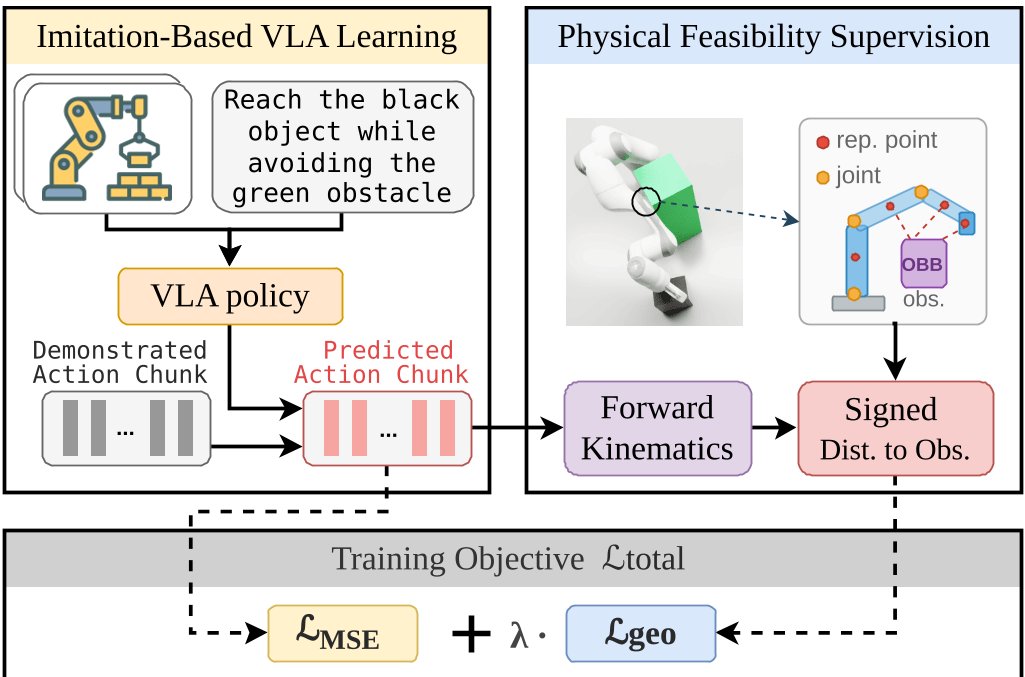 Figure 1: Integrating physical feasibility as an auxiliary loss alongside standard imitation learning.
Crucially, this geometric information is only needed during training. At inference time, the robot still only uses its cameras and the language prompt. The feasibility loss acts as an inductive bias that shapes the policy's internal reasoning.
Experimental Insights: Safety as a Learning Catalyst
The researchers tested this on the RDT-1B model (1.2 billion parameters) in a "close-obstacle reaching" task.
1. Robustness to Perturbations
When obstacles were moved (Large Perturbations), the standard MSE baseline collapsed, while the feasibility-augmented model maintained a much higher success rate. The physical signal taught the model how to "steer clear" rather than just replaying a memorized path.
2. The Low-Data Superpower
Perhaps the most striking result is data efficiency. A model trained on just 40 episodes with feasibility supervision outperformed a 120-episode model trained the traditional way.
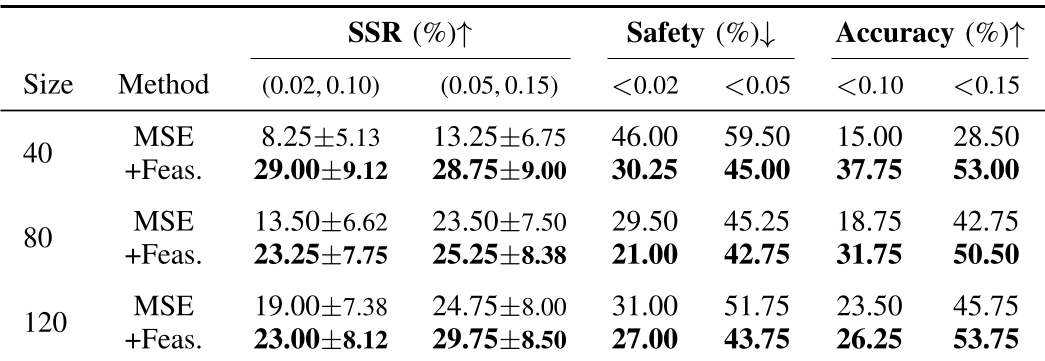 Table III: Performance comparison across different dataset sizes.
3. Accuracy vs. Safety
One might expect a safety loss to make a robot "cowardly" (avoiding everything and missing the goal). Interestingly, the authors found the opposite: Accuracy actually improved. By understanding the obstacle's boundary, the robot became more precise in its approach to the target.
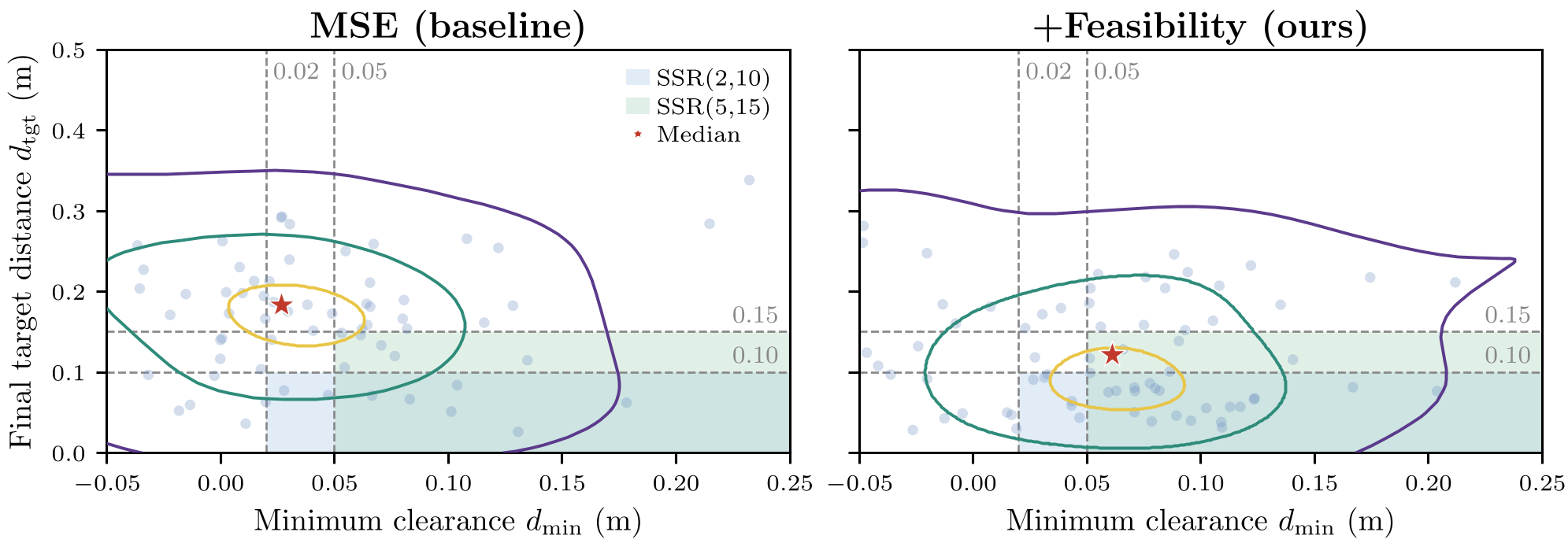 Figure 4: The feasibility objective (orange) shifts the distribution toward both higher safety and lower target error.
Critical Analysis & Conclusion
Takeaway
This work proves that we don't need to choose between "End-to-End Learning" and "Classical Robotics." We can use classical geometric priors (SDFs, FK) to supervise modern neural networks, resulting in models that are both flexible and physically grounded.
Limitations
- Geometric Simplicity: The study uses cube obstacles. Real-world geometry (deformable objects, complex clutter) remains a challenge for simple OBB representations.
- Single-Task Probe: While effective for reaching, it remains to be seen how this scales to dynamic contact tasks like assembly or pouring.
The Future
The authors suggest that the next step is moving beyond simple geometric boxes to learned geometric models or integrating this into Reinforcement Learning frameworks to provide a safety floor for exploration.