
Generative Galactic Maps: Using Cycle-GANs to Reveal Hidden CO Emissions
Extending Galactic foreground emission with neural networks
This paper introduces a Cycle-GAN based framework to simulate high-resolution Galactic Carbon Monoxide (CO) emission maps (J:1-0 and J:2-1 lines). By learning the non-linear correlations between thermal dust (Planck 857 GHz) and atomic hydrogen (HI4PI HI data), the model generates realistic CO emission even in high-Galactic latitude regions where current observations are noise-dominated.
Executive Summary
TL;DR: Researchers have developed a deep learning framework based on Cycle-GANs to "hallucinate" high-resolution, low-noise Carbon Monoxide (CO) maps of our Galaxy. By training on the structural similarities between thermal dust, atomic hydrogen, and CO, the model can predict molecular emissions in regions of the sky where current telescopes see only noise.
Context: This is a significant step in CMB Foreground Modeling. As we prepare for next-generation experiments like the Simons Observatory, distinguishing the faint "echoes" of the Big Bang from the "noise" of our own Galaxy is the ultimate challenge. This paper moves beyond simple parametric models into the realm of data-driven, non-Gaussian simulation.
The "Burying" Problem: Why We Can't See Through the Noise
Carbon Monoxide (CO) is a critical tracer of molecular clouds, but it has a nasty habit of contaminating Cosmic Microwave Background (CMB) measurements. Current surveys face a "catch-22":
- The Plane is Clear, the Sky is Not: We have great CO data for the Galactic plane, but at high latitudes (where we prefer to look for the CMB), the signal is so faint it's buried in instrumental noise.
- The Correlation Gap: Existing models like MCMole3D generate "realistic" clouds, but they aren't spatially correlated with other tracers (like dust). This makes them less useful for multi-wavelength cross-correlation studies.
The authors' insight is simple: Nature doesn't work in isolation. If we know where the dust and atomic hydrogen (HI) are, a sufficiently clever AI should be able to infer where the CO must be hiding.
Methodology: The Cycle-GAN Bridge
To bridge the gap between "what we see" (Dust/HI) and "what we want" (CO), the authors employed a Cycle-GAN. Unlike standard GANs that require perfect pairs of (Input, Output) images, Cycle-GANs learn the style and features of two domains independently.
Architecture Highlights
- Generator: A ResNet-based Encoder-Decoder. It uses "Instance Normalization" to maintain contrast and "Residual Blocks" to preserve fine-grained structural details.
- Discriminator: A "PatchGAN" that doesn't just look at the whole image, but evaluates 14x14 patches to ensure high-frequency textures (like filaments) look real.
- Loss Function: A mix of Adversarial Loss (Cycle-Consistency) and Identity Loss, ensuring that if you translate Dust to CO and back to Dust, you don't lose the original structure.
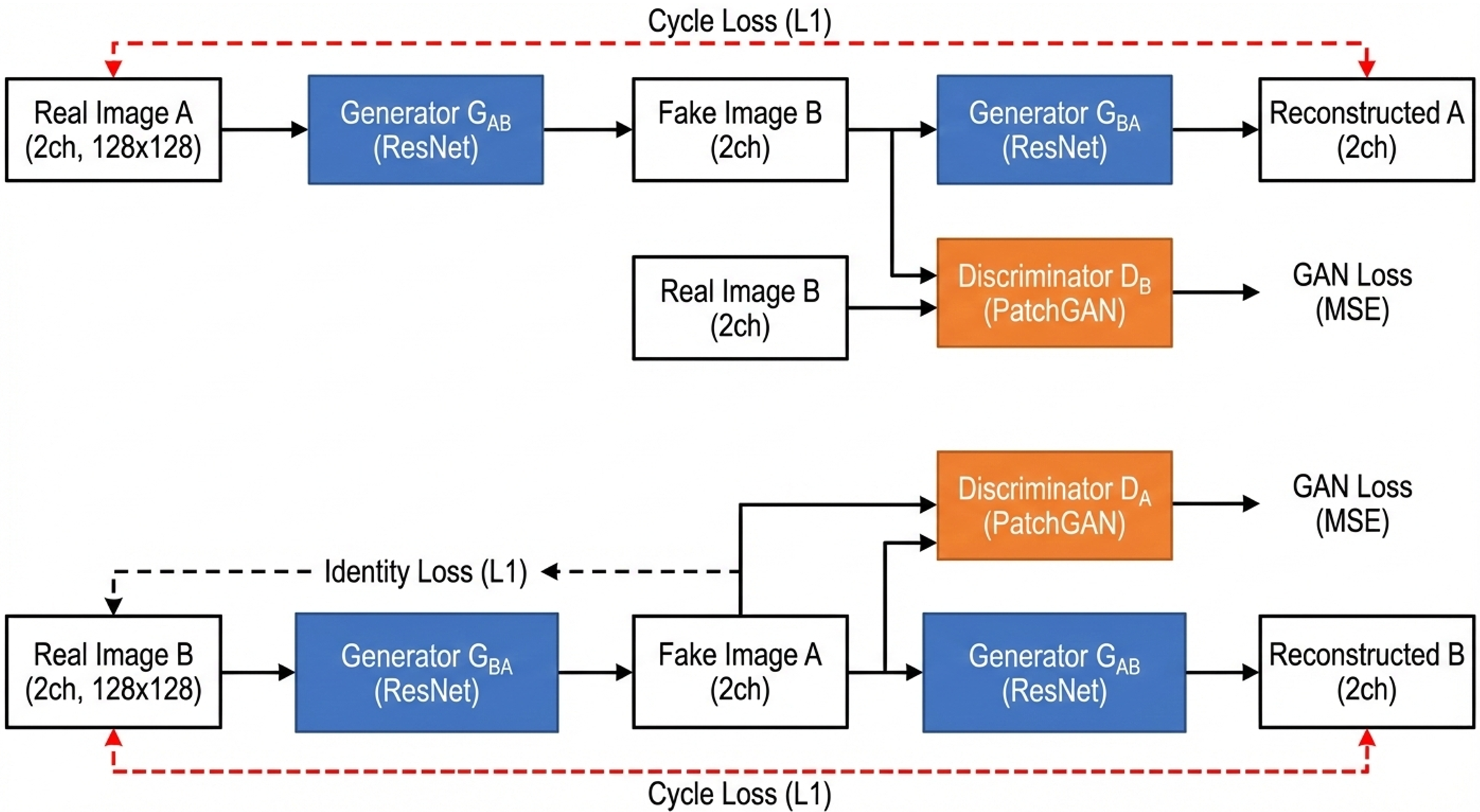 Figure 1: The overall workflow showing how the network learns to translate between astrophysical domains.
Results: Better than the Truth?
The results were validated using two main metrics:
- Angular Power Spectra (): The "spatial frequency" of the generated maps matches the real CO maps almost perfectly across various scales (0.5 deg to 3').
- Minkowski Functionals (MFs): These measure the "topology" (area, perimeter, connectivity) of the gas. The AI-generated CO shared the same non-Gaussian complex shapes as real observations, an area where traditional models often fail.
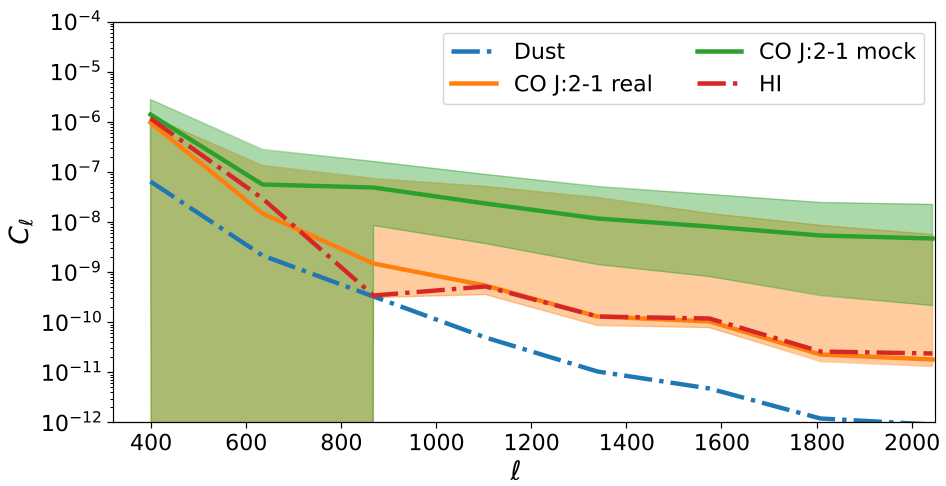 Figure 2: Power spectra comparison showing the AI (green) tracking the ground truth (orange) far better than the input traces.
The "In-the-Wild" Test
When the model was applied to High-Galactic Latitudes (the most difficult test), it produced clean, filamentary structures. In contrast, existing methods (pysm3) produced "grainy" maps where the noise was mistaken for signal.
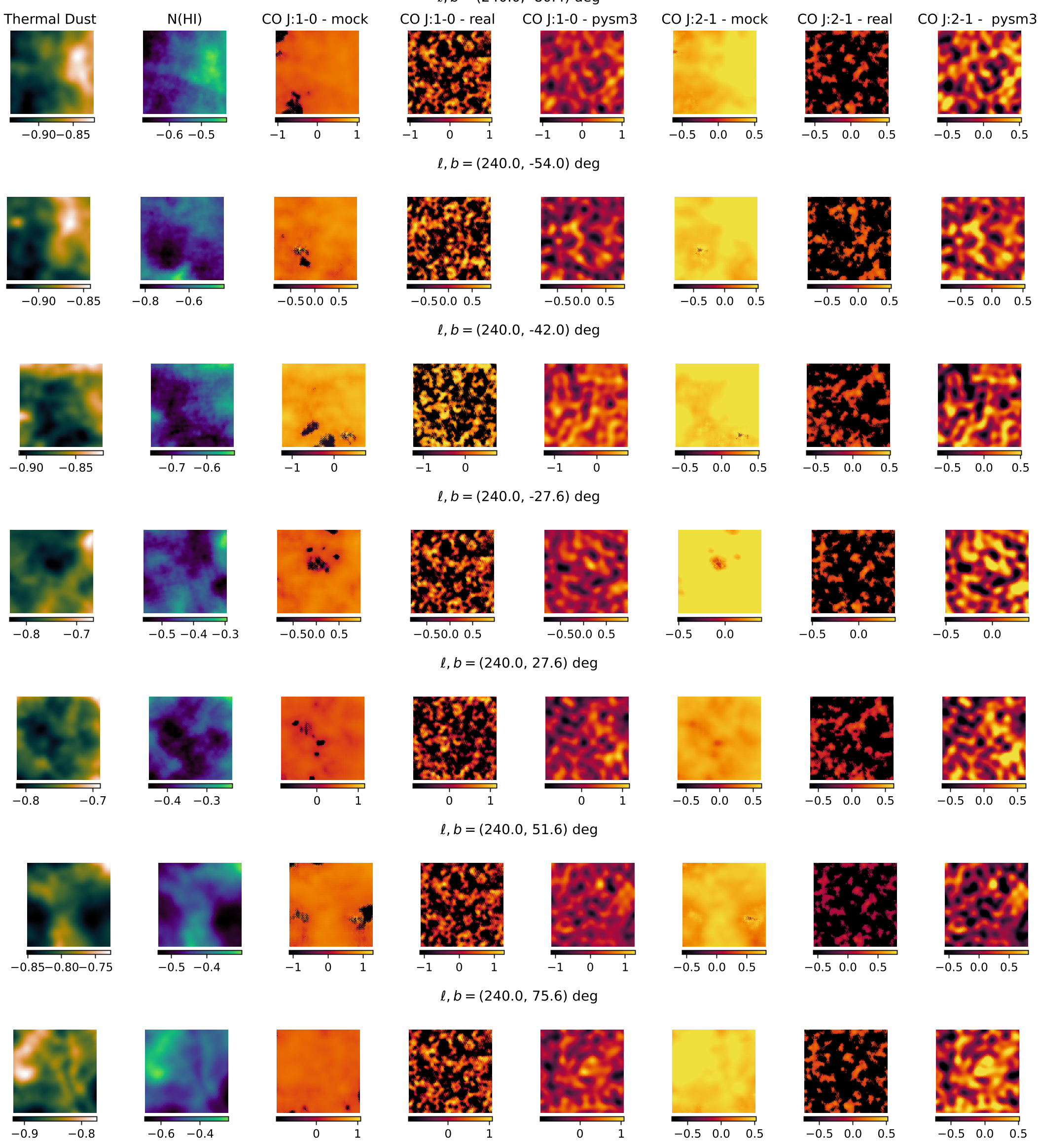 Figure 3: At high latitudes, the Cycle-GAN (middle) recovers clear structures that are invisible in the noisy Planck data (right).
Conclusion & Future Outlook
The study proves that unpaired image-to-image translation is a powerful tool for observational astronomy. By treating different sky surveys as "styles," we can fill in the gaps left by our hardware.
Limitations: The model is fundamentally limited by the SNR of its training data (>8). If there are unique physics in the darkest, most diffuse regions of the sky that aren't represented in the brighter training patches, the AI might miss them.
What's Next?: This model will likely be integrated into future Galactic emission templates, helping cosmologists "clean" the sky with unprecedented precision, potentially revealing the elusive B-mode polarization patterns from the early universe.