
EMF: Mastering One-Step Text-to-Image Generation with Discriminative Representations
Extending One-Step Image Generation from Class Labels to Text via Discriminative Text Representation
The paper introduces Extending MeanFlow to T2I (EMF), the first framework to successfully adapt the MeanFlow one-step generation method from simple class labels to complex, flexible text-to-image (T2I) tasks. By integrating a discriminative LLM-based text encoder (BLIP3o-NEXT), EMF achieves SOTA one-step generation performance, rivaling multi-step models.
TL;DR
One-step image generation has long been the "Holy Grail" of generative AI. While MeanFlow showed promise for simple class labels (e.g., "Golden Retriever"), it failed on complex text prompts. This paper introduces EMF, which identifies that the bottleneck isn't the model's size, but the text encoder. By using more discriminative LLM embeddings, EMF achieves near-SOTA quality in 1-4 steps, making high-quality generation nearly instantaneous.
Background: Why Text is Harder than Labels
In traditional class-conditioned generation, the model has 1,000 discrete "buckets." The path from noise to a "Cat" is relatively straight. However, text prompts like "A violin carved from ice with frost shedding" are dense and continuous.
The authors discovered that standard encoders create a "tortuous" denoising trajectory. This "winding path" makes it impossible for the model to predict the "average velocity" (the shortcut from start to finish) in a single step.
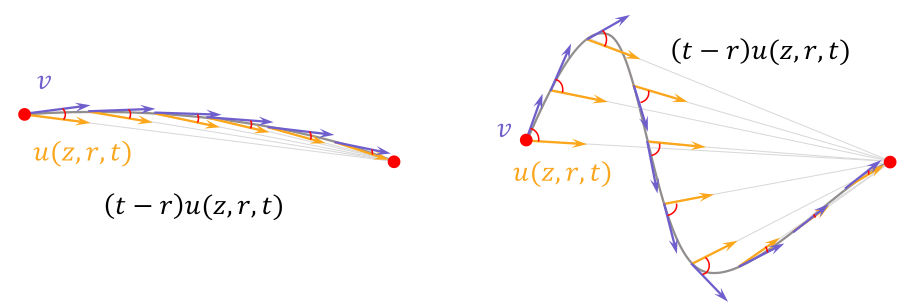 Figure: The "Straight" path of class labels vs. the "Tortuous" path of text conditioning.
Methodology: The Secret Sauce of EMF
The researchers analyzed text encoders through two lenses:
- Discriminability: Can the encoder distinguish between "blue teapot" and "red teapot" well enough to guide a 1-step jump?
- Disentanglement: Can it keep "violin" and "ice" as separate concepts without them merging into a blurry mess?
They found that the BLIP3o-NEXT encoder (an LLM-based model) possesses superior properties compared to T5 or CLIP.
Architecture Adaptation
Instead of following a simple time-step, EMF uses a dual-parameter temporal embedding:
- : Encodes the length of the "jump" ().
- : Encodes the final target time ().
This allows the model to learn the mean velocity field more effectively, stabilizing the training process and allowing the model to scale from 1 step up to 8 steps for even better quality.
Experimental Showdown
The results are striking. On the GenEval benchmark, which tests how well a model follows instructions:
- Ours (EMF) 4-step: 0.90
- Baseline (BLIP3o-NEXT) 30-step: 0.91
- SDXL-Turbo (4-step): 0.56
EMF achieves 99% of the performance of a full diffusion model in ~13% of the steps.
 Figure: EMF (left) successfully renders complex prompts like "volcanic eruption" and "balloon view" while competing models fail to follow instructions.
Deep Insight: Scaling Beyond 1 Step
A common problem with "distilled" models (like SDXL-Turbo) is that they hit a quality ceiling; taking more steps doesn't help. EMF is different. Because it models the underlying flow consistently, adding more steps (moving from 1 to 4 to 8) continues to reduce approximation error and increase visual fidelity.
Conclusion
EMF proves that the path to real-time, high-quality AI art isn't just about faster GPUs—it's about smarter representations. By ensuring the "map" (the text embedding) is clear and discriminative, the model can finally take the "shortcut" to the final image without getting lost.
Takeaway: If you want efficient generation, start by fixing your text encoder's semantic space.