
Symmetrically Coupled Readout: Making Erasure Detection "Invisible" and Always-On
Fast, High-Fidelity Erasure Detection of Dual-Rail Qubits with Symmetrically Coupled Readout
The paper introduces a hardware-efficient erasure detection scheme for transmon dual-rail qubits using a single symmetrically coupled readout resonator (SRO). By achieving a high degree of "-matching," it enables fast (384 ns), high-fidelity single-shot detection and the first demonstration of continuous, parallel erasure monitoring during quantum gates.
TL;DR
Researchers have demonstrated a breakthrough in erasure-based quantum error correction (QEC) by using a single resonator to monitor for errors without a dedicated ancilla qubit. By engineering a symmetric coupling that makes the logical states "look the same" to the resonator—a condition called -matching—they achieved high-speed erasure detection (384 ns) and pioneered continuous monitoring during gate operations with negligible logical damage ( induced error).
The Bottleneck: The Cost of Watching for Errors
In the "Erasure Qubit" paradigm, the goal is to turn difficult-to-trace errors into "erased" qubits whose locations are known. While promising, the overhead is usually high:
- Hardware Bloat: Most schemes need an extra "ancilla" transmon just to check for errors.
- Time Penalty: Stopping the circuit to check for erasures adds "dead time" where qubits just sit and decay.
- Dephasing: Simply looking at a qubit usually disturbs its quantum state (measurement back-action).
The team behind this paper asked: Can we build a detector that is blind to the data (the logical state) but hyper-sensitive to the error (the ground state)?
Methodology: The Magic of -Matching
The researchers used a transmon dual-rail qubit, where a single excitation is shared between two resonant transmons. An erasure occurs when the system decays to the vacuum state .
The core innovation is the Symmetrically Coupled Readout (SRO). By coupling a single resonator to both transmons equally, they engineered the dispersive shifts ( and ) of the logical states to be nearly identical.
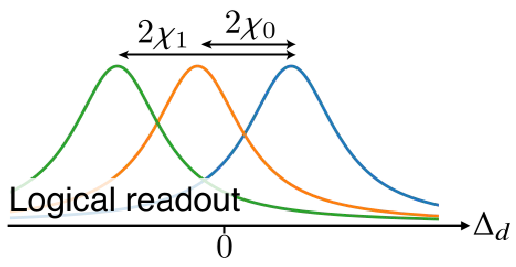 Figure 1: (a-b) Symmetric resonator coupling to a dual-rail pair. (c-d) The -matching concept allows the resonator to distinguish logical states from erasures while keeping logical states and indistinguishable.
When the resonator is driven at a specific frequency, it populates only if the qubit has "erased" into the ground state. If the qubit is in a logical state, the resonator remains "dark." This selective darkening ensures that the check doesn't "accidentally" measure the qubit's data.
Experimental Results: Near-Zero Impact
The team benchmarked their erasure check using Interleaved Randomized Benchmarking (ILRB).
- Residual Error: Only per check. Crucially, the check itself only added of dephasing—meaning the process is almost perfectly "QND" (Quantum Non-Demolition).
- Erasure Error: per check, dominated by the natural decay of the qubits during the 384 ns window rather than the measurement process itself.
The "Always-On" Mode
Perhaps the most impressive feat was Continuous Parallel Erasure Detection. Because the detector doesn't disturb the logical state, they kept it running during single-qubit gates.
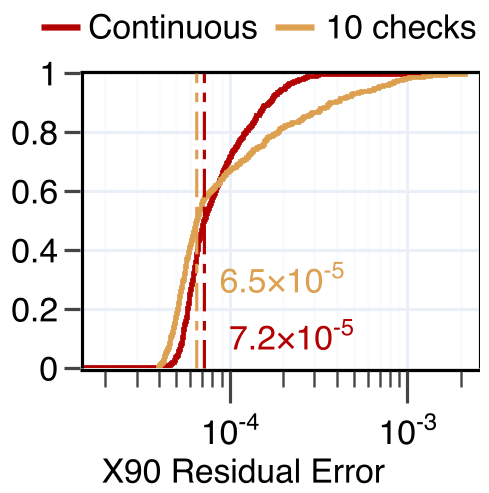 Figure 2: Continuous trajectories (e) show erasure events being caught in real-time. The cumulative distributions (f) show that parallel monitoring actually removes the "bad tails" of error caused by fluctuating defects (TLS).
Critical Insights: Why This Matters for the Future
- Ancilla-Free Scaling: By turning the readout resonator into the detector, we save space. In a giant quantum computer with thousands of qubits, removing one transmon per cell is a massive architectural win.
- Soft Information: Continuous monitoring doesn't just give a "Yes/No" on errors; it provides a stream of "maybe" probabilities. Modern decoders (like those for LDPC codes) can use this "soft info" to correct errors much more effectively than binary flags.
- TLS Mitigation: The paper elegantly shows that frequent or continuous checking can catch high-speed "leakage" events caused by materials defects (TLS), which are usually the primary cause of sudden, unpredictable errors in superconducting chips.
Conclusion and Limitations
While the residual error is world-class, the readout-induced erasure (where the drive slightly accelerates qubit decay) remains a challenge. The authors suggest that improving transmon materials and using more complex pulse shapes (optimal control) could bring these numbers down further.
This work establishes symmetrically coupled readout as a "fast, hardware-efficient, and scalable" pillar for the next generation of erasure-based fault-tolerant quantum computers.