
SMC-SD: Turning Idle GPU Compute into 5x Faster LLM Inference
Faster LLM Inference via Sequential Monte Carlo
The paper introduces Sequential Monte Carlo Speculative Decoding (SMC-SD), an approximate inference framework that replaces the rejection sampling in speculative decoding with importance-weighted resampling over a population of draft particles. By utilizing idle GPU compute, it achieves up to 2.36× speed-up over state-of-the-art speculative decoding and 5.2× over autoregressive decoding, while maintaining near-target accuracy (within 3%).
TL;DR
Autoregressive LLM generation is notoriously slow because it is limited by how fast we can pull weights from memory (Memory Bandwidth), not how fast we can calculate (Compute). SMC-SD changes the game by replacing the "all-or-nothing" rejection sampling of Speculative Decoding with a Sequential Monte Carlo approach. By running multiple "draft particles" in parallel, it saturates the GPU's idle compute units, resulting in a deterministic speed-up of up to 5.2x over standard generation with negligible accuracy loss.
Background: The "Weight-Loading" Tax
In standard LLM inference, to generate a single token, the GPU must load every single parameter of a 70B model. This is called being Memory Bandwidth-Bound.
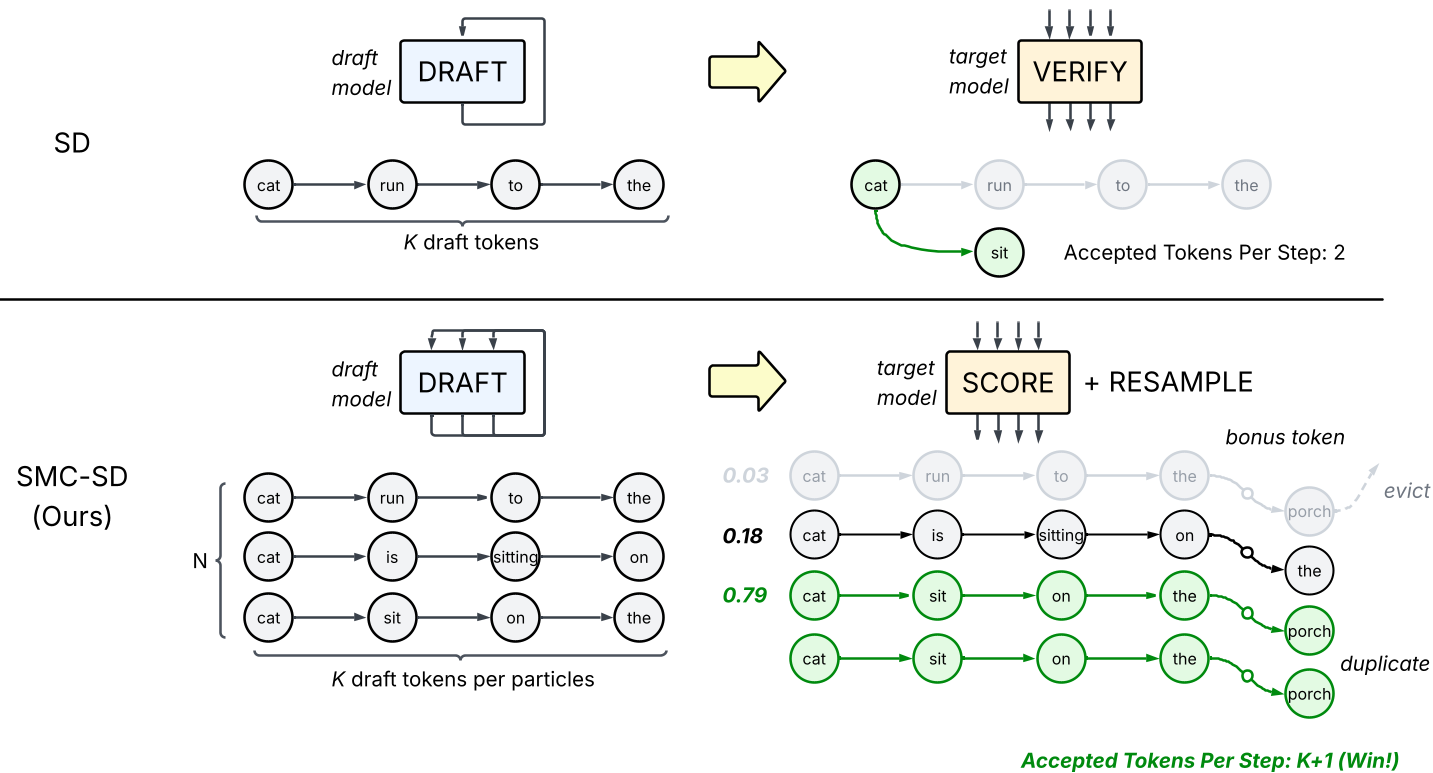
Traditional Speculative Decoding (SD) tries to hide this by having a small model guess tokens, which the big model checks. If the 3rd token is wrong, the 4th through th tokens are thrown away. This is wasteful and results in "stuttering" throughput.
The Insight: Importance Resampling
The authors of SMC-SD ask a radical question: What if we never throw away the draft?
Instead of rejecting a draft chain at the first sign of trouble, SMC-SD:
- Drafts a population of different sequences (particles).
- Scores all of them simultaneously in one big batch (vectorized).
- Reweights them based on how likely the big model thinks they are.
- Resamples: It kills off the "bad" paths and duplicates the "good" ones to keep going.
This means the "Verification" step is always a full, fixed-size batch. Because GPUs have massive unused compute headroom during weight-loading, checking 8 particles takes almost the same time as checking one.
Methodology: High-Throughput Engine Design
The secret sauce lies in Observation 1 from the paper: Arithmetic Intensity. By processing tokens in the target pass, SMC-SD increases the arithmetic intensity by roughly x over standard SD.
Furthermore, the authors optimized the system for "Prefix Sharing." When a particle is duplicated during resampling, the system doesn't copy the memory for the KV-cache. Instead, it uses Pointer Operations to share the memory, leading to a 72.3% reduction in KV-cache usage.
Experiments: Breaking the Speed Limit
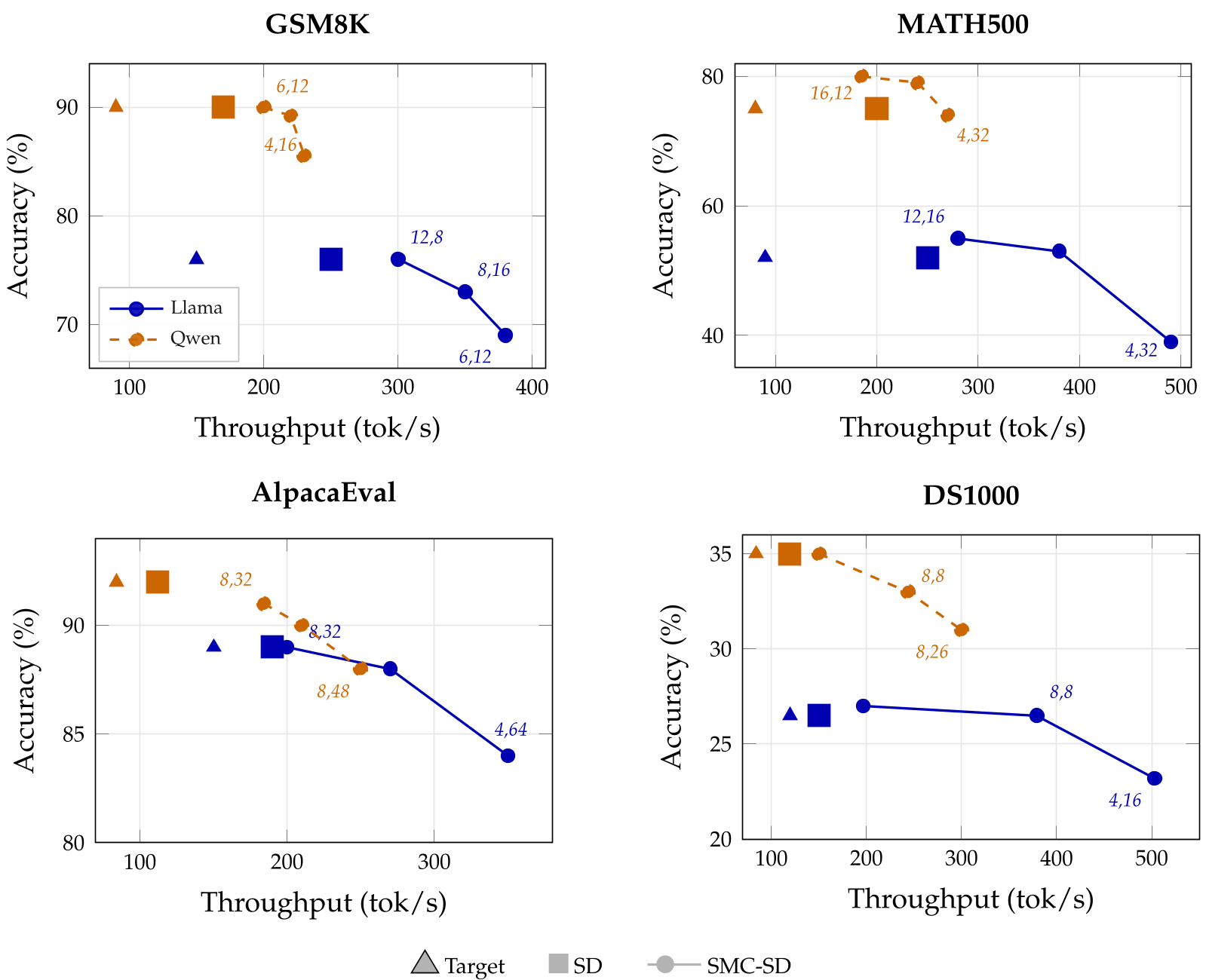
Across various benchmarks, SMC-SD consistently pushes the Pareto frontier further than standard speculative methods.
- Performance: On a 4x H100 setup with Llama-70B, it hits 342 tokens per second.
- Accuracy: Unlike other approximate methods that hallucinate, SMC-SD's importance sampling is mathematically grounded. It stays within 3% of the target model's accuracy on hard reasoning tasks like MATH500 and GSM8K.
Deep Insight: The Future of Co-Design
As hardware evolves (like NVIDIA's Blackwell architecture), FLOPS are growing much faster than memory bandwidth. Methods like SMC-SD are the blueprint for the future: they realize that "Compute is cheap, but memory movement is expensive."
By "wasting" FLOPs to explore multiple paths and then statistically combining them, we can finally break the sequential bottleneck of Transformer models without needing fundamentally new architectures.
Conclusion
SMC-SD is more than just a speed trick; it's a shift toward Probabilistic Speculation. It provides a tunable knob between "Perfect Exactness" and "Extreme Speed," making it a powerful tool for deploying the next generation of LLM agents at scale.
Limitations: As an approximate sampler, it may not be suitable for tasks requiring absolute bit-perfect identity with the target model (though for 99% of LLM tasks, this is irrelevant).