
The Critical Flux String: Bridging the Gap Between Nariai and Bertotti–Robinson Geometries
The Flat Critical Branch Between Nariai and Bertotti-Robinson Geometries as a Solution of Cosmological Einstein-Maxwell Theory
This paper introduces and analyzes a critical product geometry supported by Maxwell flux and a cosmological constant within Einstein–Maxwell– theory. This specific configuration, termed the "critical Maxwell flux string," serves as the unique algebraic midpoint that interpolates between the Nariai () and Bertotti–Robinson () spacetimes, achieved when the longitudinal Lorentzian curvature vanishes ().
TL;DR
In the landscape of classical general relativity, certain product spacetimes like the Nariai universe () and Bertotti–Robinson () are legendary. This paper identifies a long-overlooked sibling: the Critical Maxwell Flux String (). By balancing the cosmological constant against Maxwell flux, the authors uncover a "flat" midpoint that is not just a curiosity, but an almost universal solution capable of satisfying a vast range of higher-curvature gravity theories.
The Missing Link in Product Geometries
In four-dimensional Einstein–Maxwell– theory, the relationship between spacetime curvature and electromagnetic energy is often fixed by the geometry of the horizon. We typically see two extremes:
- Nariai (): Lorentzian curvature is positive, often appearing as the limit of black holes in de Sitter space.
- Bertotti–Robinson (): Lorentzian curvature is negative, famous for being the near-horizon limit of extremal Reissner-Nordström black holes.
The authors ask: What happens exactly at ? This midpoint represents a state where the "outward" pressure of the cosmological constant perfectly balances the "inward" stress of the Maxwell flux in the longitudinal direction.
Methodology: The Geometry of Balance
The researchers employ a direct-product metric ansatz: where the sector is intrinsically flat ().
The Algebraic Midpoint
Through rigorous derivation of the Einstein and Maxwell tensors, they show that the field equations collapse into simple algebraic tuning conditions. The longitudinal sector remains flat only if: and the transverse sphere's curvature is:
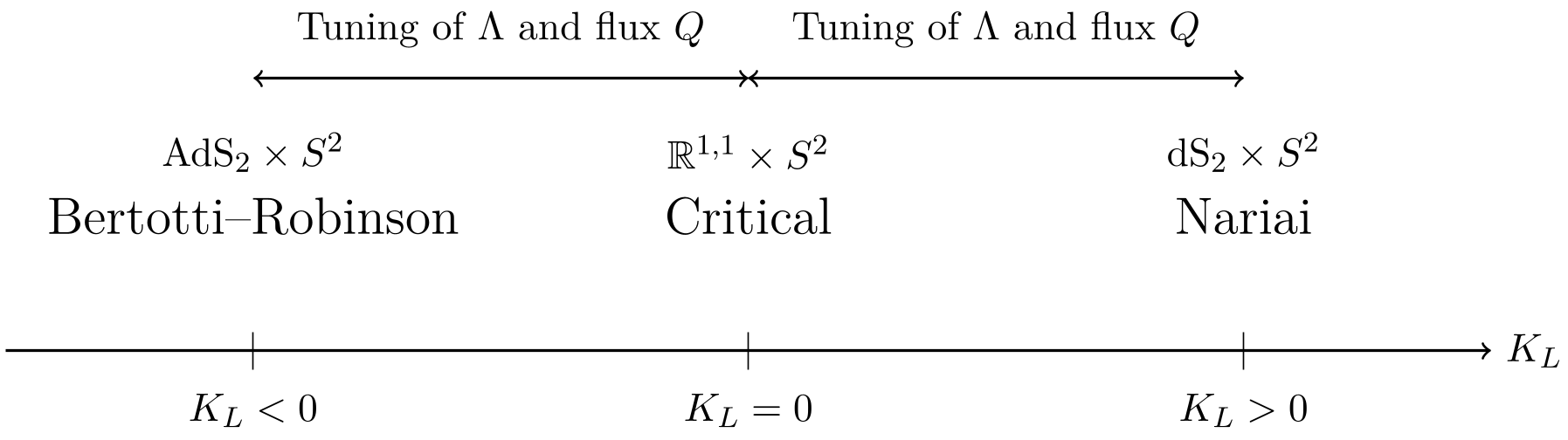 Figure 1: This figure illustrates the interpolation between Nariai, Critical, and Bertotti–Robinson branches. As the balance between and Flux shifts, the longitudinal curvature passes through zero.
Key Insights: Almost Universality
The most profound discovery here is the Almost Universality of the critical branch. Because the Riemann tensor of this geometry is so algebraically simple (Petrov type D and part of the Constant Scalar Invariant/CSI class), it possesses a unique property:
Any symmetric rank-two tensor constructed from the Riemann tensor (without derivatives) reduces simply to a linear combination of the metric and the Maxwell stress tensor.
This means that if you propose a new, complex theory of gravity—such as Quadratic Gravity or theory—this critical flux string is still likely to be a valid solution. The geometry transcends the specific "flavor" of the gravitational action, making it a fundamental structure in mathematical physics.
Rigidity and pp-wave Deformations
The paper also explores Brinkmann pp-wave deformations. In many flat backgrounds, one can "wiggle" the metric with waves traveling along null directions. However, the authors prove a Rigidity Theorem: on a round sphere , any smooth deformation of this critical background is merely a "pure gauge" (a coordinate transformation) and not a physical wave. This highlights the structural stability of the flux string.
Conclusion and Future Outlook
The "Critical Maxwell Flux String" () isn't just a mathematical zero-point; it is a homogeneous fluxbrane that stabilizes the transverse space using gauge-field energy.
For the broader research community, this work provides a "universal template." Whether one is working on string theory flux compactifications or testing modified gravity, the R 1,1 midpoint serves as a crucial benchmark for how matter and curvature interact at the most fundamental algebraic level.
References:
- Gürses, M., Şişman, T. Ç., & Tekin, B. (2026). Journal of Physics: Conference Series.
- Sen, A. (2005). Attractor mechanism in higher derivative gravity. JHEP.
- Hervik, S., et al. (2017). Universal spacetimes in four dimensions. JHEP.