
Fluctuating PDW: Unveiling the Particle-Hole Asymmetry in the Hubbard Phase Diagram
Fluctuating Pair Density Wave in Finite-temperature Phase Diagram of the $t$-$t^\prime$ Hubbard Model
This study utilizes state-of-the-art thermal tensor network methods (tanTRG) to map the temperature-doping phase diagram of the Hubbard model. It reveals a robust d-wave superconducting (dSC) phase on the electron-doped side, while identifying a fluctuating pair density wave (PDW) regime at finite temperatures on the hole-doped side that precedes charge density wave (CDW) order.
TL;DR
By employing advanced thermal tensor network (ThermoTN) simulations, researchers have finally mapped the finite-temperature phase diagram of the Hubbard model. The core finding is a striking asymmetry: while electron doping fosters robust d-wave superconductivity (dSC), hole doping leads to a fluctuating Pair Density Wave (PDW) at intermediate temperatures, which eventually transitions into a Charge Density Wave (CDW).
The "Hole-Doping" Mystery
For decades, the single-band Hubbard model has been the "standard model" for high- cuprates. However, a persistent numerical tension has haunted the field. Ground-state DMRG and iPEPS calculations often fail to find robust superconductivity on the hole-doped side—the very region where cuprates are most well-known for their high critical temperatures. This work addresses the mystery by looking at the problem through a finite-temperature lens, asking not just what the ground state is, but what physics dominates as the system cools.
Methodology: Seeing Through the Noise with ITP
The researchers utilized tanTRG (Tangent-Space Tensor Renormalization Group) to reach ultra-low temperatures (), far beyond the reach of standard DQMC due to the sign problem.
A key technical innovation is the use of Imaginary-Time Proxies (ITP). Conventional equal-time correlators are "noisy," often dominated by high-frequency, short-range fluctuations. By calculating the Green's function at the midpoint of the imaginary-time interval (), the authors effectively applied a low-pass filter, isolating the low-energy physics responsible for long-range order.
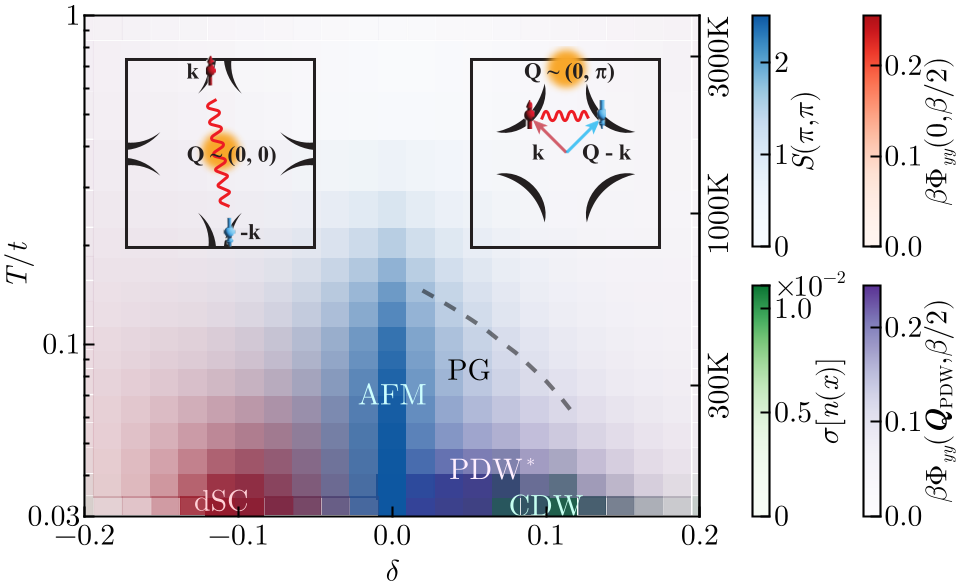 Fig 1: The calculated temperature-doping phase diagram showing the emergence of AFM, dSC, and PDW phases.
The Node-Antinode Dichotomy
The root of the asymmetry lies in the electronic structure. By visualizing the spectral weight , the authors observed:
- Electron-doped side: Spectral weight is concentrated near the antinodes , favoring zero-momentum d-wave pairing.
- Hole-doped side: Weight is concentrated in Fermi arcs near the nodes. Here, the system prefers "inter-arc" pairing with a finite net momentum —the signature of a Pair Density Wave.
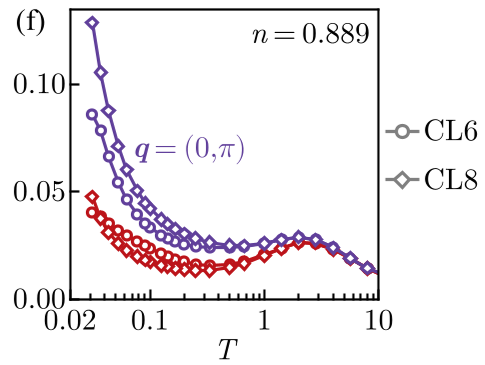 Fig 2: Comparison of spectral weight distributions for electron and hole doping, highlighting the nodal/antinodal dichotomy.
Experimental Evidence: PDW Dominance
The most controversial finding is that for hole doping, the PDW fluctuations are significantly stronger than dSC fluctuations. As shown in the pairing structure factor , a pronounced peak emerges at finite momentum , while the (dSC) peak remains weak.
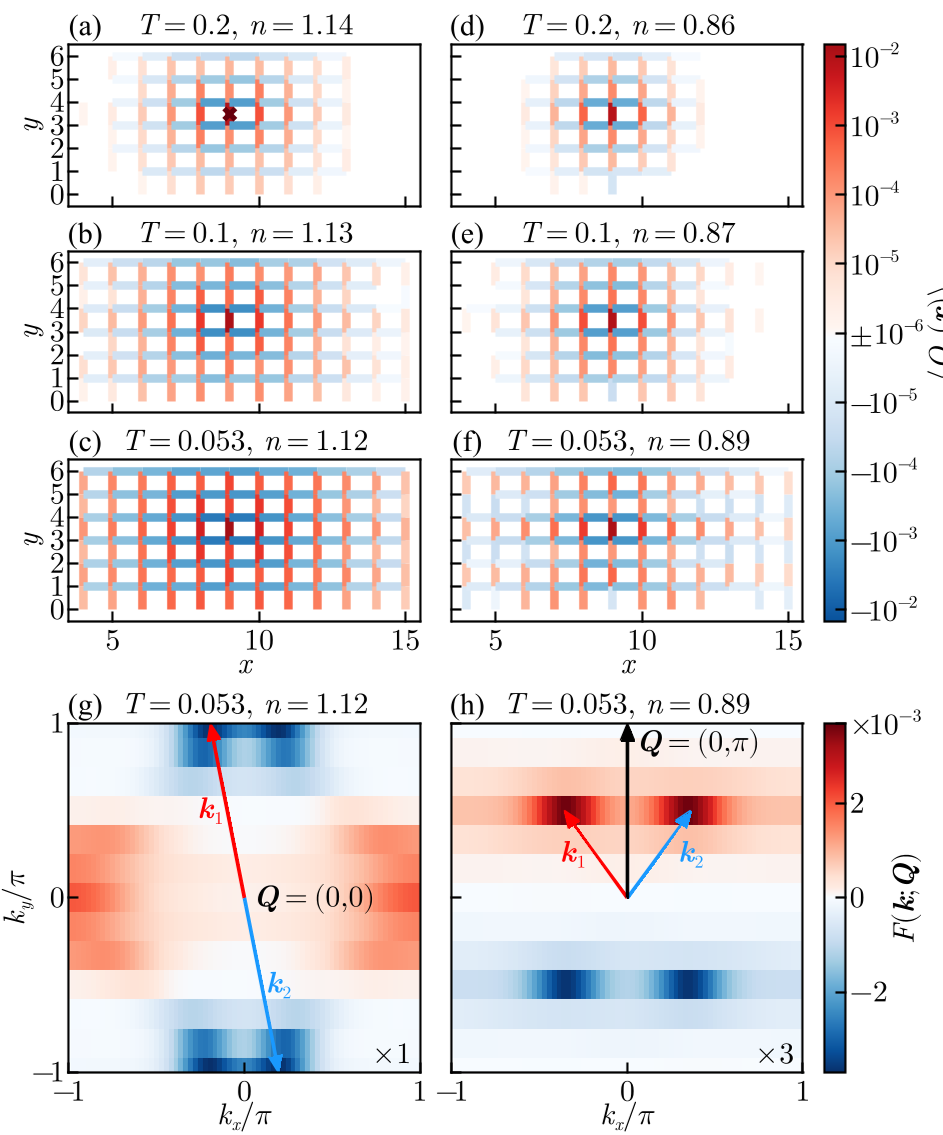 Fig 3: Pairing symmetry patterns. Note the staggered sign changes in the hole-doped PDW state.
Critical Insight & Future Outlook
This work confirms that the pure Hubbard model might be insufficient to explain the physics of hole-doped cuprates, as it naturally gravitates toward PDW and CDW orders rather than the experimentally observed -wave superconductivity.
Takeaway: The "fluctuating PDW" state occupies the heart of the pseudogap regime in this model. This suggests that the pseudogap in real materials might indeed be a high-temperature precursor to more exotic orders, and that additional physics—perhaps the three-band Emery model or lattice phonon effects—is required to "stabilize" d-wave superconductivity on the hole-doped side of the phase diagram.