
FreqFlow: Redefining Image Synthesis via Frequency-Aware Flow Matching
Frequency-Aware Flow Matching for High-Quality Image Generation
The paper introduces Frequency-Aware Flow Matching (FreqFlow), a novel generative framework that explicitly incorporates frequency-domain characteristics into the flow matching process. By employing a two-branch architecture and time-dependent adaptive weighting, FreqFlow achieves a new state-of-the-art FID of 1.38 on ImageNet-256 image generation.
TL;DR
FreqFlow is a state-of-the-art generative model that addresses the "blurriness" in traditional flow matching by explicitly separating low-frequency (global structure) and high-frequency (fine detail) processing. Using a dual-branch architecture and an adaptive weighting mechanism, it achieves a record-breaking FID of 1.38 on ImageNet-256, proving that frequency-domain awareness is key to high-fidelity synthesis.
The Problem: The Hidden Non-Uniformity of Noise
While current SOTA models like DiT (Diffusion Transformer) and SiT (Scalable Interpolant Transformer) operate primarily in the spatial domain, the noise corruption process they seek to reverse is fundamentally non-uniform across the frequency spectrum.
Empirically, global structures (low frequency) are captured early in the reverse process, while textures and edges (high frequency) emerge much later. However, because standard models treat every pixel/latent dimension equally, they lack the "inductive bias" required to prioritize fine-grained detail at the right moment, often resulting in slightly smoothed results.
Methodology: The Two-Branch Synergy
The core innovation of FreqFlow is its explicit treatment of frequency bands through a specialized architecture:
- The Frequency Branch: This branch uses Discrete Fourier Transform (DFT) to split the input into low-pass (structure) and high-pass (detail) components. It leverages a Vision Transformer (ViT) to model long-range dependencies, which is ideal for frequency representations.
- The Spatial Branch: Utilizing ConvNeXt, this branch synthesizes the final image in the latent domain, guided by the features extracted from the frequency branch.
- Adaptive Frequency Integration: Perhaps the most elegant part of the paper is the weighting mechanism . As shown in the training dynamics, the model learns to prioritize human-like perception: "Structure first, detail later."
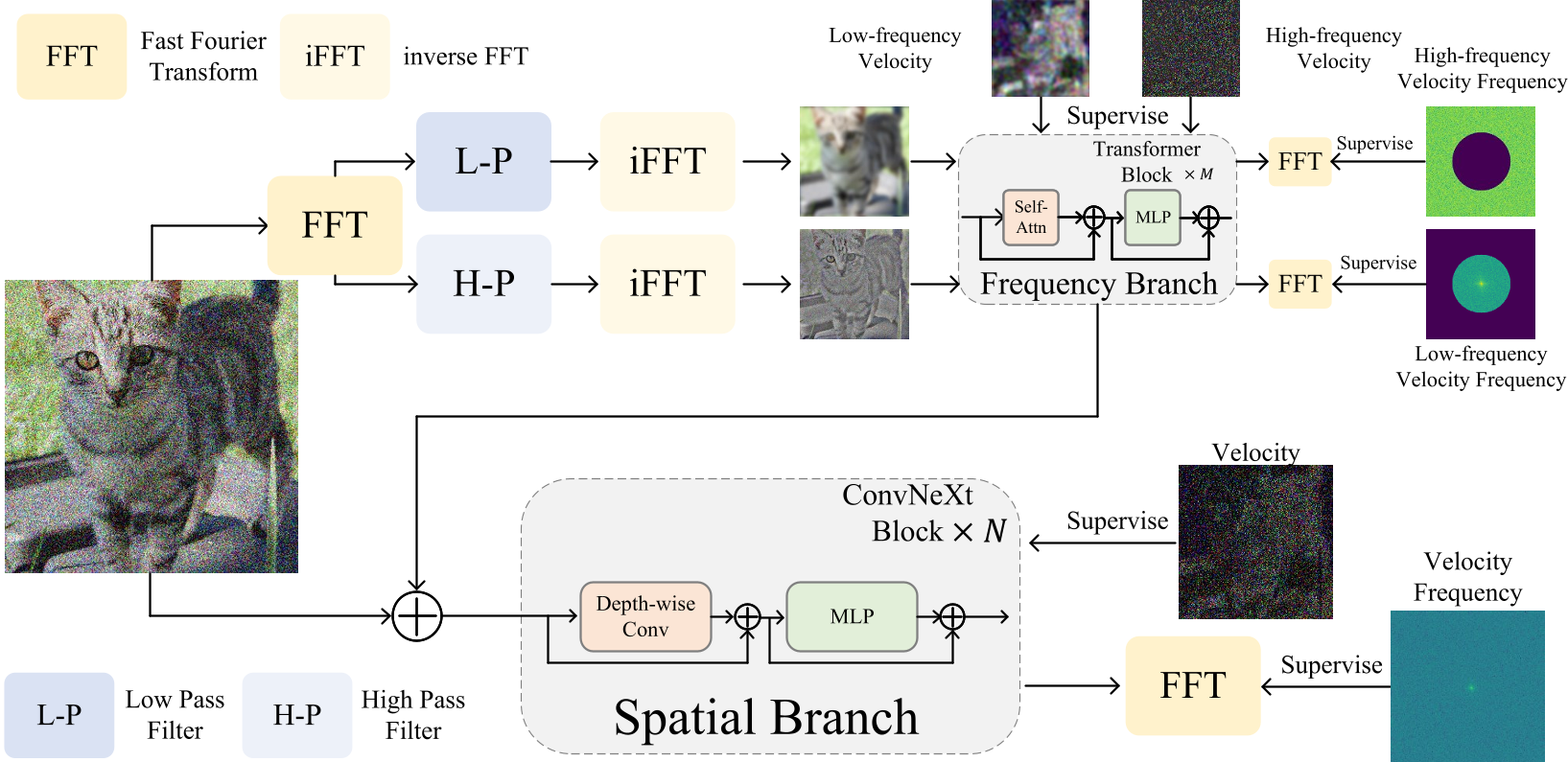 Figure 1: The FreqFlow architecture showing the decoupling of frequency components and their integration into the spatial branch.
Dual-Domain Supervision
The model isn't just told to look at frequencies; it's supervised by them. The loss function includes a Frequency Domain Loss () alongside the standard spatial loss (): This ensures that the predicted velocity fields correctly transport the spectral distribution of the data.
Experimental Triumphs: Setting a New SOTA
The results on class-conditional ImageNet generation are decisive. FreqFlow-H (1.08B parameters) sets a new bar for flow-based models.
- Efficiency: FreqFlow-L (507M) outperforms DiT-XL (675M) despite being smaller.
- Fidelity: On ImageNet-256, FreqFlow achieves an FID of 1.38, a significant jump over SiT (2.06) and DiT (2.27).
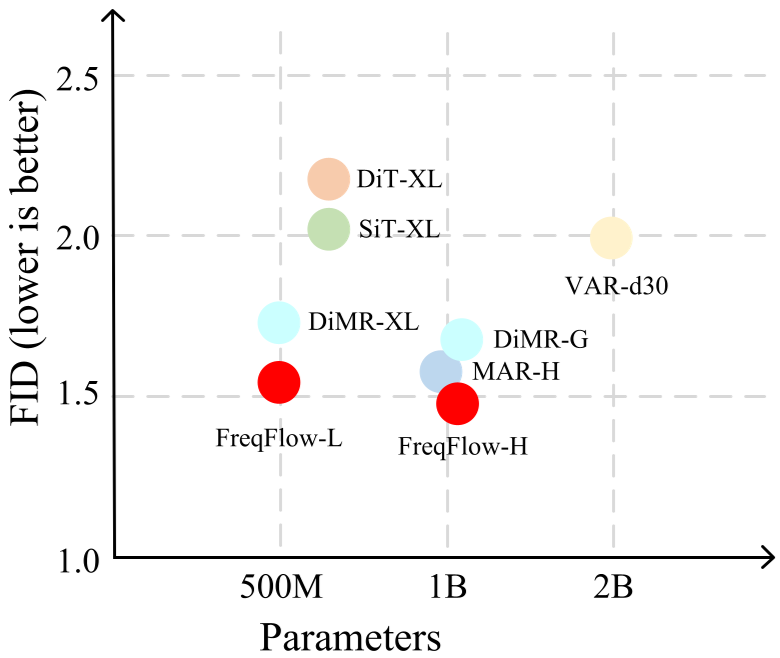 Figure 2: Parameters vs. FID. FreqFlow demonstrates superior Pareto efficiency compared to previous diffusion and flow-based models.
Why It Works: Spectral Analysis
The authors quantified the "Frequency Error." Previous models like SiT had a high-frequency error of 0.69, whereas FreqFlow dropped this to 0.48. Visualizations in the paper show that FreqFlow reaches lower log amplitudes (structural stability) much earlier in the ODE trajectory than its predecessors.
Critical Insight & Conclusion
FreqFlow proves that even in the age of "scaling laws" and massive Transformers, domain-specific insights—like the behavior of Fourier components—still offer massive performance gains.
Limitations: While powerful, the model currently scales to around 1.08B parameters. As the authors noted, future work will likely explore scaling this to the multi-billion parameter range (e.g., competing with 12B+ parameter models like FLUX).
Final Takeaway: By aligning the mathematical flow with the spectral stages of image formation, FreqFlow achieves detail sharpness that was previously elusive in pure spatial-domain models.