
From Procedural Skills to Strategy Genes: Unlocking Experience-Driven Test-Time Evolution
From Procedural Skills to Strategy Genes: Towards Experience-Driven Test-Time Evolution
This paper introduces "Strategy Genes," a compact, structured, and evolution-ready representation of experience designed for LLM agents. Evaluated across 4,590 trials in 45 scientific code-solving scenarios, the method achieves significant SOTA improvements, boosting performance on the CritPt benchmark from 17.7% to 27.14% through test-time evolution.
TL;DR
More experience is not always better. Researchers from Tsinghua University and EvoMap have discovered that the traditional way we teach AI agents—using long, "documentation-style" skill packages—actually hampers performance. By shrinking these descriptions into compact, high-signal "Strategy Genes" (governed by a new protocol called GEP), they enabled agents to not only perform better in the short term but to evolve iteratively, boosting scientific code-solving accuracy by nearly 10% without any parameter updates.
The Cognitive Friction of "Documentation-Heavy" AI
In the current agentic landscape, we treat "experience" like a library. When an AI fails, we give it a long post-mortem or a detailed manual (a "Skill"). However, this paper argues that LLMs at test-time don't need a textbook; they need a control signal.
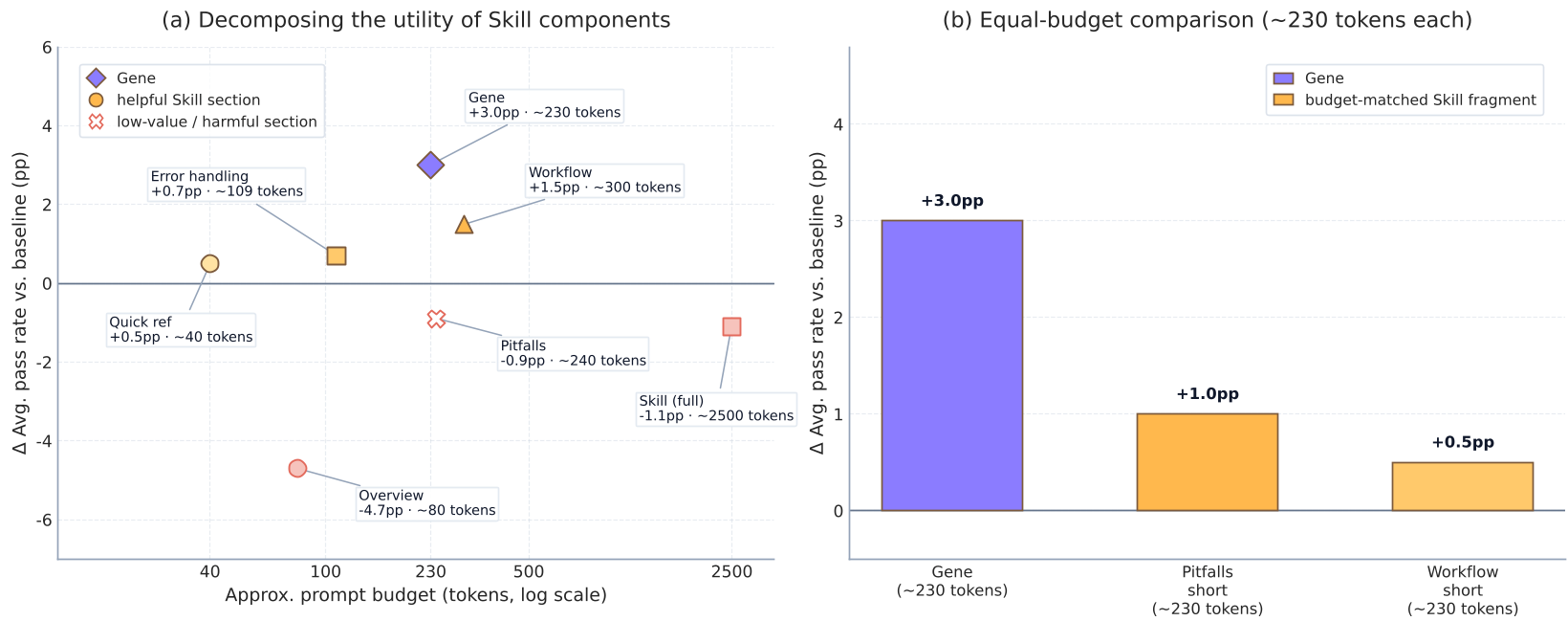
The "Skill Probe" conducted by the authors revealed a startling truth: documentation-oriented skills are misaligned with test-time control. Much like a pilot doesn't want to read a physics manual during a mid-air emergency, an LLM struggles when useful information is buried under 2,500 tokens of auxiliary notes. In fact, adding documentation often degraded performance for stronger models like Gemini 3.1 Pro.
The Methodology: What is a "Strategy Gene"?
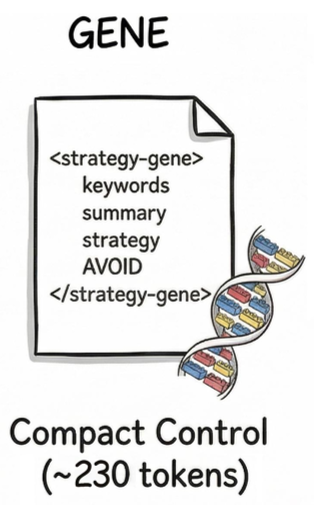
Instead of a "Skill.md" file, the authors introduce the Strategy Gene. It is a protocolized object designed for maximum signal density.
The Gene Anatomy
A Gene (typically ~230 tokens) is structured into focused fields:
- Match Signals: Keywords that trigger the gene.
- Strategy: A tight, ordered list of steps.
- AVOID Cues: Explicit warnings about failure modes (the most effective part of the representation).
- Validation Hooks: Checks to see if the strategy worked.
The authors also introduced the Gene Evolution Protocol (GEP), an "object layer" for AI experience. It separates abstract strategies (Genes) from specific successful runs (Capsules) and the history of how those strategies changed (Events).
The Power of the "AVOID" Signal
One of the most profound insights from the experiments is how we should handle failure. Traditional "reflection" mechanisms append failure history. This paper found that selective compression is superior.
Failure history is most effective when distilled into compact "AVOID" warnings within a Gene. Simply appending a list of past mistakes ("Failure History") was consistently less effective than distilling those mistakes into a structured strategy.
Experiments: Real-World Scientific Impact
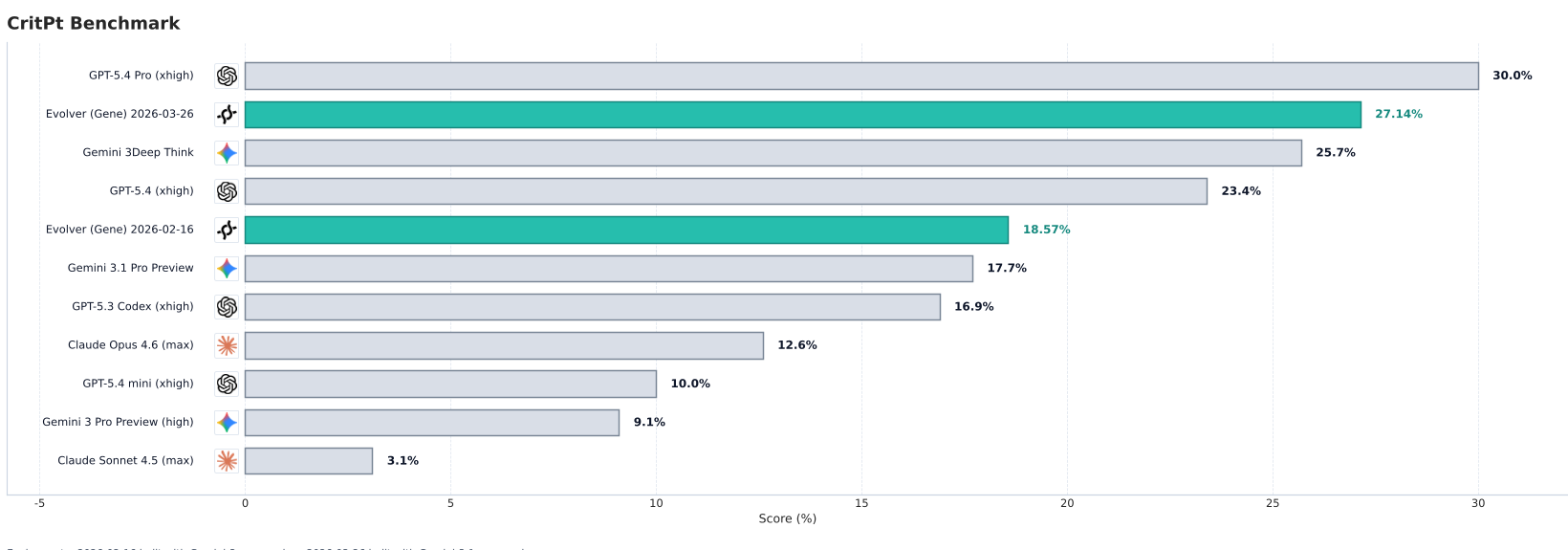
The researchers tested this on CritPt, a benchmark for frontier physics research. The results were clear:
- Baseline Gemini 3.1 Pro: 17.7% accuracy.
- Evolver (Gene-based): 27.14% accuracy.
This ~10 point jump comes purely from the agent's ability to "evolve" its internal strategy genes over time. The agent converts transient runtime errors into persistent, reusable control assets.
Critical Insight: Selective vs. Additive Growth
The take-home message for AI researchers is that Experience Accumulation should be Selective, not Additive.
- Packaging matters: How you label and structure a prompt (the "schema") is as important as the content.
- Structure provides Robustness: Strategy Genes are remarkably robust to structural perturbations (like changing word order) but highly sensitive to semantic errors, making them a "stable substrate" for evolution.
- The GEP protocol acts as a "genetic code" for agents, allowing successful behaviors to be inherited and refined across thousands of tasks.
Conclusion and Future Outlook
This work marks a shift from "LLMs as learners" to "Agents as evolving systems." By treating experience as a Strategy Gene rather than a text file, we enable a form of test-time adaptation that is both token-efficient and remarkably powerful. As we move toward autonomous researchers and engineers, protocols like GEP will likely become the standard for how agents "remember" how to succeed.
Limitations: The study is currently focused on scientific code-solving. Whether "Gene" representations work as effectively in more creative or multi-modal domains (like video generation or creative writing) remains an open question for the next generation of Evolver systems.