
GATES: Generalization at the Edge of Stability — Measuring the Chaos
Generalization at the Edge of Stability
The paper introduces Generalization at the Edge of Stability (GATES), a framework that models stochastic optimization as a Random Dynamical System (RDS). It proposes the "Sharpness Dimension" (SD), a novel complexity measure based on the fractal geometry of random attractors, yielding State-of-the-Art (SOTA) explanations for generalization in chaotic, overparameterized regimes.
TL;DR
Modern neural networks don't just "converge"; they collide with the Edge of Stability (EoS), a regime where standard optimization is technically unstable but generalization is remarkably good. This paper introduces the Sharpness Dimension (SD), a fractal-based measure that explains generalization not by how "flat" a single point is, but by the "effective dimensionality" of the chaotic set (the Random Attractor) the optimizer eventually calls home.
Background: Beyond Pointwise Flatness
For years, the deep learning community has chased "flat minima"—the idea that if you land in a broad valley, you generalize better. However, reality is messier. When we use large learning rates, the Hessian's top eigenvalue often exceeds the stability limit (). Instead of diverging, the model enters a state of "stable instability" or chaos.
Pointwise metrics like the Hessian trace or spectral norm fail here because the model isn't at a point; it's oscillating within a complex, fractal-like structure. The authors of GATES argue that to understand generalization, we must look at the geometry of this entire set.
Methodology: The Geometry of Chaos
The paper reframes stochastic optimization as a Random Dynamical System (RDS).
1. The Random Attractor
Instead of a single weight vector, the authors look at the Pullback Random Attractor—a "snapshot" of all possible states the optimizer reaches asymptotically under a specific noise realization.
2. Sharpness Dimension (SD)
The core contribution is the Sharpness Dimension, inspired by the Kaplan-Yorke conjecture in chaos theory. It calculates the effective number of "expanding" directions in the landscape.
- Intuition: While the model has millions of parameters (), the optimization dynamics actually collapse onto a set with much lower dimensionality ().
- The Math: It uses the full spectrum of the Hessian to balance directions that stretch the volume against those that contract it.
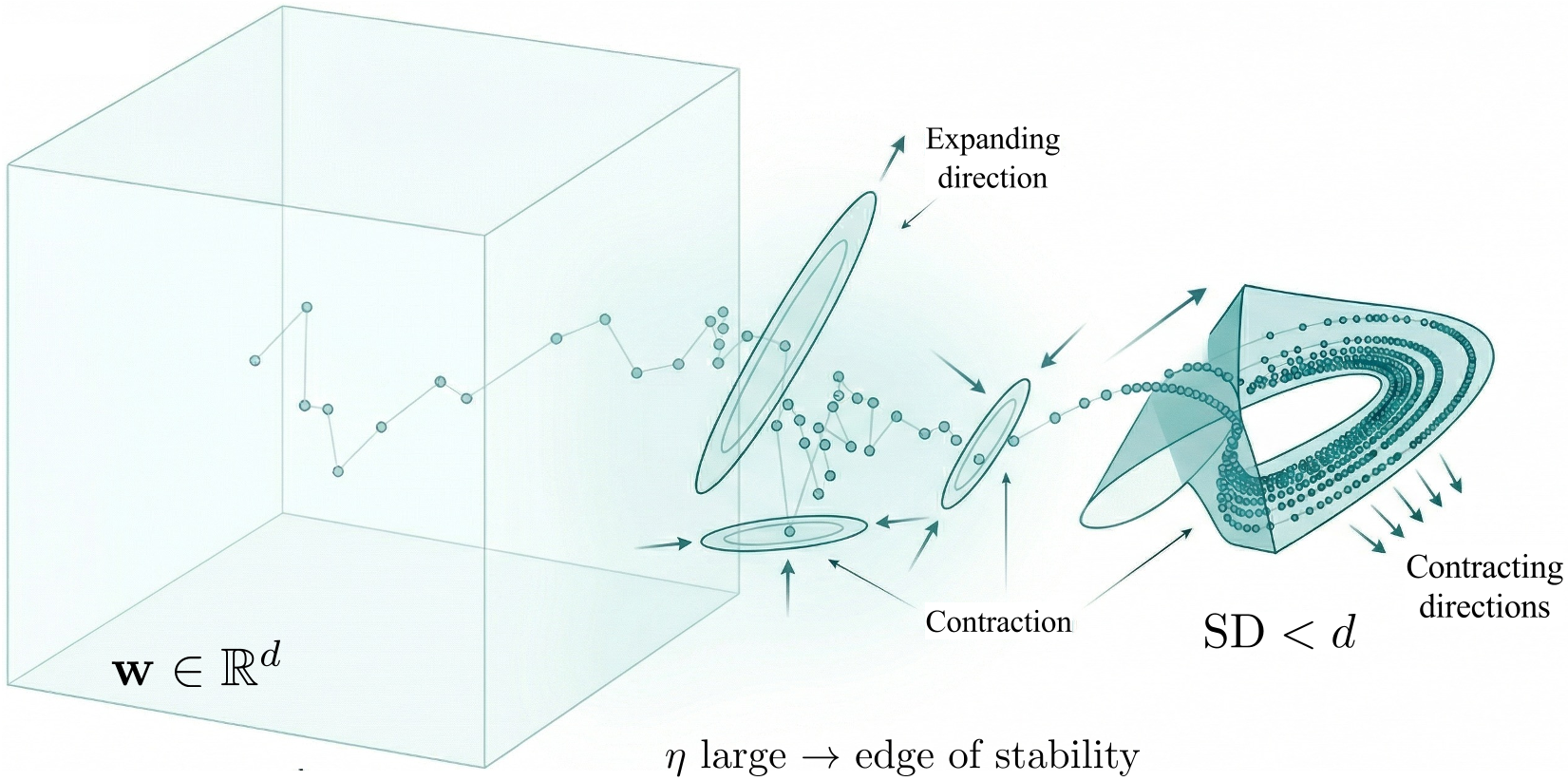 Figure 1: Illustration of how the spectrum relates to the Sharpness Dimension. Even when locally unstable (), the overall set remains bounded and low-dimensional.
Scalable Estimation: Stochastic Lanczos Quadrature
Calculating the full Hessian spectrum for a Transformer like GPT-2 is computationally impossible via traditional SVD. The authors use Stochastic Lanczos Quadrature (SLQ) to estimate the spectral density efficiently. This allows the framework to scale to 124M+ parameters by only requiring Hessian-vector products rather than explicit Hessian storage.
Experiments & Results
The authors tested the Sharpness Dimension against standard benchmarks and the mysterious phenomenon of Grokking (delayed generalization).
Grokking Phase Transitions
In algorithmic tasks (like modular arithmetic), models often overfit for thousands of steps before suddenly "understanding" the rule. The Sharpness Dimension (SD) captures this transition perfectly, showing a sharp decrease in the attractor's complexity exactly when the model "groks" the data.
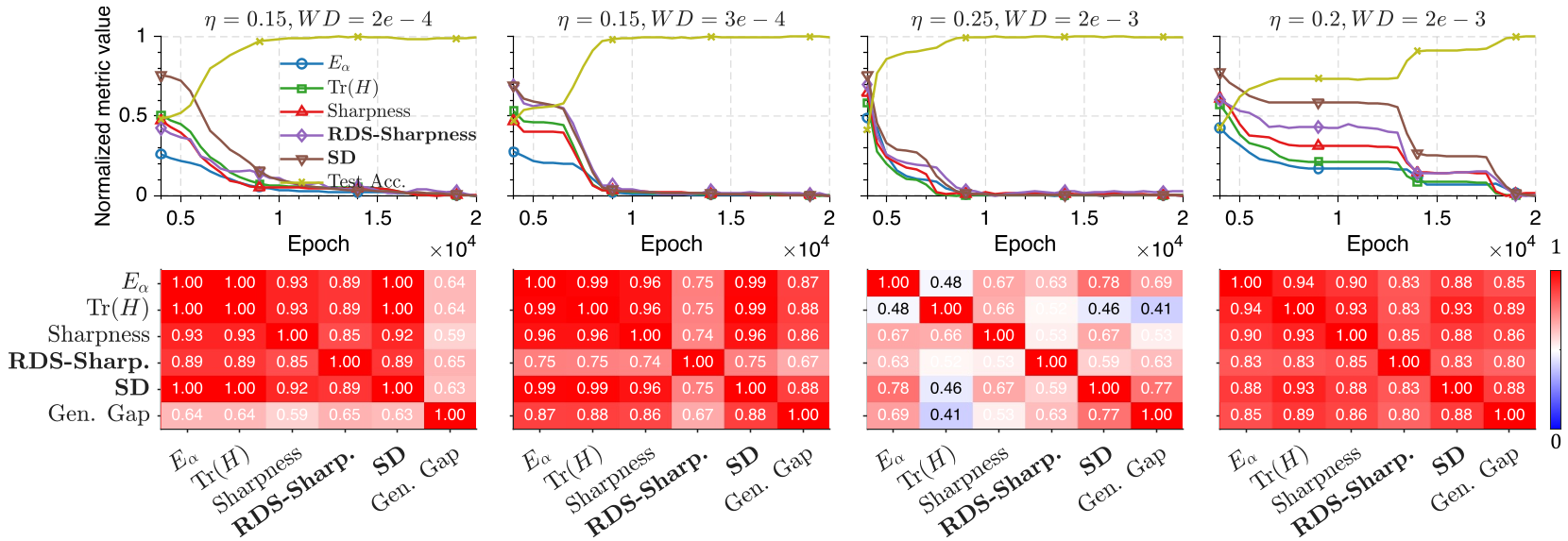 Figure 2: In grokking experiments, SD (red/blue lines) tracks the sudden leap in test accuracy more reliably than traditional trace-based metrics.
GPT-2 Performance
On GPT-2, the SD showed a consistently higher correlation with the generalization gap compared to classical "sharpness" (the max eigenvalue), confirming that the entire spectrum matters, not just the peak.
Critical Analysis & Conclusion
The GATES framework provides a rigorous mathematical bridge between Chaos Theory and Deep Learning. Its primary value lies in proving that overparameterized models generalize because their optimization dynamics restrict them to a lower-dimensional fractal "manifold," despite the apparent chaos of the training trajectory.
Limitations: While SLQ is efficient, calculating the entire Hessian spectrum still adds overhead compared to simple gradient norms. Furthermore, the bound is "worst-case," which can still be numerically loose compared to empirical gaps.
Takeaway: If you want to know if your model will generalize, don't just look at the bottom of the hill; measure the size of the storm it's dancing in.