
Deterministic QITE: A Gauge-Invariant Shortcut to the Z2 Lattice Ground State
Ground state preparation in two-dimensional pure $\mathbb{Z}_2$ lattice gauge theory via deterministic quantum imaginary time evolution
This paper implements the deterministic Quantum Imaginary Time Evolution (QITE) algorithm to prepare the ground state of a 2D pure lattice gauge theory. By generalizing Pauli pool construction to commute with Gauss’s law, the authors achieve a gauge-invariant simulation with significantly reduced gate and measurement costs.
TL;DR
Simulating Lattice Gauge Theories (LGTs) is the "Holy Grail" for understanding fundamental physics, but quantum hardware struggles with the non-unitary nature of cooling a system to its ground state. This paper presents a breakthrough in Deterministic Quantum Imaginary Time Evolution (QITE), specifically tailored for 2D Lattice Gauge Theory. By mathematically "pruning" the operator space to only include gauge-invariant terms, the authors reduced the computational cost by orders of magnitude while maintaining a precision of 99.9%.
The Problem: The Exponential Price of Precision
In standard QITE, we approximate the non-unitary operator using a series of unitary rotations. To find the right rotations, we solve a linear equation . The catch? The size of the matrix scales with the number of Pauli strings in your "Pauli pool." For a 2D lattice, the pool grows so fast that measuring the required elements becomes a "tomography nightmare." Furthermore, if any step in the evolution drifts outside the Physical Hilbert Space (violating Gauss's Law), the whole simulation fails to represent real physics.
Methodology: Pruning the Pauli Pool
The authors' core insight is that we don't need the full Pauli pool. They applied three layers of "mathematical filters" to reduce the operators:
- The Reality Filter (): Since the Hamiltonian and states are real in the computational basis, only Pauli strings with an odd number of operators contribute to the evolution.
- The Gauge Filter (): They proved that only operators commuting with the Gauss’s law operators are necessary. This keeps the state strictly within the sector of physical charges.
- The Quotient Filter (): By treating operators that differ only by a symmetry generator as equivalent, they further halved the pool size.
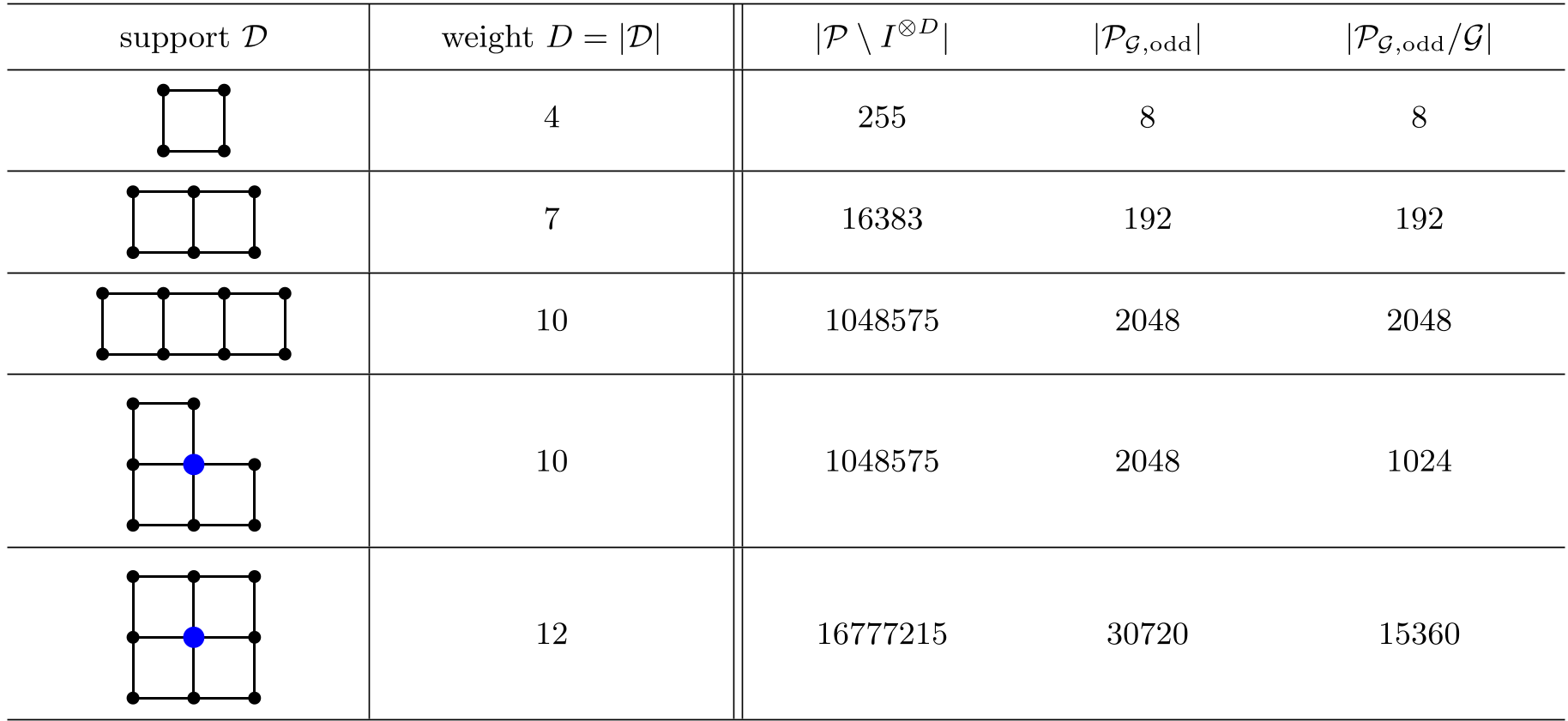 Table showing the dramatic reduction: for a single plaquette, the pool drops from 255 to 8 operators.
Architecture and Geometry
The study utilized a ladder-like geometry (up to sites) under Open Boundary Conditions. The link variables of the theory were mapped directly to qubits.
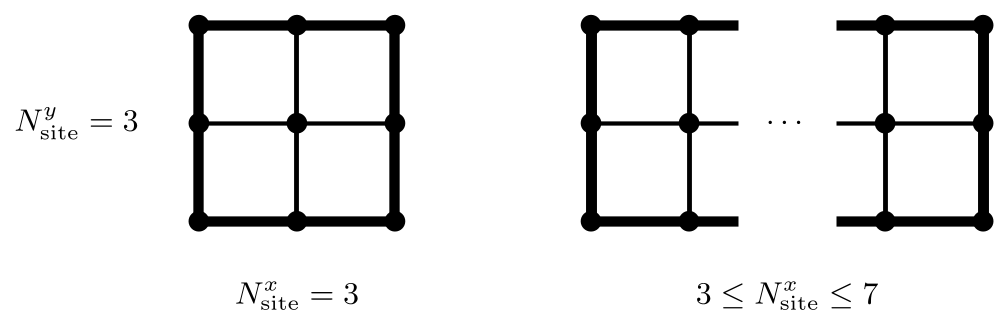 The ladder geometry used for the Tensor Network (MPS) simulations.
Experimental Results: High Fidelity, Low Cost
Using Matrix Product States (MPS) to simulate the quantum algorithm classically, the authors compared QITE against the Gold Standard: DMRG (Density Matrix Renormalization Group).
- Accuracy: For (weak coupling), the relative error was effectively negligible. Even at strong couplings (), errors stayed below 0.1%.
- Convergence: The imaginary time was sufficient for most systems to reach the ground state.
- Step Size Dependence: Shorter time steps () led to better convergence, though errors eventually saturate due to the fixed size of the Pauli pool support.
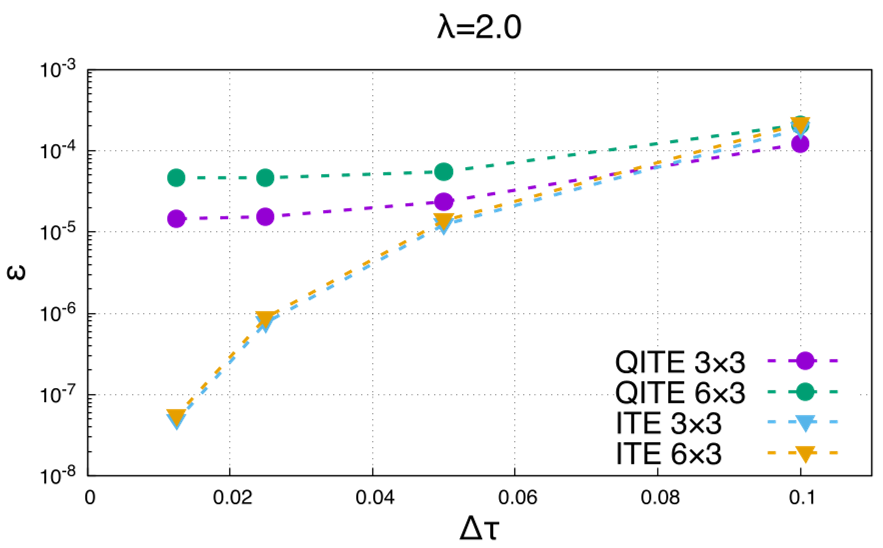 Relative error as a function of time step and system size, showing the robustness of the QITE-specific approximation.
Critical Insight & Future Outlook
The most profound takeaway is the scalability of the reduced pool. While the total Hilbert space is vast, the local constraints of Gauge Theory provide a natural "shroud" that limits where the quantum state can live.
However, the paper notes a limitation: as system size increases, the QITE-specific error (the error from approximating the non-unitary step with a unitary one) grows slightly faster than the Suzuki-Trotter error. This suggests that for much larger 2D lattices, we might need slightly larger Pauli pool "supports" or more sophisticated initial state guesses (like starting from the strong-coupling limit).
This work moves us one step closer to simulating the dynamics of quarks and gluons on real NISQ-era quantum hardware by proving that symmetries are not just a nuisance to maintain—they are a tool for massive optimization.