
HALO: Bringing Stability Guarantees to Data-Driven Humanoid Locomotion
HALO: Hybrid Auto-encoded Locomotion with Learned Latent Dynamics, Poincaré Maps, and Regions of Attraction
The paper introduces HALO (Hybrid Auto-encoded Locomotion), a data-driven framework that learns low-dimensional Reduced-Order Models (ROMs) for high-dimensional hybrid dynamical systems like legged robots. It combines autoencoders with Poincaré return maps to capture step-to-step locomotion stability and enables the lifting of latent Lyapunov-based regions of attraction back to the full-order state space.
TL;DR
Locomotion is complex, but its underlying physics often lives on a simple, low-dimensional "manifold." HALO (Hybrid Auto-encoded Locomotion) is a new framework that uses autoencoders to compress the high-dimensional chaos of a walking robot (like the Unitree G1) into a stable, low-dimensional latent space. Unlike previous "black-box" models, HALO allows engineers to perform formal stability analysis (Lyapunov theory) in the latent space and translate those safety guarantees back to the real robot.
Background: The Gap Between Templates and Data
For decades, roboticists relied on "Template Models" like the Linear Inverted Pendulum (LIP). These are simple "cart-on-a-stick" models that humans can understand and analyze. However, they are mere approximations; they don't capture the flapping of a humanoid's arms or the subtle dynamics of a heel-strike.
Recently, Deep Reinforcement Learning (RL) has conquered humanoid walking, but it has a "black box" problem: we don't know exactly when or why it will fail. HALO bridges this gap by learning a model that is both data-driven (accurate) and mathematically structured (analyzable).
Methodology: Mapping the "Chaos" to Order
HALO focuses on the Poincaré Map—the discrete "snapshot" of a robot's state at the exact moment its foot hits the ground.
1. The Autoencoder Pipeline
The framework uses a three-part neural network architecture:
- Encoder (): Compresses the full robot state (e.g., 59 dimensions for G1) into a latent state .
- Latent Dynamics (): Captures how the robot evolves from one footfall to the next in this simplified space.
- Decoder (): Reconstructs the full-order state from the latent representation.
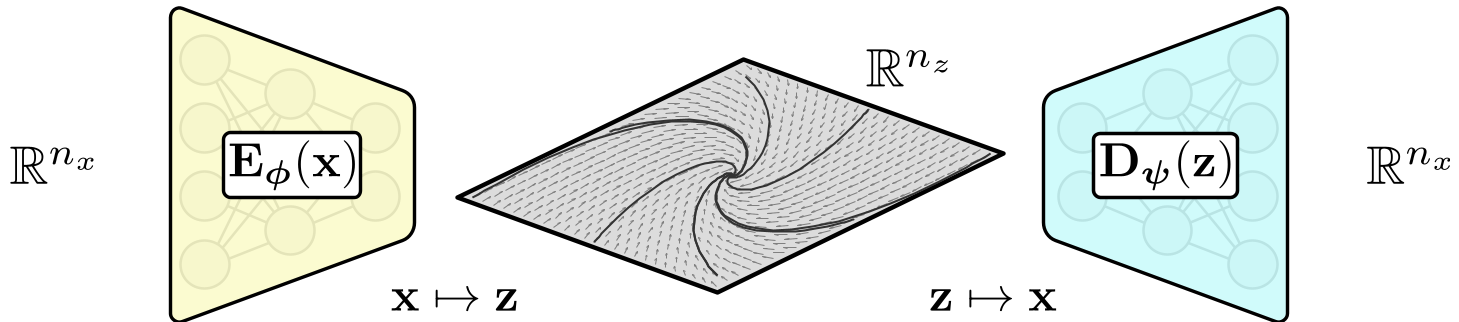 Figure 1: The HALO framework. High-dimensional trajectories are encoded into a latent space where a simpler model predicts the next state before being decoded back.
2. The Loss Secret Sauce
To make this work, the authors didn't just use standard reconstruction loss. They used Conjugacy Loss (to ensure latent steps match real steps) and Prediction Loss (to ensure the model doesn't drift over 10+ steps). This makes the learned latent space a "True Surrogate" of the physics.
Stability Analysis: Finding the "Safety Zone"
The most impressive part of HALO is its ability to estimate the Region of Attraction (ROA)—the set of all initial configurations from which the robot can successfully recover its gait.
By linearizing the learned latent model , the authors can solve a Lyapunov Equation to find a stable "ellipsoid" in the latent space. They then "lift" this ellipsoid back into the real world using the Decoder.
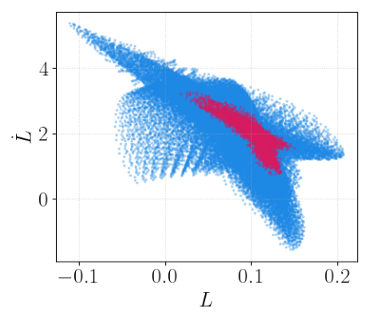 Figure 2: Visualization of the G1 Humanoid's Region of Attraction. The method accurately identifies the boundaries within which the robot's center-of-mass can safely stay.
Experimental Battle-Test
The authors tested HALO on three systems:
- Paddle-Ball: A simple 4D system.
- Planar Hopper: An 8D hybrid system.
- Unitree G1 Humanoid: A massive 59D state space.
In the G1 test, HALO reduced the state space from 59 dimensions to just 12. Despite this massive compression, the latent model predicted the robot's behavior with 99.9% accuracy regarding whether a certain stance would lead to a fall or a stable step.
Deep Insight: Why Does This Matter?
HALO proves that we don't need to choose between the formal rigor of classical control and the high performance of RL. By using machine learning to find the "invariant manifold" (the natural low-dimensional surface the robot moves on), we can treat a 59-DOF humanoid as if it were a much simpler system, without losing the nuances of its full-body dynamics.
Limitations & Future Work
While HALO is a major step forward, it currently assumes the existence of an "attractive invariant manifold." If a robot is performing highly erratic or non-periodic movements (like parkour), the dimensionality reduction might be harder to maintain. The next frontier will be applying HALO to non-periodic, highly agile maneuvers where the "manifold" is constantly shifting.
Conclusion
HALO provides a mathematically grounded way to "see" inside the high-dimensional dynamics of modern robots. It tells us not just that a robot is walking, but how stable each step is, providing a crucial safety layer for the next generation of humanoid workers.