
[CoRL 2025] QWM: Breaking the "Hardware Lottery" with Morphology-Conditioned World Models
Toward Hardware-Agnostic Quadrupedal World Models via Morphology Conditioning
The paper introduces Quadrupedal World Model (QWM), a hardware-agnostic framework that enables a single dynamics model and policy to control a diverse fleet of quadruped robots. By explicitly conditioning the model on morphological engineering specifications (USD files), QWM achieves zero-shot transfer to unseen robots like the Unitree Go1 and ANYmal-D in both simulation and real-world environments.
TL;DR
The "Hardware Lottery" in robotics refers to the painful reality where a policy trained for a Unitree A1 is useless for an ANYmal, despite both being quadrupedal. QWM (Quadrupedal World Model) solves this by treating morphology not as a hidden variable to be guessed, but as a known engineering specification. By conditioning a world model on physical features extracted from USD files, the researchers achieved zero-shot real-world deployment on unseen robots without a single second of fine-tuning.
Background: The Specialist Trap
Most robotic agents today are high-end specialists. If you change a motor's torque characteristic or extend a limb by 5cm, the underlying dynamics model usually collapses. Prior attempts at "Generalists" often relied on Implicit System Identification, where the RNN tries to "feel" its own weight and limb length through movement history.
The authors identify two fatal flaws in this approach:
- Adaptation Lag: The robot must move (and potentially fall) to identify itself.
- Latent Entanglement: The model's "brain" (recurrent state) is forced to memorize static facts (how long is my leg?) at the cost of processing dynamic facts (am I falling right now?).
Methodology: Engineering Specifications as First-Class Citizens
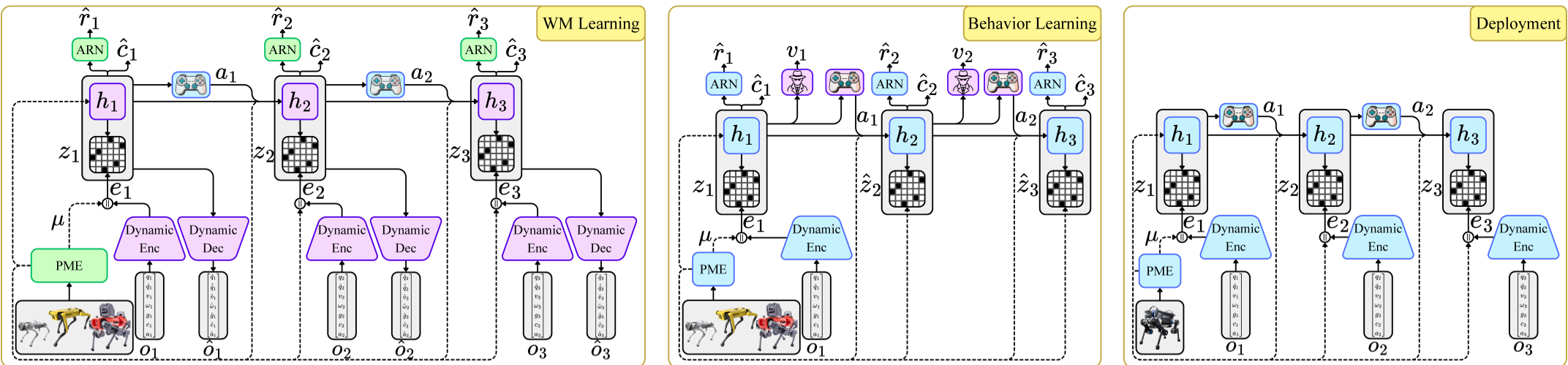
The core innovation is the Physical Morphology Encoder (PME). Instead of letting the model guess, they feed it the truth.
1. Feature Extraction (The PME)
The system extracts four key categories from the robot's USD (Universal Scene Description) file:
- Kinematics: Limb lengths and segment ratios.
- Topology: Is the knee "dog-like" or "X-config" (inward bending)?
- Dynamics: Logarithmic mass and mass distribution ratios.
- Actuation: Torque density (effort limits scaled by total mass).
2. The Dual-Tower Architecture
To prevent high-frequency noise from "washing out" the static morphology data, the authors use a dual-tower encoder. The dynamic observation and the static morphology are processed in parallel before being fused. Crucially, the morphology vector is injected directly into the Recurrent Model at every timestep.
3. Adaptive Reward Normalization (ARN)
Training a Spot (reward peak ~350) and a Unitree B2 (reward peak ~15) together usually leads to gradient dominance. ARN uses a Per-Robot Exponential Moving Average (EMA) to scale rewards by the 5th and 95th percentiles, ensuring every robot contributes equally to the learning signal.
Experimental Mastery: Zero-Shot and Beyond
The model was trained on a "Hetero-Isaac" setup, managing a mixed batch of morphologies in a single forward pass.
Performance and Stability
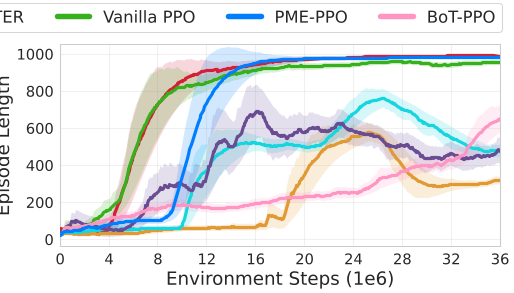
Compared to Vanilla PPO and DreamerV3, QWM shows significantly higher stability. Standard World Models (WMs) often suffer from "mean-dynamics collapse," where they learn an average physics that fits no robot perfectly. QWM's explicit conditioning steers the dynamics into the correct morphology-specific manifold.
The Interpolation Success
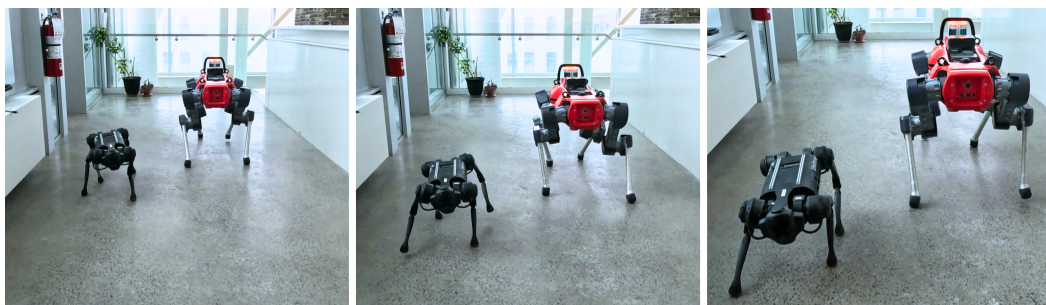
In zero-shot tests, QWM was deployed on the Unitree Go1 and ANYmal-D (which were never seen during training).
- Interpolation: Since Go1 is physically similar to the trained A1, the model interpolated the dynamics perfectly.
- Extrapolation: The model struggled with the Unitree B2, a massive 80kg robot which sat far outside the "physics basis" of the training set.
Deep Insight: Latent Disentanglement
Does the model actually separate "who I am" from "how I move"? The authors performed a Probing Analysis (t-SNE/PCA) on the latent states:
- Deterministic State (): Showed clear, isolated clusters for each robot brand.
- Stochastic State (): The clusters dissolved into a single cloud, but velocity gradients remained.
This proves that becomes morphology-agnostic, focusing purely on instantaneous motion, while handles the physical context. This is the "Holy Grail" of generalizable robotics: a modular brain where the sense of "self" is decoupled from the sense of "environment."
Conclusion
QWM is a major step toward a Universal Physical World Model. While it currently acts as a "distribution-bounded interpolator" (it can't yet control a biped if it only saw quadrupeds), it proves that morphology-conditioning is the key to escaping hardware-locked silos. The future of robotics lies not in training more experts, but in building generalists that understand the underlying physics of any structure they inhabit.
Senior Editor's Note: The success of the Unitree Go1 zero-shot deployment is particularly impressive because of the "adaptation lag" it eliminates. This is a foundational step toward a "Foundation Model" for robotics that understands rigid-body dynamics as a universal language.