
The Illusory Precision of TTV: Why We Recalibrated Kepler-9’s Masses
The Illusory Precision of TTV Masses: Hidden Solutions Behind Kepler-9's Tight Mass Ratio
The paper introduces a "mode-first" parallel searching algorithm to address multidimensional degeneracies in Transit Timing Variation (TTV) mass determinations. Applied to the Kepler-9 system, the method reveals that planetary masses are not uniquely determined as previously thought but exist across a broad linear ridge, maintaining a consistent mass ratio of ~1.45 despite individual mass variations of over 50%.
TL;DR
For years, the Kepler-9 system was the "poster child" for Transit Timing Variations (TTV), providing what seemed like precise planetary masses. However, new research using a specialized "mode-first" searching algorithm reveals that these masses are part of a massive linear degeneracy. While the mass ratio between the planets is rock-solid at ~1.45, the individual masses can swing by 50% without affecting the fit, proving that previous "precise" measurements were likely just samples of a single local peak.
The Paradox of Sharpness and Sparsity
Determining planetary mass from TTV is a classic inverse problem. We see the timing of transits deviate and try to calculate the gravitational pull required to cause those shifts. Historically, scientists used Markov Chain Monte Carlo (MCMC) methods to find the "best fit."
The authors point out a fundamental technical barrier:
- Extreme Sharpness: The likelihood surface is incredibly steep. A change in a semi-major axis of just AU can cause the likelihood to tank. This forces MCMC samplers to use tiny steps.
- Global Sparsity: Because the problem is "degenerate," there are multiple "islands" of good solutions separated by vast "oceans" of low probability. Tiny steps can never jump between these islands.
The result? Most previous studies found one island, stayed there, and reported a "converged" Gaussian result that was actually just one of many possible solutions.
Methodology: The Mode-First Strategy
To break this deadlock, the researchers developed a mode-first algorithm. Instead of trying to maintain the "Markovian property" (which guarantees a clean statistical posterior but prevents global jumping), they prioritized finding every possible mode.
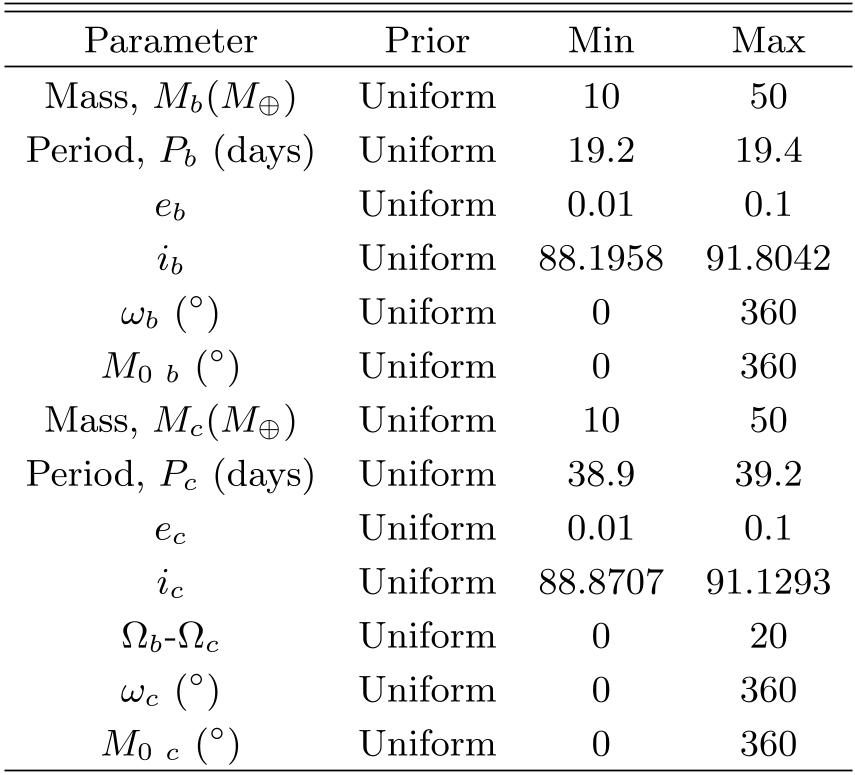
The algorithm launches 15 parallel MCMC chains with widely different "step sizes." Every 100 iterations, these chains swap their settings. This creates a "scout and refine" dynamic: some walkers act as explorers looking for new islands, while others act as settlers refining the current peak.
Results: The Linear Ridge of Degeneracy
When applied to Kepler-9 b and c, the algorithm didn't find one solution—it found 40. These solutions aren't random; they form a perfect linear ridge in the mass-mass plane.
- Mass of Kepler-9 b: Ranges from 31.6 to 47.1 .
- Mass of Kepler-9 c: Ranges from 21.8 to 32.3 .
- Consistency: Across all 40 solutions, the ratio remains roughly 1.45.
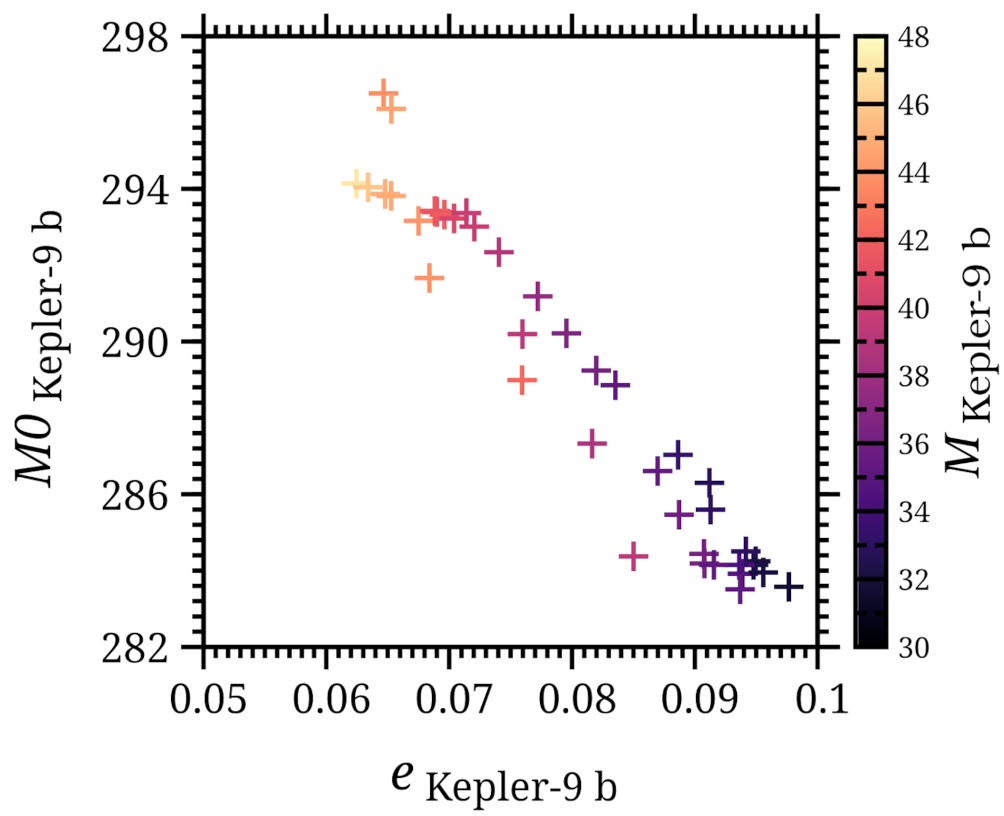
As shown in the figure above, previous landmark studies (labeled D14, W18, B19) fall perfectly onto this ridge. The "precision" they reported wasn't a measurement of the planet's true mass, but rather the width of a single spiky mode in a much larger, degenerate landscape.
Deep Insight: Visualizing the Likelihood Surface
The paper includes a manually constructed "corner plot" using 78 million synthetic TTV evaluations to prove why global convergence is practically impossible for standard tools.
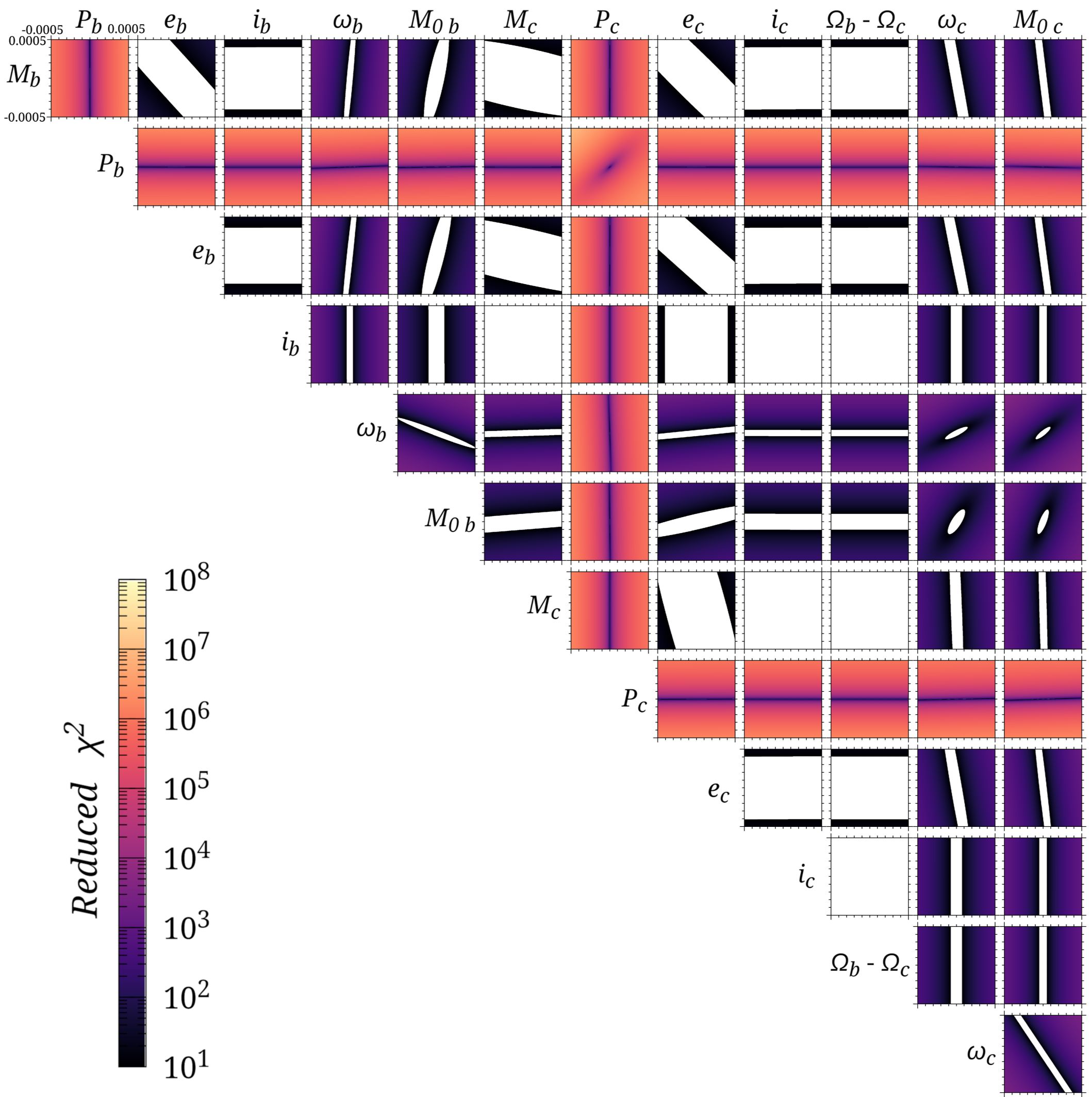
Notice the "white regions" in the plot above. They represent the tiny areas where the fit is actually good (). These shapes are highly non-Gaussian; they are long, thin, and angled. Standard MCMC ellipses are a poor fit for this "spiky" reality.
Critical Analysis & Conclusion
This work serves as a high-level "warning shot" to the exoplanet community. If Kepler-9—the gold standard of TTV data—suffers from 50% mass uncertainty, then other systems with lower-quality data are likely even less understood than we think.
Key Takeaways:
- Convergence is often local: A "pretty" Gaussian corner plot is not proof that you have found the only solution.
- The Mass Ratio is the True Signal: In resonant two-planet systems, TTV essentially only tells us the ratio of the masses, not the absolute values.
- Algorithm Matters: For high-dimensional astronomy problems, traditional Markovian MCMC might be less effective than "mode-searching" strategies that embrace non-convergence to map the global topology.
The absolute masses of the planets in the Kepler-9 system are, effectively, undetermined once again.