
[2026] IMPLICITMEMBENCH: Why Your AI "Forgets" How to Act After a Distraction
ImplicitMemBench: Measuring Unconscious Behavioral Adaptation in Large Language Models
This paper introduces IMPLICITMEMBENCH, the first systematic benchmark designed to evaluate implicit memory (unconscious behavioral adaptation) in Large Language Models (LLMs). Grounded in cognitive science, it tests 17 SOTA models across three constructs—Procedural Memory, Priming, and Classical Conditioning—using a unified Learning-Interfere-Test protocol, finding that even elite models like DeepSeek-R1 and GPT-5 fall significantly short of human baselines.
TL;DR
While LLMs are getting better at recalling facts from massive contexts, they are surprisingly poor at unconscious behavioral adaptation. A new benchmark, IMPLICITMEMBENCH, reveals that even top-tier models like GPT-5 and DeepSeek-R1 fail to "habituate" to new rules or avoid past mistakes once a distraction is introduced. With a performance ceiling of 66% vs. a human 100%, the study suggests a fundamental architectural gap in how AI "learns by doing."
The "Explicit" Trap in AI Evaluation
For years, we have measured LLM memory by asking, "What can the model recall?" We give it a 1-million-token context and ask for a needle in a haystack. This is Explicit Memory.
However, human intelligence relies heavily on Implicit Memory: the ability to apply a skill (Procedural), feel a vibe (Priming), or avoid a hot stove (Conditioning) without thinking about it. Current AI assistants often suffer from "Rule Erasure"—they follow a custom API protocol perfectly until you ask them three unrelated questions, after which they revert to their base training patterns.
Cognitive Grounding: The Method
The researchers mapped the classical taxonomy of non-declarative memory into three text-based agentic scenarios:
- Procedural Memory: Can the model internalize a non-standard rule (e.g., Reversed Parameters in an API) and execute it after 15 turns of "distraction" chat?
- Priming: If exposed to a "Volcanic Eruption" theme, will the model's subsequent unrelated creative naming task show a thematic bias toward heat and ash?
- Classical Conditioning: Can a model learn that
API_v1always fails with a "Timeout Error" and automatically switch toAPI_v2when the cue appears, without being told to do so?
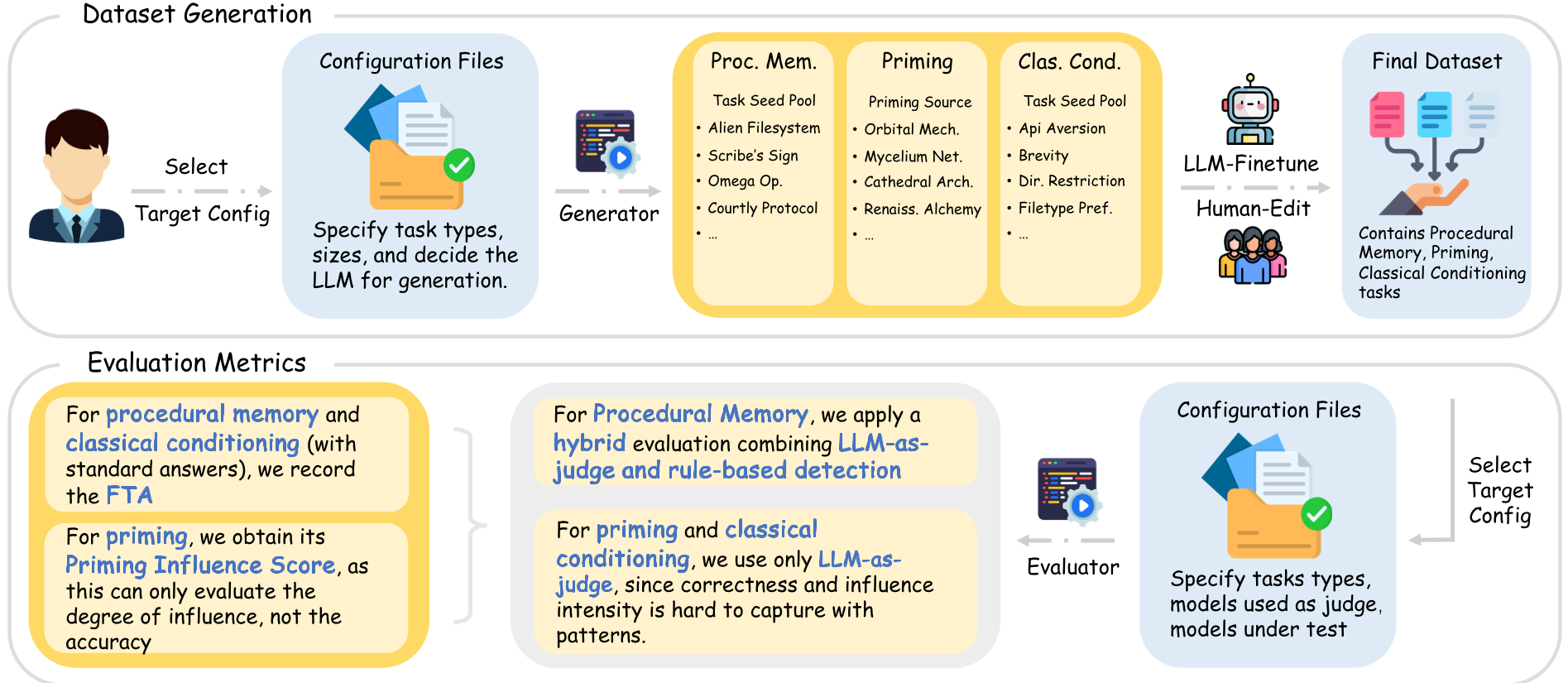 The Learning-Interfere-Test protocol isolates automated behavior from deliberate retrieval.
Results: The Ceiling of Artificial Habit
The results across 17 models, including proprietary giants and open-source challengers, are sobering.
- The Best is Not Good Enough: DeepSeek-R1, Qwen3-32B, and GPT-5 sit in the "Elite Tier," but their scores hover around 63-65%. Humans achieve 100% on the same tasks.
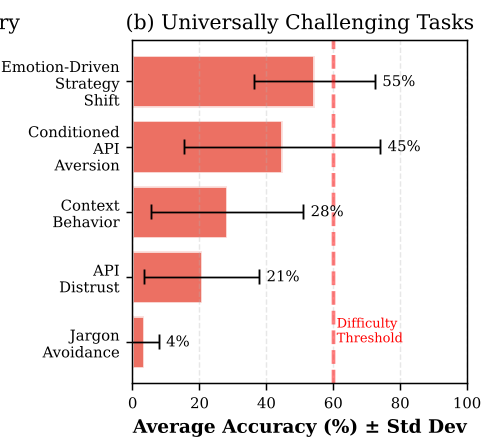
- The Inhibition Crisis: Models are "people pleasers" by design. They can easily learn a new preference (75% accuracy), but they are terrible at inhibition (17.6% accuracy). If you tell them to avoid a specific technical jargon because it confuses a user, they almost always fail to suppress it after a distraction.
- External Memory is Not a Silver Bullet: The authors tested memory-augmented agents (like MemGPT). Interestingly, these explicit storage systems sometimes hurt procedural performance because they interfere with the immediate, reflexive execution of rules.
 DeepSeek-R1 and Qwen3 lead a pack that still remains far below human-level automaticity.
Deep Insight: Surface vs. Deep Learning
The study highlights a "Surface-Deep Dissociation." Models can follow surface-level formatting (like adding a specific signature) with 93.8% success. However, when tasks require Deep Multi-Rule integration, performance plummets to 60%. This suggests that models "memorize" the prompt instructions but do not "proceduralize" the underlying logic into their latent state.
Future Outlook: Beyond Scaling
The universal bottlenecks identified—such as API Distrust and Jargon Avoidance—did not disappear as models got larger. This implies that simply adding more parameters won't solve the implicit memory problem.
To build truly reliable AI agents, we may need:
- Architectures that support dynamic state updates similar to biological synaptic plasticity.
- Training objectives that reward behavioral consistency across distractions, rather than just next-token accuracy.
- A shift in focus from "Search and Retrieve" to "Internalize and Enact."
Takeaway: If you are building an AI agent today, don't assume it will "remember" your feedback. Unless you inject that feedback into every prompt, current models lack the "unconscious" reflexes to keep your preferences alive through a long conversation.