
IR-Flow: Redefining Image Restoration by Bridging Generative and Discriminative Paradigms
IR-Flow: Bridging Discriminative and Generative Image Restoration via Rectified Flow
This paper introduces IR-Flow, an image restoration framework based on Rectified Flow that bridges discriminative regression and generative paradigms. By utilizing linear transport flows between degraded and clean image domains, IR-Flow achieves state-of-the-art results in tasks like deraining and denoising with only 1-4 sampling steps.
TL;DR
IR-Flow is a novel framework that treats image restoration as a direct transport problem. By shifting from noisy SDE-based diffusion to linear ODE-based Rectified Flows, it achieves superior perceptual quality and structural fidelity with as little as a single inference step, outperforming traditional transformers and diffusion models in both speed and accuracy.
Background: The Generative vs. Discriminative Dilemma
In the world of image restoration (IR), researchers have long been caught between two worlds:
- Discriminative Mapping: Models like Restormer or MPRNet learn to predict the "average" clean image. This results in high PSNR (low distortion) but "blurry" textures (poor perception).
- Generative SDEs (Diffusion): Models like IR-SDE generate sharp textures by reversing noise. However, they require hundreds of steps and struggle with "noise-residual coupling," making them computationally expensive.
IR-Flow bridges this gap. It asks: What if we don't turn the image into noise, but instead create a straight-line path (Flow) directly from the rainy/noisy image to the clean one?
Methodology: The Power of Straight Paths
The core of IR-Flow is Rectified Flow. Instead of the complex curved trajectories of Diffusion models, IR-Flow enforces a linear transport path .
1. Cumulative Velocity Field (CVF)
Standard flows learn the tangent direction (instantaneous velocity). IR-Flow introduces Cumulative Velocity, which points directly from any intermediate state toward the target.
- Physical Intuition: If a tangent is like following a compass that changes every meter, CVF is like seeing the lighthouse and walking straight toward it.
- Efficiency: The authors prove that CVF reduces kinetic energy by 3x compared to standard fields, leading to much faster convergence.
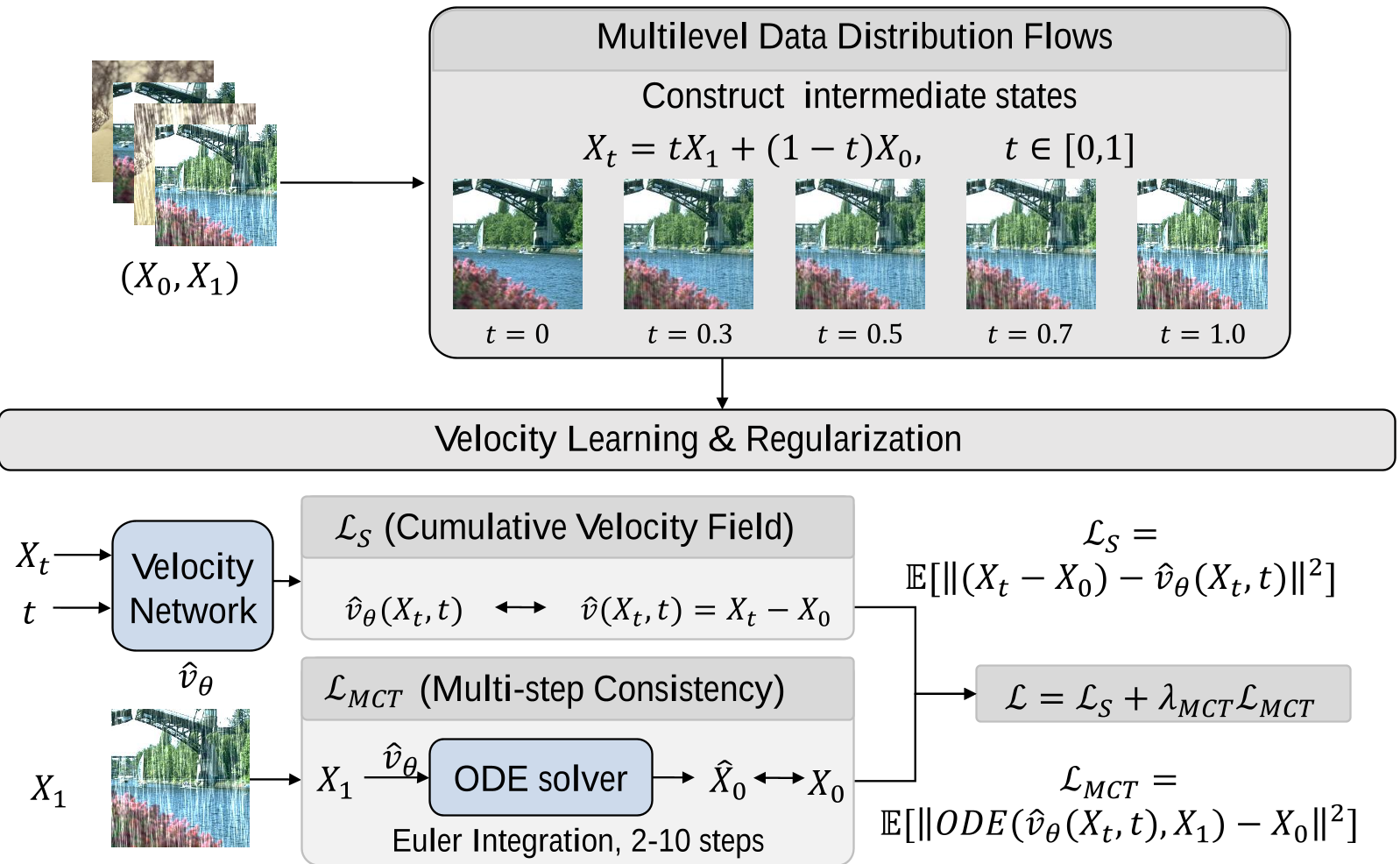
2. Multi-step Consistency Training (MCT)
To ensure the model stays on the "straight-line" path during inference, the authors add a consistency constraint. This forces the output of a 2-step or 4-step solver to match the 1st-order solution, ensuring high performance even with minimal sampling.
Experimental Performance: SOTA Results
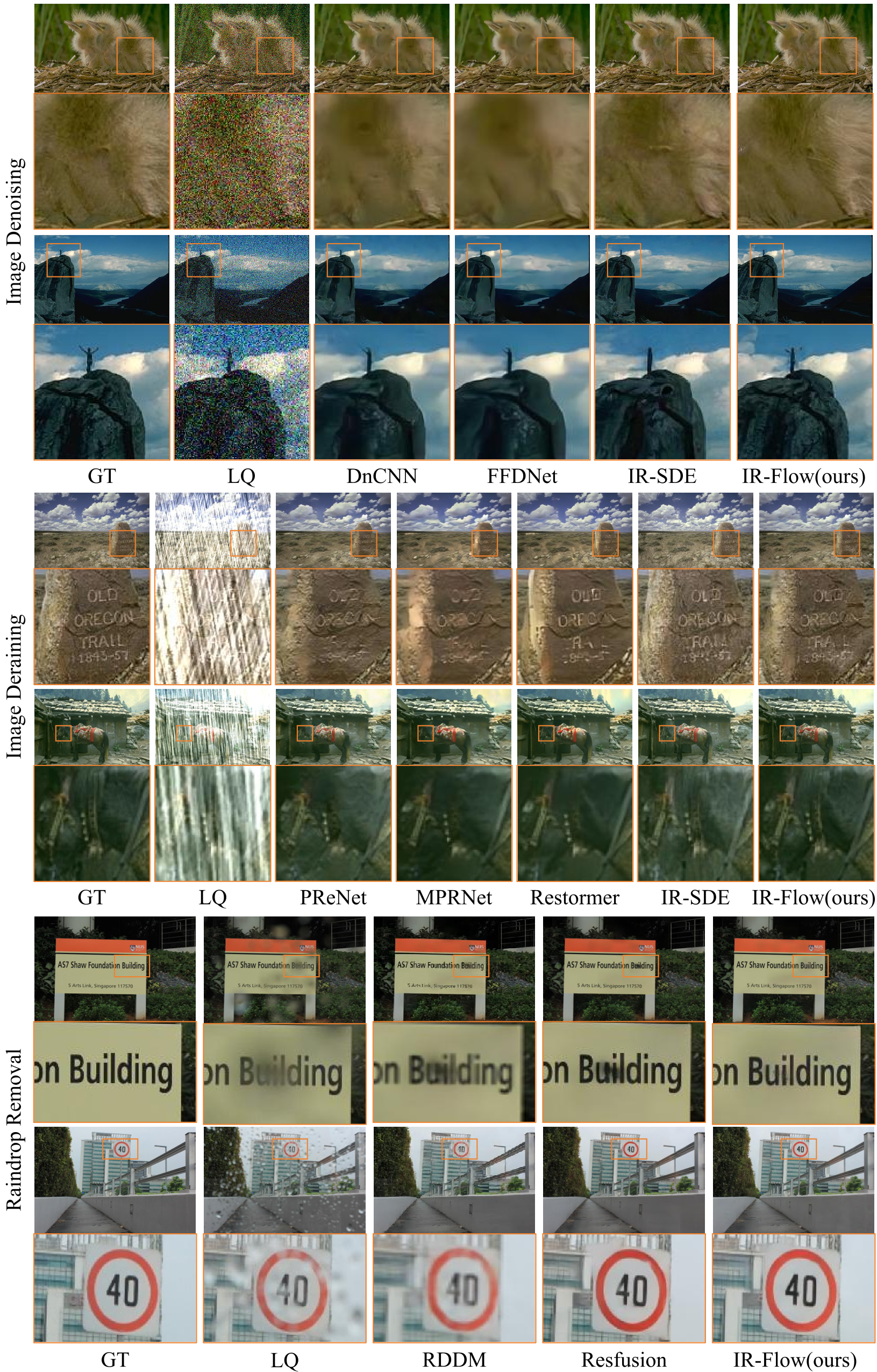
IR-Flow was tested across deraining, denoising, and raindrop removal.
- Deraining (Rain100H): IR-Flow reached 32.69 dB PSNR in 1 step, significantly higher than the previous SDE-based SOTA (IR-SDE at 31.65 dB).
- Efficiency: At an inference time of 0.07 seconds, it is roughly 100 times faster than IR-SDE and 4-7 times faster than other recent diffusion-based competitors like Resfusion.
The Perception-Distortion Balance
One of the most striking results is the model's flexibility. By increasing the number of steps from 1 to 4, the LPIPS (perceptual metric) improves while PSNR stays stable, allowing users to choose between pixel accuracy and visual "crispness."
Critical Analysis & Conclusion
IR-Flow successfully demonstrates that the "Gaussian noise" assumption in diffusion isn't always necessary for image restoration. By constructing multi-level data distribution flows, the model gains a better "Inductive Bias" for handling different degradation levels.
Limitations: The model currently relies on supervised pairs. In real-world scenarios where paired data is scarce, the method’s performance might drop. Future work involving self-supervised learning or joint text-image guidance (for semantic restoration) is the next logical frontier.
Takeaway: IR-Flow is more than an incremental improvement; it is a unified framework that proves that "shorter, straighter trajectories" are the key to real-time, high-fidelity generative restoration.