
JoyAI-RA: Bridging the Embodied Gap with Multi-Source Pretraining
JoyAI-RA 0.1: A Foundation Model for Robotic Autonomy
JoyAI-RA 0.1 is a Vision-Language-Action (VLA) foundation model designed for generalizable robotic manipulation. It utilizes a multi-source pretraining framework (web, human egocentric videos, simulation, and real-robot data) and an action-space unification strategy to achieve SOTA performance on RoboTwin 2.0 (90.48% success) and RoboCasa (63.2% success).
TL;DR
JoyAI-RA 0.1 is a new foundation model for robotic manipulation that tackles the "data scarcity" and "embodiment gap" problems simultaneously. By unifying web data, human egocentric videos, and simulated/real robot data into a single training pipeline, it achieves State-of-the-Art (SOTA) results across major benchmarks, including a 90.48% success rate on RoboTwin 2.0 and significant gains in complex real-world tasks on the AgiBot G1 platform.
The Core Challenge: Why Robots Can't "Just Learn" from Humans
Building a generalist robot is difficult because high-quality robot data is expensive to collect. While we have millions of hours of human videos, a robot's hardware (arms, grippers, dexterous hands) is fundamentally different from a human's. This embodiment gap prevents simple imitation. Furthermore, most models struggle with "long-tail" scenarios where the environment changes slightly from the training data.
Methodology: The JoyAI-RA Recipe
The researchers at Joy Future Academy and JD proposed a three-pillar solution:
1. Unified Action Space
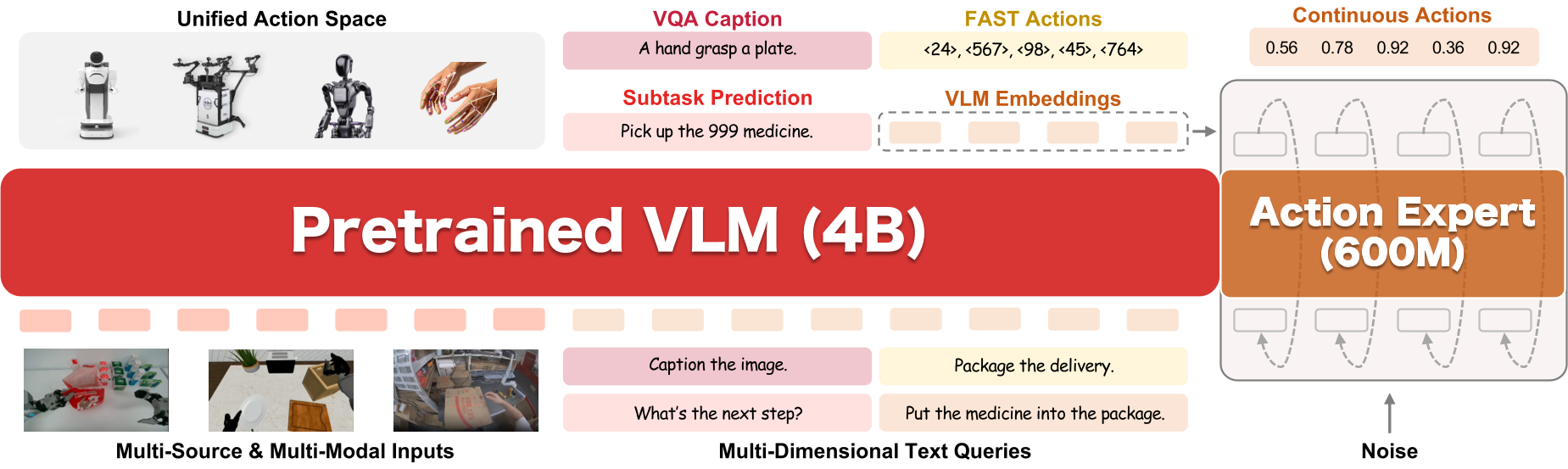
To treat human, simulation, and robot data as "one," JoyAI-RA maps all actions into a Camera-Frame End-Effector Representation. By using a 6-DoF pose (translation + axis-angle rotation) relative to the camera rather than the robot's base, the model learns spatial relationships that are independent of the specific robot's limb lengths or joint configurations.
2. The EgoLive Dataset
The authors introduced EgoLive, a massive in-house egocentric human manipulation dataset featuring 1,969 object categories. Using hand-pose estimation, they retargeted human movements to robot embodiments, providing a bridge between human "intent" and robotic "execution."
3. Perception-Action Expert (Perceiver-Based)
Instead of a simple MLP head, JoyAI-RA uses a Perceiver-based action expert that employs Flow-Matching. This allows the model to generate smooth, continuous, and temporally consistent action sequences rather than jittery discrete steps.
Experimental Performance
The model was put to the test in both virtual and physical worlds:
- RoboTwin 2.0: In "Hard" settings with randomized lighting and clutter, JoyAI-RA hit an 89.28% success rate, outperforming the previous SOTA (Motus) by over 2%.
- RoboCasa: On tasks involving complex dexterous hands (like putting milk in a microwave), it achieved a 63.2% success rate, a massive jump over ABot-M0 (58.3%).
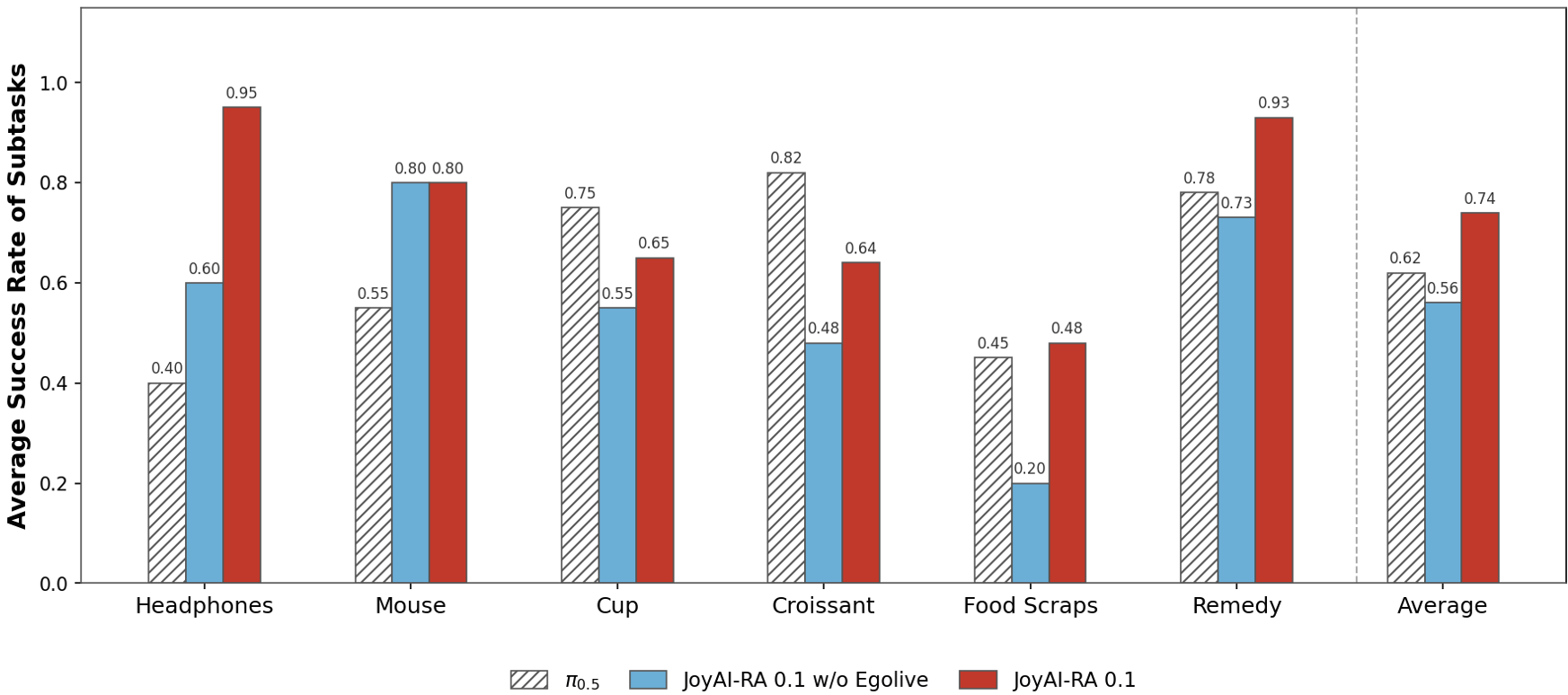
- Real-World AgiBot: In 5 house-hold scenarios, JoyAI-RA demonstrated superior "semantic grounding"—successfully identifying and hanging headphones or packaging remedies where other models failed.
Deep Insight: The Value of Human Data
One of the paper's most critical findings is the scaling law of egocentric data. Ablation studies showed that while 10% of the EgoLive dataset provided some benefit, the full dataset led to a 6% boost in average success. This confirms that for robotics, "visual common sense" from human videos is just as important as physical "muscle memory" from robot trials.
Conclusion & Future Outlook
JoyAI-RA 0.1 proves that a structured, multi-level pretraining strategy can effectively bypass the data bottleneck in robotics. However, the authors note that long-horizon sequential manipulation (like cleaning food scraps) remains a challenge, suggesting that future iterations might need stronger reasoning capabilities or hierarchical planning. This work sets a solid foundation for the next generation of humanoid robots capable of operating in unconstrained, open-world environments.