
JUMPLORA: Master of Sparsity—Solving Task Interference in LLM Continual Learning
JumpLoRA: Sparse Adapters for Continual Learning in Large Language Models
JUMPLORA is a novel framework for rehearsal-free Continual Learning (CL) in LLMs that adaptively induces coordinate-wise sparsity in LoRA adapters using learnable JumpReLU gating. By dynamically isolating task-specific parameters, it achieves SOTA performance on major benchmarks, significantly outperforming previous methods like ELLA.
TL;DR
Catastrophic forgetting remains the "Achilles' heel" of Large Language Models (LLMs) when learning new tasks sequentially. JUMPLORA introduces a paradigm shift by moving from dense updates to adaptive sparse updates. By integrating a learnable JumpReLU gating mechanism into LoRA blocks, the model learns not just what to update, but where to update with surgical precision. It achieves state-of-the-art results on classic and long-sequence benchmarks by ensuring task-specific parameters remain effectively isolated.
The Stability-Plasticity Dilemma
In the world of Continual Learning (CL), models face a trade-off: they must be plastic enough to learn new info but stable enough to keep the old. Standard Low-Rank Adaptation (LoRA) is efficient, but because its updates are dense, even a tiny change can "overwrite" previously learned knowledge across many coordinates.
Current SOTA methods like ELLA use coordinate-wise penalties to restrict updates. However, they still operate in a "dense regime" where parameters are shared and contested. JUMPLORA’s insight is simple but powerful: If two tasks don't share the same weight coordinates, they can't interfere.
Methodology: The Magic of JumpReLU Gating
The core innovation is the repurposing of JumpReLU. Traditionally used for activations, JUMPLORA applies it to the weight update .
1. The Thresholding Mechanism
The model learns a threshold . If a weight update's magnitude is below , it is dropped. This forces the model to focus on the "top-magnitude" elements that are most relevant to the current task.
2. The Interpolation Schedule
You can't just start with a threshold—it would kill the gradient at because LoRA matrices are often initialized to zero. JUMPLORA uses a convex interpolation: is annealed from 0 to 1, allowing the model to "explore" the weight space before committing to a sparse mask.
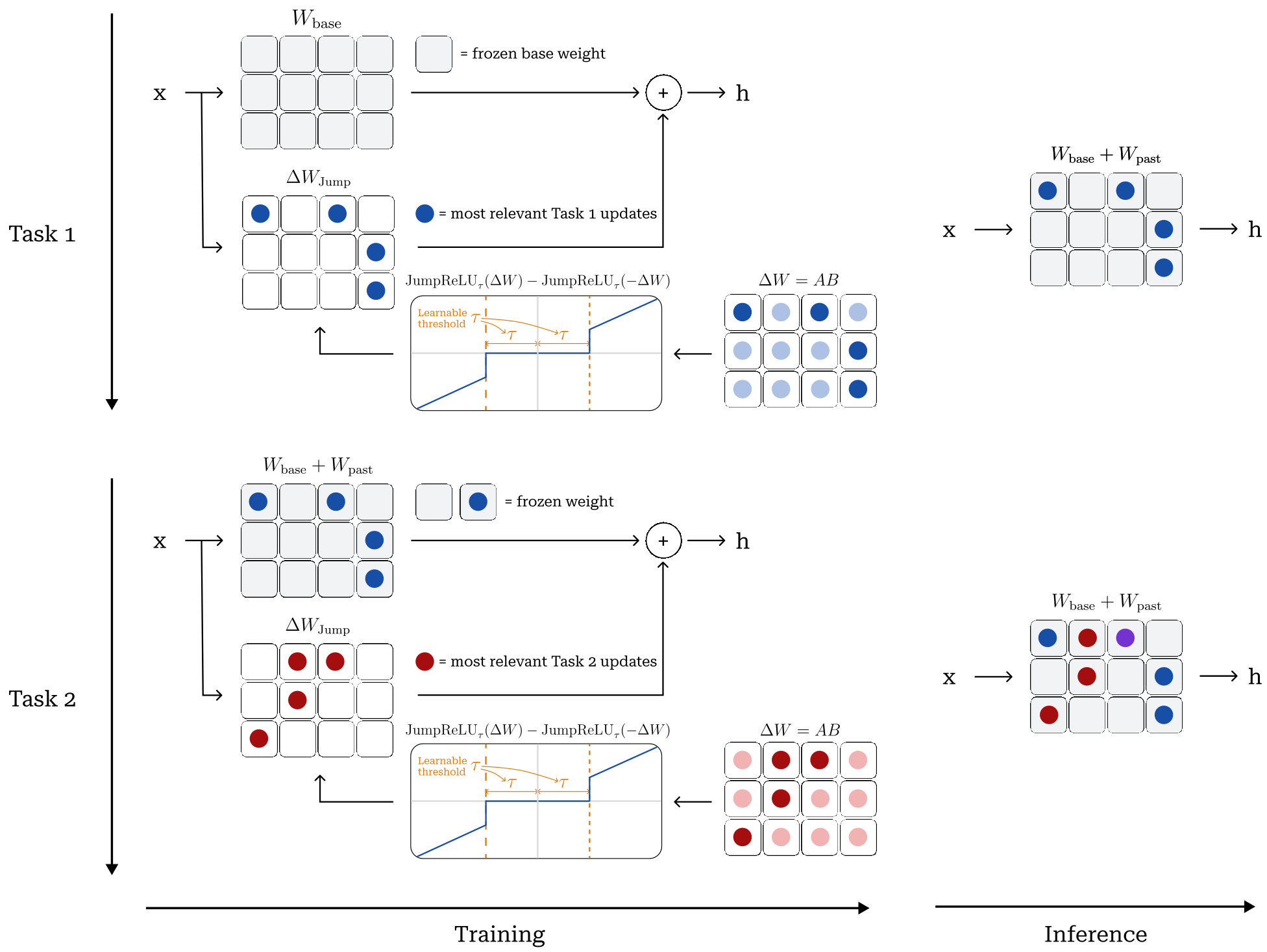 Figure 1: The JUMPLORA workflow showing how JumpReLU cuts off low-magnitude updates to minimize interference.
Experiments: Proving the Power of Isolation
JUMPLORA was tested against IncLoRA (naive sequential LoRA) and ELLA (the reigning SOTA) across two major benchmarks: Standard CL (SC) and the grueling 15-dataset Long Sequence (LS) benchmark.
Key Stats:
- Baseline Boost: JUMPLORA elevated IncLoRA's performance by nearly 8% on the LS benchmark without any extra regularization.
- SOTA Advancement: When combined with ELLA, it consistently outperformed standalone ELLA, achieving the highest Overall Accuracy (OA) across all task orders.
- Minimal Overlap: Analysis showed a Jaccard overlap of just 0.012 between task adapters, proving that JUMPLORA effectively creates "disjoint" knowledge silos within the model.
 Table 1: JUMPLORA vs. Baselines. Note the consistent lead in Overall Accuracy (OA).
Deep Insight: Why Sparsity Wins
The study of sparsity evolution (Figure 4 in the paper) reveals that JUMPLORA maintains high sparsity even in deeper layers of the Transformer. This prevents "capacity saturation"—a common problem where a model runs out of "un-interfered" space as the number of tasks grows. By using a learnable threshold rather than a fixed sparsity ratio, JUMPLORA allows each layer to decide its own level of intervention based on task complexity.
Conclusion & Future Outlook
JUMPLORA proves that parameter isolation through sparsity is a robust defense against catastrophic forgetting. It is modular (works with any LoRA variant) and computationally efficient.
Future Directions: The authors suggest this could be a game-changer for Vision Transformers (ViT) and multi-modal models where task-specific "features" are even more distinct. In the race to build truly lifelong-learning AI, JUMPLORA is a significant leap toward models that grow without overwriting.
Senior Editor's Note: JUMPLORA’s use of Straight-Through Estimators (STE) to train the threshold is a clever solution to the non-differentiability of the Heaviside step function. This work effectively bridges the gap between architectural isolation and parameter-efficient fine-tuning.