
LATENTFT: The Structural Equalizer for Generative Music
Latent Fourier Transform
Wang et al. introduce LATENTFT, a framework for controllable music generation that applies a Fourier Transform to the latent space of a diffusion autoencoder. By training with frequency-masking on latent vectors, the model achieves SOTA performance in timescale-specific music editing and blending, allowing users to manipulate structural patterns like chords and rhythms with the precision of an equalizer.
TL;DR
Researchers from MIT have unveiled LATENTFT, a novel framework that brings "Equalizer-like" control to the structural elements of music. By applying a Fourier Transform to the latent space of a diffusion model, the system allows users to isolate and manipulate musical patterns based on their timescale—such as keeping the chord progression of one song while adopting the rhythmic "flutter" of another.
Context: The Problem with Hierarchy
In the current generative landscape, we often talk about "coarse-to-fine" generation. Models like MusicLM or AudioLM generate high-level structures first and then fill in the details. However, these layers are often tangled. If you try to change the "fine" details of a song, you often inadvertently break the "coarse" harmony.
The authors argue that we lack a continuous, intuitive axis for timescale. Music is inherently multiscale:
- Slow scales (< 1 Hz): Chord progressions and global structure.
- Mid scales (1-5 Hz): Main rhythm and beat.
- Fast scales (> 5 Hz): Trills, textures, and transients.
Methodology: Fourier Meets Latent Space
The core innovation is treating the latent representation not as a static vector, but as a time series that can be decomposed via the Discrete Fourier Transform (DFT).
The Workflow
- Encode: Audio is turned into a sequence of latent vectors .
- Transform: A DFT is applied to to create a Latent Spectrum.
- Mask & Learn: During training, parts of this spectrum are randomly "blacked out." The decoder (a diffusion model) must learn to "hallucinate" the missing musical components based only on the remaining frequencies.
- Invert: An Inverse DFT brings the modified spectrum back to the time domain for the final audio synthesis.

Why It Works: The "Inductive Bias" of Orthogonality
Because Fourier components are orthogonal, changing one frequency does not theoretically affect others. This provides a natural separation of concerns—a "Structural EQ" where the knobs control musical events rather than just audio pitch.
Experiments and Results
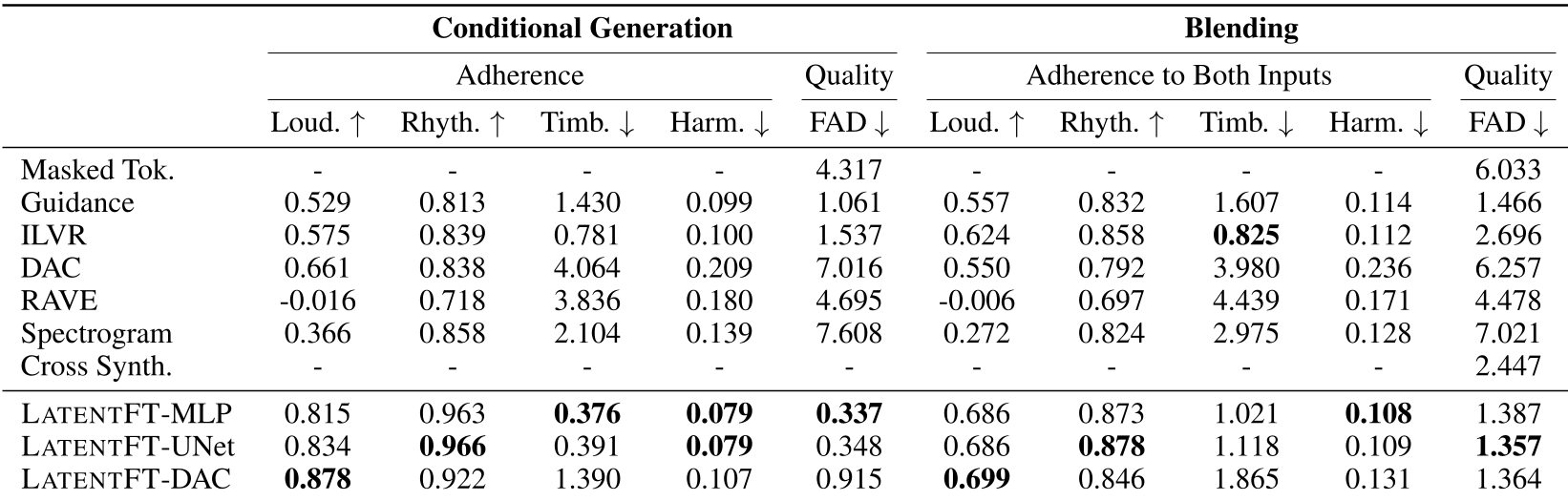
The authors tested LATENTFT against heavyweights like ILVR and VampNet. The results in the table below show a clear lead in "Adherence"—meaning the model actually follows the timescale constraints the user sets.
Key Application: Musical Blending
One of the most impressive feats is Blending. You can take a Jazz track (Reference 1) and a Techno track (Reference 2). By selecting the low-frequency latents from Jazz and high-frequency latents from Techno, the model generates a track with Jazz's chord structure but Techno's rapid-fire percussion.
Critical Insight: Interpreting the Latent Spectrum
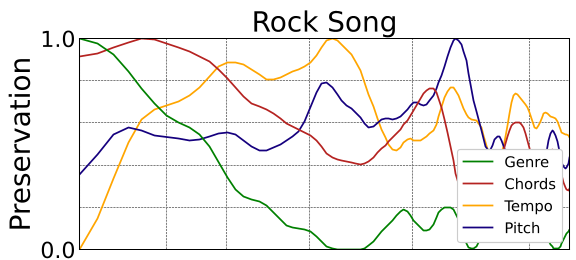
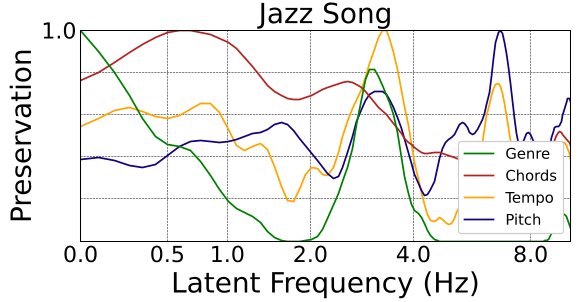
Perhaps the most fascinating part of the research is the "Preservation Curves." The authors mapped where specific musical concepts live within the latent spectrum:
- Genre is global (centered at 0 Hz).
- Chords live in the ultra-low frequencies (< 1 Hz).
- Pitch and Tempo reside in the higher frequencies (often multiples of the BPM).
Conclusion
LATENTFT is a significant step toward interpretable AI music production. By moving away from "black box" latent vectors and toward the frequency domain, it gives creators a familiar, EQ-style interface for complex generative tasks.
Limitations: The current model operates on short clips (approx. 6 seconds) and requires significant GPU memory when using raw audio frontends like DAC. However, the framework itself is architecture-agnostic and paves the way for real-time generative "remixing."