
[CVPR 2025] LiVER: Beyond Pixels — Mastering Physically Accurate Lighting in Video Generation
Lighting-grounded Video Generation with Renderer-based Agent Reasoning
LiVER is a scene-controllable video generation framework that achieves physically accurate lighting, layout, and camera control by conditioning a Latent Diffusion Model (Wan2.2-5B) on a 3D-rendered scene proxy. It achieves state-of-the-art results in temporal consistency and photorealism, significantly outperforming existing controllable models like CameraCtrl and MotionCtrl.
Executive Summary
TL;DR: LiVER (Lighting-grounded Video genERation) is a novel framework that moves beyond simple text-to-video by grounding generation in the laws of physics. By using a 3D-renderer-based agent to generate "scene proxies" (diffuse and specular reflections), it enables precise control over lighting, layout, and camera trajectories that were previously "entangled" and uncontrollable in standard diffusion models.
Positioning: This work is a significant "System-level Innovation" that bridges the gap between traditional 3D Graphics (CGI) and modern Generative AI (Diffusion Models). It sets a new SOTA for controllable video generation, particularly for professional filmmaking and virtual production.
Problem & Motivation: The Illusion of Reality
While models like Sora or Wan2.2 produce stunning visuals, they often fail the "physicality test." Shadows don't move correctly with the light source, and reflections on metallic surfaces often look like painted textures rather than dynamic light interactions.
The core bottleneck is that current models treat lighting as part of the "style" or "pixel pattern" rather than a result of geometry and material properties (BRDF). Previous attempts at 3D-grounding focused mostly on bounding boxes or depth maps, ignoring the complex interplay of light bouncing off surfaces (Rough vs. Glossy reflections).
Methodology: The Core Architecture
LiVER introduces a two-part solution: a reasoning agent and a physically-grounded synthesis pipe.
1. The Renderer-based Agent
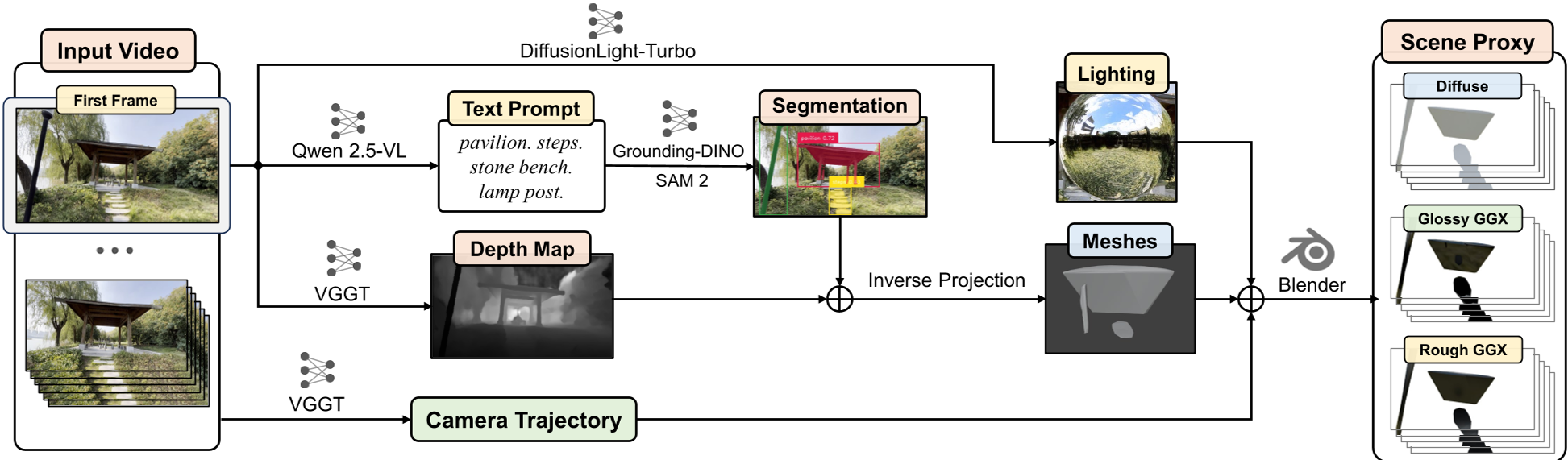
Instead of asking the user to be a 3D artist, LiVER uses an LLM-based agent. When a user says "A golden robot walking in warm sunset," the agent:
- Retrieves 3D mesh assets.
- Sets up an HDR environment map for "warm sunset."
- Plans a camera path.
- Crucially, it renders the scene into three 2D passes: Diffuse, Glossy GGX, and Rough GGX.

2. Lighting-Aware Injection
These three passes (9 channels total) act as a "Physical Proxy." A lightweight Conditional Encoder processes these passes and injects them into the Latent Space of the Wan2.2-5B model. This ensures that the generated pixels aren't just pretty—they follow the shading cues provided by the renderer.
Experiments & Results: Setting the Standard
The authors curated LiVERSet, a dataset of 11,000 videos including both real-world footage (with reconstructed 3D metadata) and synthetic PBR renders.
SOTA Comparison
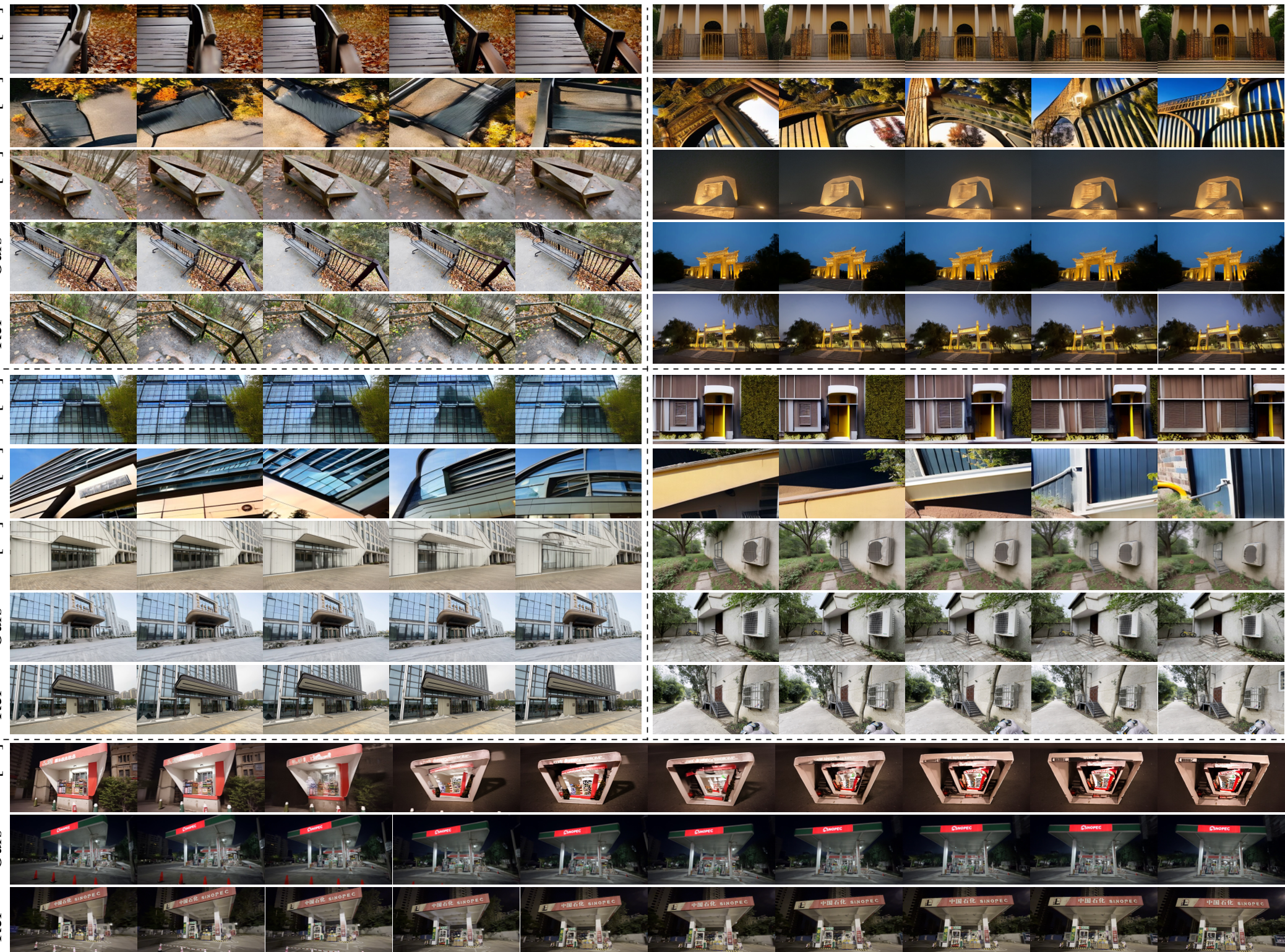
LiVER smokes previous baselines in both quality and control. Specifically:
- FVD (Quality): Down to 32.56 from CameraCtrl’s 48.03.
- mIoU (Layout): Reached 0.87, showing the model strictly follows the geometric proxy.
- Lighting Stability: Captured the lowest "Lighting Instability" (LI) score, meaning shadows don't flicker between frames.
Ablation Insight
A key finding was the three-stage training. Training everything at once led to "frozen" videos. By training the proxy encoder first, then adding LoRA, and finally mixing real/synthetic data, the model learned to respect the 3D laws without losing the creative "juice" of the base diffusion model.
Critical Analysis & Conclusion
Takeaway
LiVER proves that we don't need a pure "3D Transformer." Instead, using 2D Intermediate Proxies (like GGX passes) acts as a universal language that links the rigorous math of 3D rendering with the flexible generation of Diffusion Models.
Limitations
The model is still somewhat dependent on the quality of the initial 3D reconstruction. If the agent picks a "coarse" mesh, the final video might lack fine structural details unless the prompt is highly descriptive.
Future Prospect
This work paves the way for a "Hybrid Film Engine," where directors can tweak a simplified 3D scene in Blender and have the AI instantly render it into a photorealistic cinematic shot, maintaining perfect lighting consistency.
Disclaimer: This analysis is based on the LiVER technical paper. Visuals are credited to the original authors from Peking University and partners.