
LiteResearcher: Small Models, Big Intelligence — Scaling Agentic RL for Deep Research
LiteResearcher: A Scalable Agentic RL Training Framework for Deep Research Agent
LiteResearcher is a scalable Reinforcement Learning (RL) training framework for Deep Research agents. It introduces a "virtual world" mirroring real-web dynamics to train a 4B parameter model that achieves SOTA results on GAIA (71.3%) and Xbench (78.0%), outperforming significantly larger models like Claude-4.5 Sonnet and Tongyi DeepResearch 30B.
Executive Summary
TL;DR: LiteResearcher is a breakthrough framework that proves a 4B parameter model can dominate the deep research landscape—traditionally the playground of giants like Claude and GPT-5. By building a high-fidelity local "replica" of the internet and applying difficulty-aware curriculum Reinforcement Learning, the authors achieved SOTA performance on GAIA and Xbench while slashing training costs from hundreds of thousands of dollars to nearly zero.
Background: In the academic landscape, this work marks a shift from "Scaling Laws of Parameters" to "Scaling Laws of Environment & Data." It moves beyond simple RAG (Retrieval-Augmented Generation) into a regime where the agent learns strategic search behaviors through autonomous exploration.
The Problem: The High Cost of "Real" Experience
Why haven't we seen a "DeepSeek-R1 moment" for research agents yet? The authors identify a fundamental "Agentic RL Bottleneck":
- Noise & Cost: Training on the live web is like training a pilot in a storm where every flight costs $1,000. High latency and non-deterministic web changes break the RL reward signal.
- Breadth vs. Depth: Most local simulators (like Wikipedia-only environments) are too "clean." They don't force the agent to learn "Atomic Search Capabilities" such as cross-verification, statistical aggregation, or multi-step enumeration.
Methodology: Building a Virtual High-Fidelity World
LiteResearcher solves this by creating a twin architecture of the internet that is isolated for execution but realistic in content.
1. The Data-Corpus Flywheel
Instead of hand-crafting logic, the authors scale the information source. They start with a seed corpus, generate QA pairs, and then perform "Information Source Masking"—deleting the source page to force the agent to find the answer through alternative, complex paths.
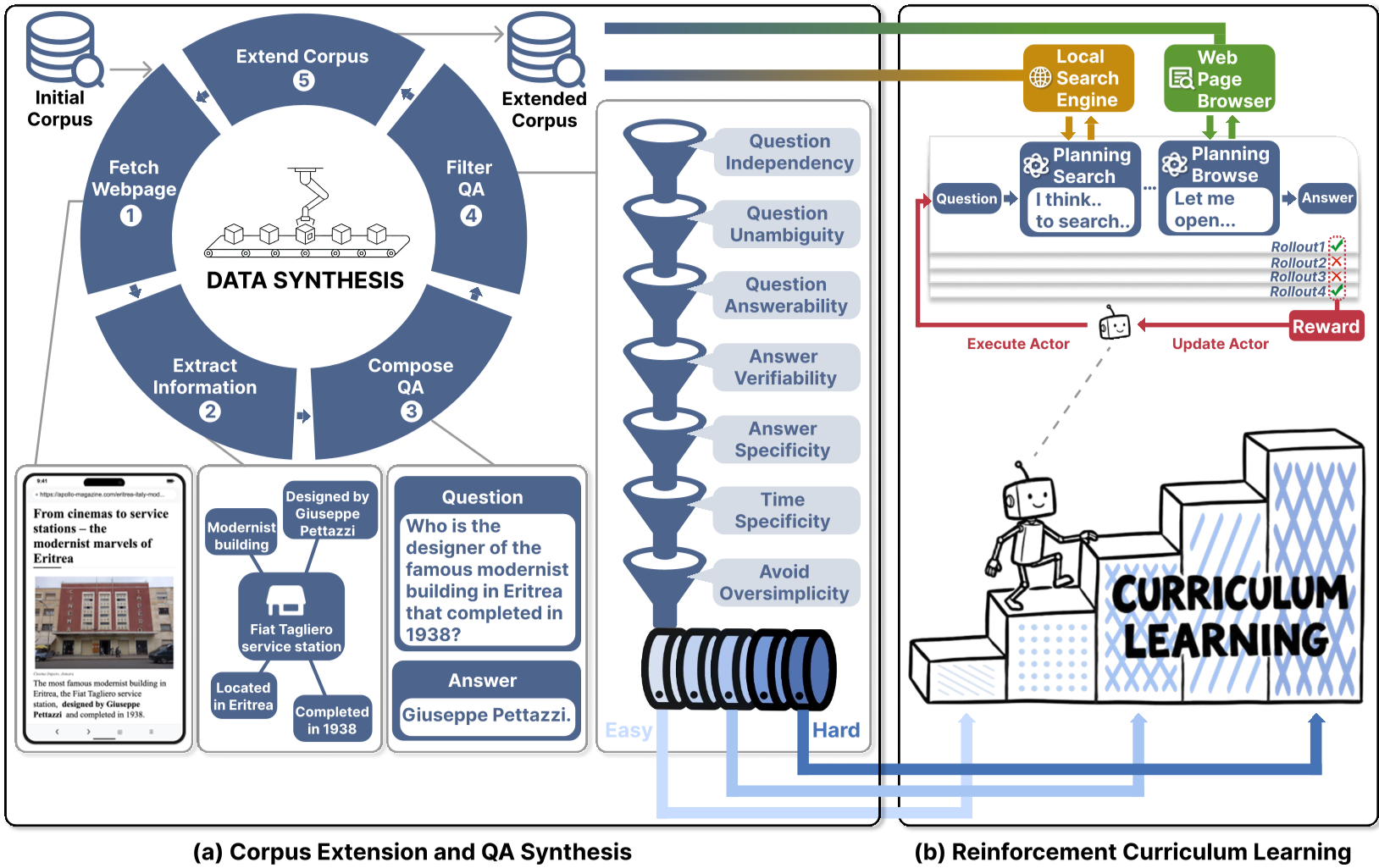 Figure 1: The LiteResearcher ecosystem, featuring the iterative corpus expansion and curriculum RL loop.
2. High-Throughput Local Tools
To support 73.2M tool calls during training, the team built:
- Local Search Engine: Powered by BGE-M3 and Milvus/DiskANN, achieving 0.15s per query (10x faster than Google/Serper).
- Local Browse Tool: Page-level Markdown storage in PostgreSQL, serving content 46x faster than Jina Reader.
3. Curriculum Learning & GRPO
The "Secret Sauce" is Difficulty-Aware Filtering. If the agent gets 8/8 rollouts right, the task is discarded (no gradient). If it gets 0/8 right, it's too hard. Training only focus on the "Goldilocks Zone" (1-7 correct answers), ensuring the model is always pushed to its limits without being overwhelmed.
Experiments: David vs. Goliath
The performance of the 4B model is startling. In the deep research benchmark Xbench-DS, it scored 78.0%, surpassing OpenAI-GPT-5-high (77.8%) and Claude-4.5-Sonnet (66.0%).
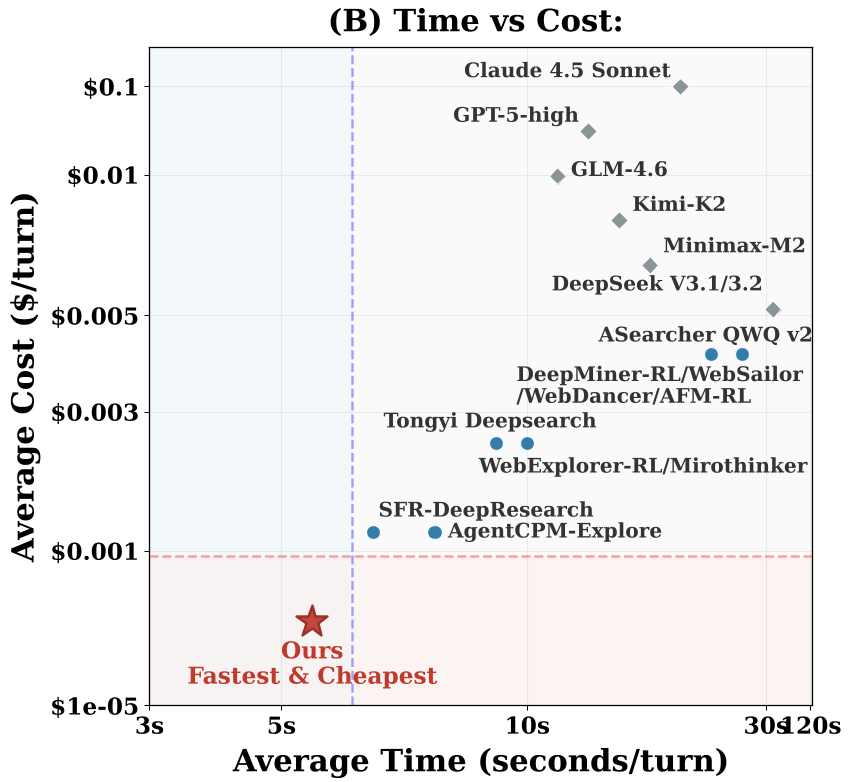 Figure 2: LiteResearcher-4B consistently outperforms models with significantly higher parameter counts across deep search benchmarks.
Key Insights from Ablation:
- On-Policy vs. Off-Policy: The study reveals that long-horizon search tasks are highly sensitive to policy lag. A strictly on-policy GRPO approach leads to more stable, monotonic improvement compared to standard mini-batch updates.
- Behavioral Correction: RL didn't just improve accuracy; it cured the "Repetitive Action Loop" syndrome. As training progressed, the mean number of turns dropped from 30 to 24, as the agent learned to stop "bumping into the same wall" and started exploring smarter paths.
Critical Analysis & Conclusion
Takeaway: LiteResearcher proves that for agentic tasks, the quality of the "Gym" (the environment) and the "Workout Plan" (the curriculum) are the true enablers of intelligence, not just the size of the "Brain" (parameters).
Limitations:
- Memory Constraints: At 4B parameters, the model still struggles with extremely long-context browsing (20+ pages) where summary-based memory mechanisms become necessary.
- Tool Breadth: The current framework focuses on Search and Browse; adding advanced tools like Python interpreters or multi-modal analysis would be the next frontier.
Future Outlook: The open-sourcing of this framework, including the 32M-page corpus and RL code, will likely democratize the development of "On-Device Deep Research" agents, moving us away from reliance on expensive, closed-source APIs.