
MWM: Predicting Geometry, Not Pixels - The Key to Robust Robot Policy Learning
Mask World Model: Predicting What Matters for Robust Robot Policy Learning
The paper introduces Mask World Model (MWM), a video-diffusion-based world model for robot manipulation that predicts future semantic masks instead of RGB pixels. By shifting the predictive target to geometric structures, MWM achieves state-of-the-art performance (98.3% success on LIBERO) while operating purely on raw RGB inputs at inference time.
TL;DR
Researchers have introduced the Mask World Model (MWM), a new paradigm for robot learning that swaps high-fidelity video prediction for semantic mask forecasting. By forcing the model to predict how object shapes and contact relations evolve—rather than worrying about reflections or background changes—MWM achieves a staggering 98.3% success rate on standard benchmarks and demonstrates unprecedented robustness in real-world scenarios.
The "Photometric Trap" in Robot Learning
Current SOTA robot policies often utilize "World Models" to imagine future outcomes before acting. However, most of these models are trained to predict RGB pixels.
While visually impressive, pixel prediction is inherently inefficient for control. Why? Because a robot doesn't need to know how the sun reflects off a metal table to pick up a spoon. In traditional models, lighting shifts or background movement are treated with the same importance as the actual movement of the robot arm. This leads to predictive drift: small appearance-driven errors accumulate, causing the robot to "lose its mind" when it encounters a different colored tablecloth or a dimmer room.
Methodology: The Geometric Information Bottleneck
MWM breaks this cycle by introducing a Geometric Information Bottleneck. Instead of predicting the next frame of a video, it predicts the next semantic mask.
1. The Architecture
The system follows a two-stage training protocol:
- Stage 1 (Mask Dynamics): A Diffusion Transformer (DiT) is trained to forecast future mask latents. It learns the "physics" of how objects move and interact.
- Stage 2 (Action Diffusion): A policy head is attached to the backbone. It doesn't just look at the current frame; it looks at the hierarchical features of the predicted mask sequence.
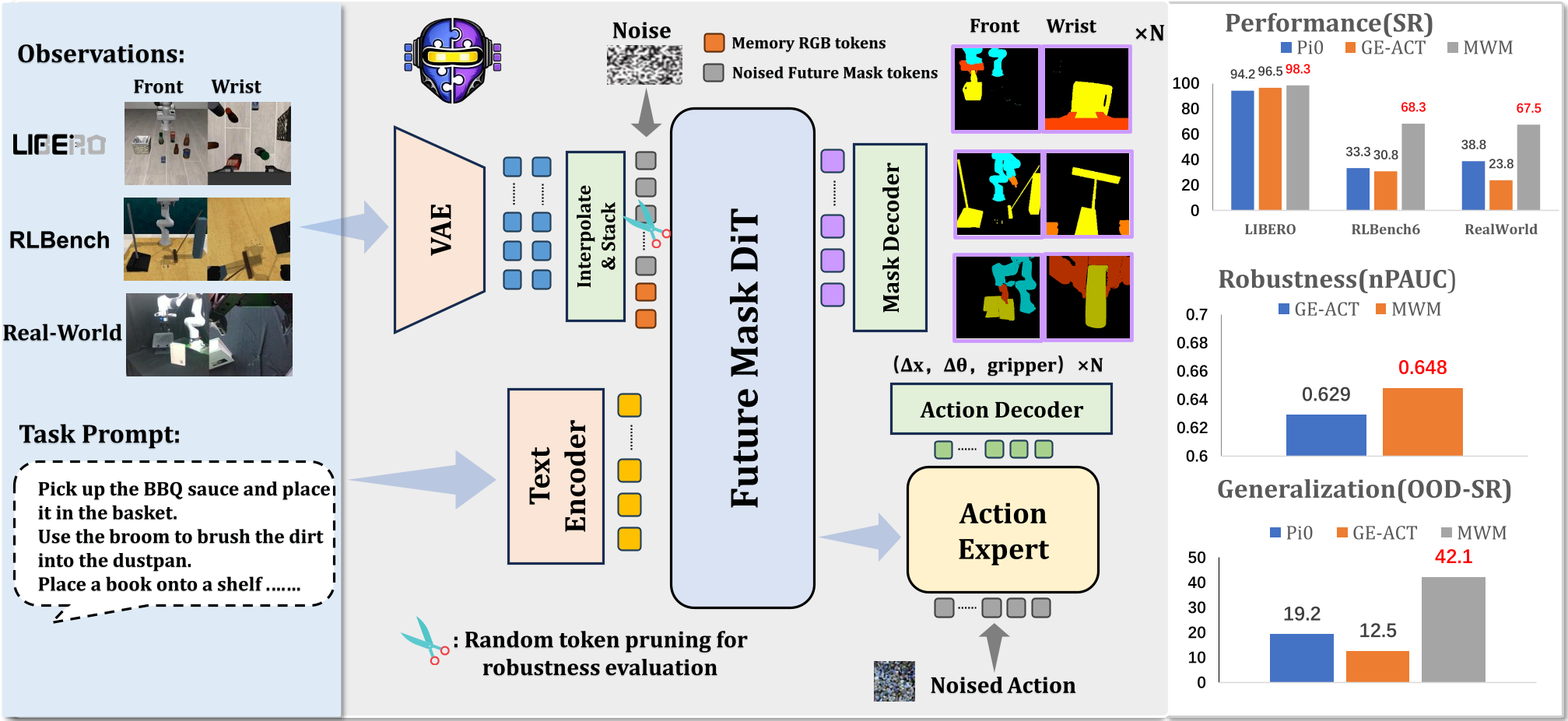 Figure 1: MWM uses semantic masks during training to teach the model dynamics, but operates on pure RGB at test time—no external segmenter needed.
2. The Clever Part: "Semantic Lookahead"
Crucially, MWM does not require a segmentation model during deployment. Because the backbone has learned the relationship between RGB inputs and semantic dynamics during training, it can extract "mask-centric" features directly from raw video at test time.
Proving Robustness: SOTA Performance
The researchers tested MWM against heavyweights like OpenVLA and π0 across simulation suites (LIBERO, RLBench) and real-world hardware.
Quantitative Edge
On the RLBench benchmark, MWM achieved a 68.3% average success rate, more than doubling the performance of the RGB-centric GE-ACT (30.8%).
 Table 2: Success Rates across representative RLBench tasks.
Real-World "Stress Tests"
The true value of MWM shines in visual generalization. When the team changed the background tablecloth, the lighting, or the color of the objects (color shifts), MWM's performance remained stable while traditional models' success rates plummeted.
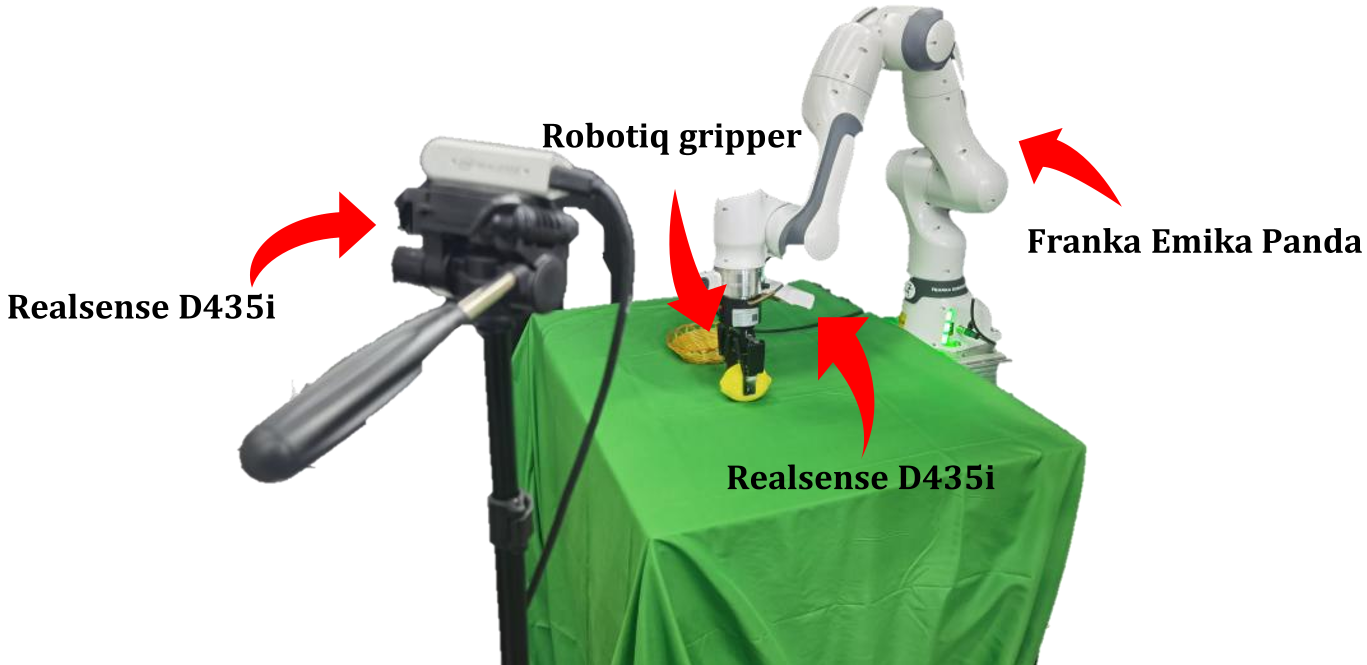 Figure 3: Real-world experimental setup and the four core tasks evaluated.
Critical Analysis: Why It Works
The "why" is simple yet profound: Invariance. By stripping away the texture and lighting, the model is forced to focus on Topology and Contact Dynamics.
- Inductive Bias: Semantic masks provide a strong inductive bias that objects are discrete entities.
- Efficiency: The model doesn't waste "neurons" on rendering shadows; it spends them on calculating gripper-to-handle distances.
Limitations
Despite its success, MWM relies on having semantic masks during the training phase. While tools like RoboEngine can automate this, it remains an extra step in the data pipeline compared to pure end-to-end pixel learning.
Conclusion
The Mask World Model proves that for generalist robots, "Predicting What Matters" is far more important than achieving visual realism. This approach significantly narrows the gap between simulation and the messy, unpredictable real world, marking a vital step toward robots that can operate in any kitchen, regardless of the lighting or the decor.