
Micro Language Models: Masking Cloud Latency with Instant On-Device Openers
Micro Language Models Enable Instant Responses
The paper introduces Micro Language Models (µLMs), ultra-compact decoder-only Transformers (8M–30M parameters) designed for instant response generation on resource-constrained edge devices. These models generate the first 4-8 words of a response locally to mask cloud latency, achieving SOTA-level efficiency for their size and matching the performance of models up to 10x larger.
TL;DR
Researchers from the University of Washington and Meta AI have unveiled Micro Language Models (µLMs)—tiny models ranging from 8M to 30M parameters that live on your smartwatch or smart glasses. Instead of trying to do everything, they do just one thing: generate the first 4-8 words of a response instantly (within 55ms). This "opener" is displayed immediately to the user while a massive cloud model continues the sentence, effectively making the multi-second cloud latency invisible.
Background: The Latency Gap in Wearables
The promise of "always-on" AI assistants on wearables is currently broken by a technical bottleneck. High-quality LLMs are too big for the tens-of-megabytes memory budgets of smart glasses. Moving them to the cloud solves the compute problem but introduces a "latency wall": network round-trips and server queuing create a 2-5 second delay.
Existing techniques like Speculative Decoding don't solve this because they require the cloud model to verify tokens before the user sees them. The authors of this paper argue for a paradigm shift: Commit-and-Continue.
Methodology: Small Scale, High Precision
The researchers built a family of decoder-only Transformers optimized for extreme efficiency using features like Grouped-Query Attention (GQA) and Rotary Positional Embeddings (RoPE).
The Tiny Architecture
| Hidden size | Layers | Parameters (M) |
|---|---|---|
| 256 | 8 | 8.79M |
| 512 | 8 | 28.85M |
Despite their diminutive size, these models are trained on a high-quality 1.48B token corpus including UltraChat and MOSS. The core innovation, however, isn't just the model size—it's the Collaborative Generation Framework.
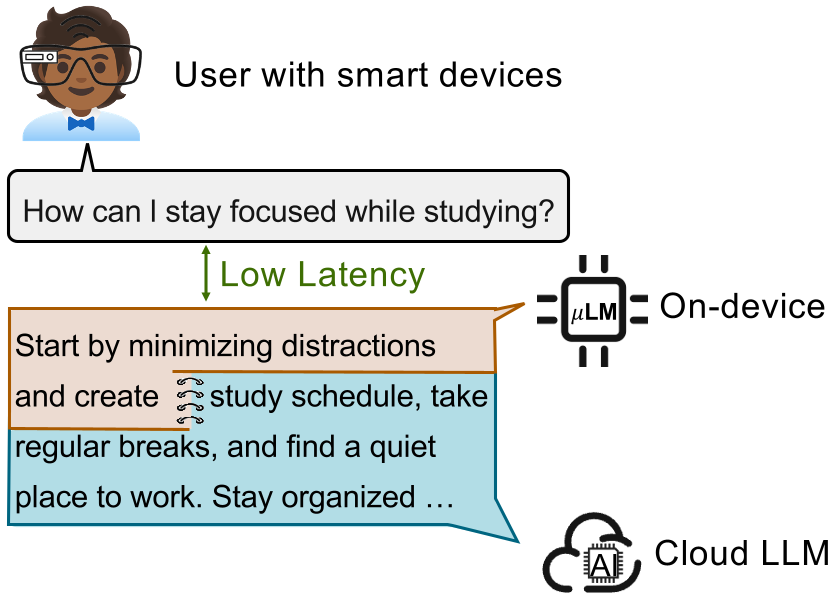 Figure 1: The dual-process flow where µLM handles the "Sprint" (TTFT) and the Cloud LLM handles the "Marathon" (reasoning).
Graceful Recovery from "Hallucinated" Openers
One major risk of using an 8M parameter model is that it might start a sentence incorrectly. To solve this, the authors designed three Error Recovery Modes:
- Explicit: "Correction: [Correct Info]..."
- Natural: A human-like pivot, e.g., "Wait, that's not right, let me rephrase..."
- Humor-aware: A witty detour, "Classic mix-up! I blame zero gravity. Actually..."
Experiments: Breaking the Parameter Barrier
The 28M µLM variants were tested against baselines like Pythia (70M-160M) and LaMini (124M-256M). Remarkably, the µLMs held their own, proving that for short "openers," parameter density matters more than raw count.
Performance on Embedded Hardware (Orange Pi)
The efficiency gains on edge hardware are striking:
- TTFT (Time to First Token): 45ms (vs. up to 5s for cloud-only).
- Throughput: 142 tokens/s (4.3x faster than SmolLM2).
- Energy: 31 mJ/token (4.5x more efficient).
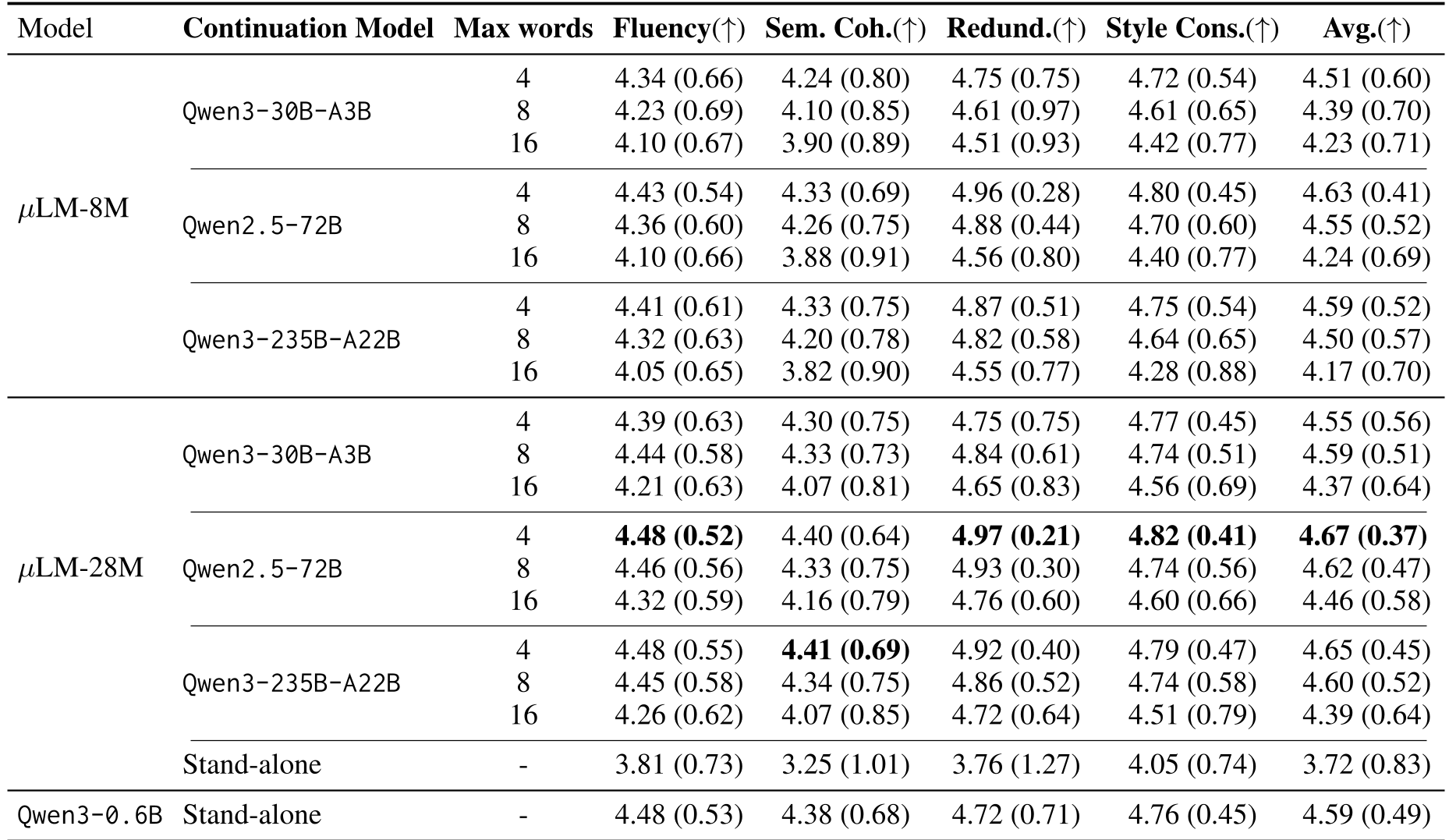 Table 1: Stitched response quality across different word budgets. 4-8 words emerged as the "sweet spot" for maintaining semantic coherence.
Deep Insight: Why 4-8 Words?
The study found that committing 4-8 words is the optimal operating point.
- Too few (1-2 words): Trigger sentence restarts or repetitions in the cloud model.
- Too many (16+ words): The local model's error rate spikes, forcing the cloud model to spend too much effort "repairing" the response.
By providing a short semantic anchor, the µLM "captures" the user's attention while the cloud model performs the heavy lifting.
Summary & Future Outlook
The µLM project demonstrates that asymmetric collaboration is the future of edge AI. By moving away from "all-or-nothing" on-device execution, we can achieve near-instant responsiveness on hardware as limited as a pair of smart glasses.
While currently focused on text, the team notes that this framework is a perfect fit for Full-Duplex Audio interfaces. Imagine an AI earbud that begins answering your question before you've even finished the last syllable—that is the world µLMs are building toward.
Limitations: µLMs are less robust with extremely long or highly technical prompts (math/code). However, for the informal, conversational queries typical of wearables, they are a game-changer.