
[MNRAS 2025] The Missing Ultra-Faint Satellites: Why the Milky Way's Faintest Neighbors Are Hiding in Plain Sight
The missing ultra-faint satellites of the Milky Way
This study utilizes the high-resolution Aquarius-A N-body simulation combined with the GALFORM semi-analytic model to predict the full satellite population of the Milky Way. By implementing a novel tidal stripping framework for both dark matter and stars, the research argues that the total number of Milky Way satellites is limited to ~200, matching the massive end of the observed satellite mass function while predicting a significant population of "missing" ultra-faint dwarfs.
TL;DR
Researchers have utilized the highest-resolution Milky Way-scale simulation to date to solve a lingering cosmic mystery: where are the missing ultra-faint dwarf galaxies? By modeling "orphan" galaxies that previous simulations "lost" to numerical noise, they predict a population of ~200 satellites. Crucially, they identify that many recently discovered compact stellar systems are likely dark-matter-rich "microgalaxies" that have survived near the Galactic center due to their extremely dense dark matter cores.
Background Positioning
In the ΛCDM (Lambda Cold Dark Matter) paradigm, small-scale structure is the ultimate testing ground. While the "Missing Satellites Problem" was largely solved for bright dwarfs via reionization feedback, the ultra-faint regime remains the frontier. This paper is a "SOTA census," moving beyond simple subhalo counting to provide a physically grounded, tidally-aware map of every luminous satellite the Milky Way should possess.
The Problem: Artificial Disruption and Missing "Orphans"
Traditional N-body simulations suffer from a "resolution floor." When a subhalo is stripped of particles by the host's gravity, it eventually disappears from the catalog. In reality, ΛCDM predicts that halos with "cuspy" (steep) inner density profiles should never fully disrupt.
The authors find that even in the ultra-high-resolution Aquarius-A simulation, over half of the luminous satellites are "orphans"—their parent halos were numerically destroyed, but the galaxies they hosted should still exist.
Methodology: The Tidal Track Breakthrough
To fix this, the team used "Tidal Tracks"—analytical formulas that predict how a galaxy's mass and size change based on its orbit and original density.
1. Dark Matter Evolution
The model tracks the maximum circular velocity () and characteristic radius () from the moment of "infall" (when it first hits the Milky Way).
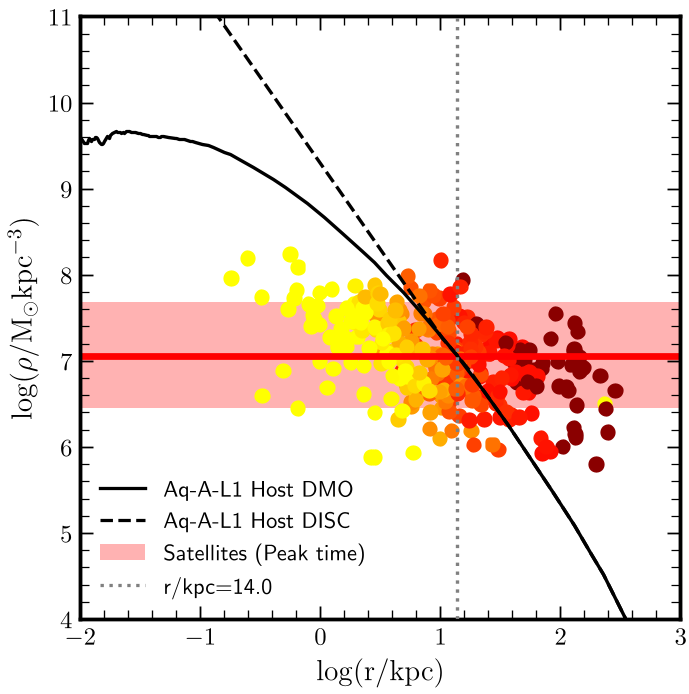 Figure: The "Tidal Track" shows how subhalos follow a universal path of structural decay. Note how simulation data (grey) fails to follow the physical track (colored) at low mass.
2. The "Fiducial" vs. "Scaled" Model
Because the original GALFORM model predicted dwarfs that were too large, the authors tested a "Fiducial" model where the faintest galaxies are born ultra-compact. This mimics the properties of the recently discovered Ultra-Faint Compact Satellites (UFCSs), which occupy the "no-man's-land" between globular clusters and dwarf galaxies.
Results: A New Map of the Neighborhood
The findings recalibrate our understanding of the local environment:
- The 15 kpc Boundary: Satellites that wander within 15 kpc of the Galactic Center are obliterated. This explains why we see very few dwarf galaxies in the inner Galaxy—they haven't just "not formed," they've been tidally shredded into the stellar halo.
- The UFCS Connection: The model perfectly reproduces the distribution of UFCSs. It suggests these systems are "microgalaxies" that were born dense and stayed dense.
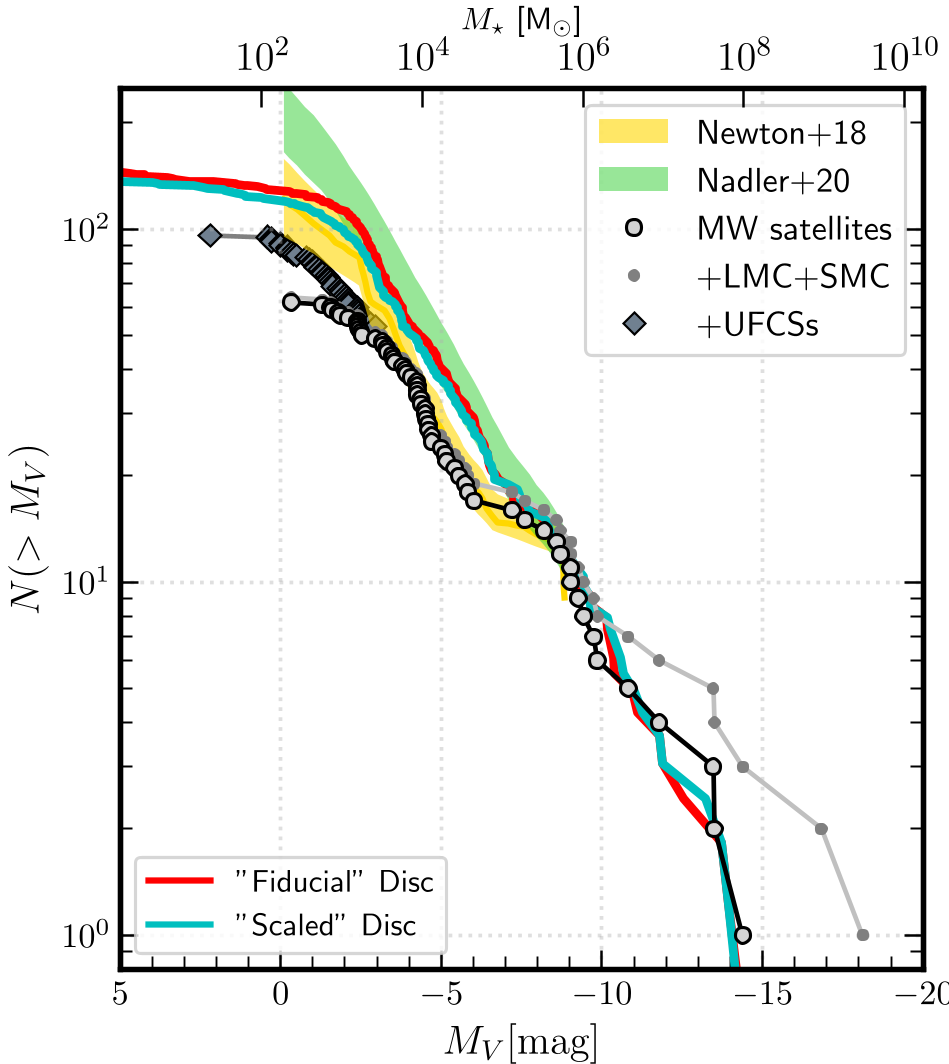 Figure: The predicted cumulative luminosity function. The colored lines (model) match the observed MW satellites (grey circles) and account for the "missing" ultra-faints.
Clinical Analysis: Microgalaxies or Star Clusters?
The most "falsifiable" prediction is the internal kinematics. If UFCSs (like UMa3/U1) are star clusters, they should have velocity dispersions () of ~0.2 km/s. If they are the "microgalaxies" predicted here, should be 1-3 km/s.
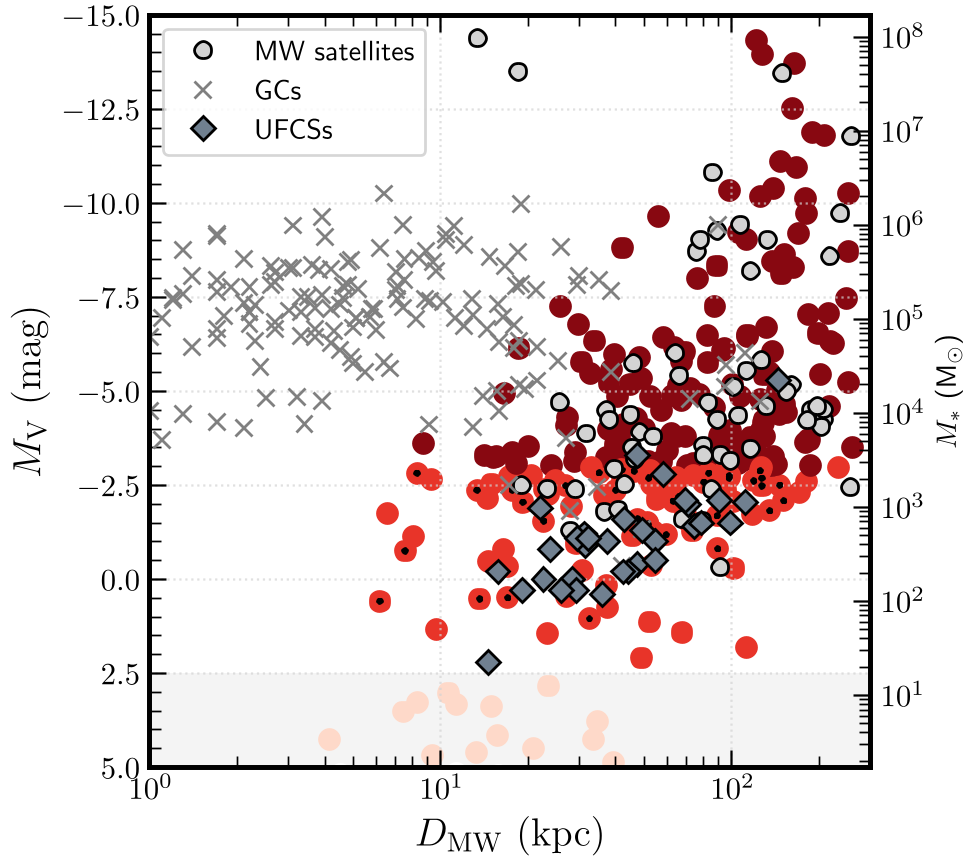 Figure: Dwarf galaxies (red/grey circles) show significantly higher internal velocities than pure stellar systems (open diamonds) because of their dark matter "cradles."
Conclusion and Future Outlook
This work shifts the narrative: the Milky Way isn't missing satellites; we just haven't looked deep enough or in the right structural parameter space. The prediction that the census will double with the arrival of the Rubin Observatory (LSST) provides a clear benchmark. If these ultra-compact systems are confirmed to be dark-matter-rich, it provides the strongest evidence yet for the "cuspy" nature of CDM halos, essentially proving the standard cosmological model on the smallest possible scales.
Limitations: The study relies on a single host halo (Aquarius-A). While rescaled, host-to-host variation and the specific impact of the LMC's own satellite system (not present in this simulation) could alter the specific count of the faintest members.