
Motion-Adapter: Enabling Compound Action Synthesis via Decoupled Cross-Attention
Motion-Adapter: A Diffusion Model Adapter for Text-to-Motion Generation of Compound Actions
This paper introduces Motion-Adapter, a plug-and-play module designed to enable text-to-motion diffusion models to generate "compound actions" (e.g., greeting while walking). By utilizing decoupled cross-attention maps as structural masks, it achieves state-of-the-art performance in complex motion synthesis without fine-tuning the backbone model.
TL;DR
Synthesizing human motion where multiple actions happen at once—like "waving while jogging"—is surprisingly difficult for current AI. Most models "forget" one action or execute them sequentially. Motion-Adapter is a new plug-and-play module that fixes this by using "Structural Masks" to guide diffusion models. It requires no retraining of the main model and sets a new SOTA in multi-action fidelity.
The "Catastrophic Neglect" Problem
Current text-to-motion models (like MDM or MotionDiffuse) are excellent at single actions. However, when you ask for "throwing a ball while jumping," they often suffer from two technical failures:
- Catastrophic Neglect: The temporal fusion layers essentially "overwrite" the features of the first action with the second.
- Attention Collapse: The cross-attention maps, which should link words to body parts, become a blurry mess (collapse) because the model over-fuses joint features to maintain global smoothness.
As a result, models either pick one action or create a "glitchy" hybrid that follows neither command accurately.
Methodology: The Power of Structural Masks
The core insight of Motion-Adapter is that we don't need to retrain the whole model. Instead, we need a smarter way to tell the model which joints should follow which words.
1. Decoupled Cross-Attention
The authors designed a self-supervised STEncoder (Spatial-Temporal Encoder) that learns to associate specific verb tokens (like "kick") with specific joints (the legs). It generates Decoupled Cross-Attention Maps that are sharp and spatially accurate.
2. Plug-and-Play Denoising
During the diffusion process, these maps act as Structural Masks. If the prompt is "punching while walking," the Punch-mask guides the upper body while the Walk-mask guides the lower body simultaneously.
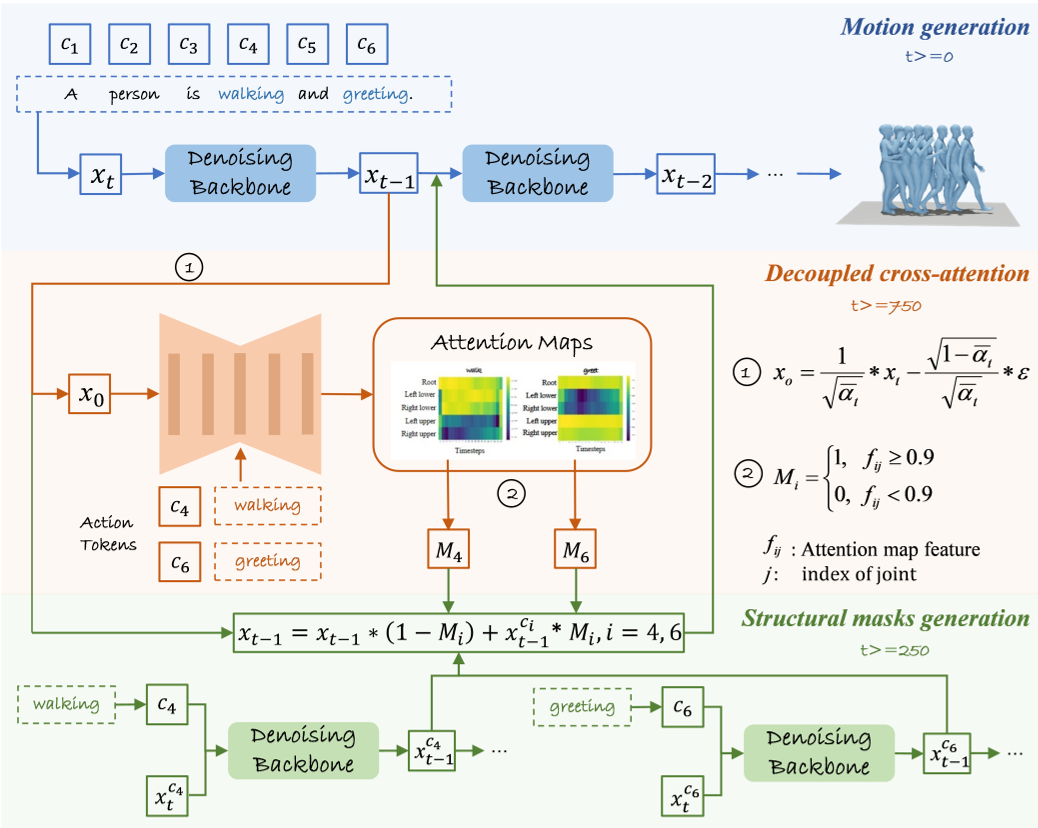 Figure: The Motion-Adapter integrates into the diffusion denoising loop, applying masks to refine the motion at each step.
Experimental Results: Quantitative & Qualitative Superiority
The results are striking. In user studies, Motion-Adapter achieved a Perceptual Quality (PQ) of ~89%, while the previous SOTA (SALAD) struggled at around 41%.
SOTA Comparison
In terms of the Fréchet Inception Distance (FID)—a measure of how "real" the motion looks—Motion-Adapter MDM achieved 3.592, a massive improvement over the baseline MDM's 8.019.
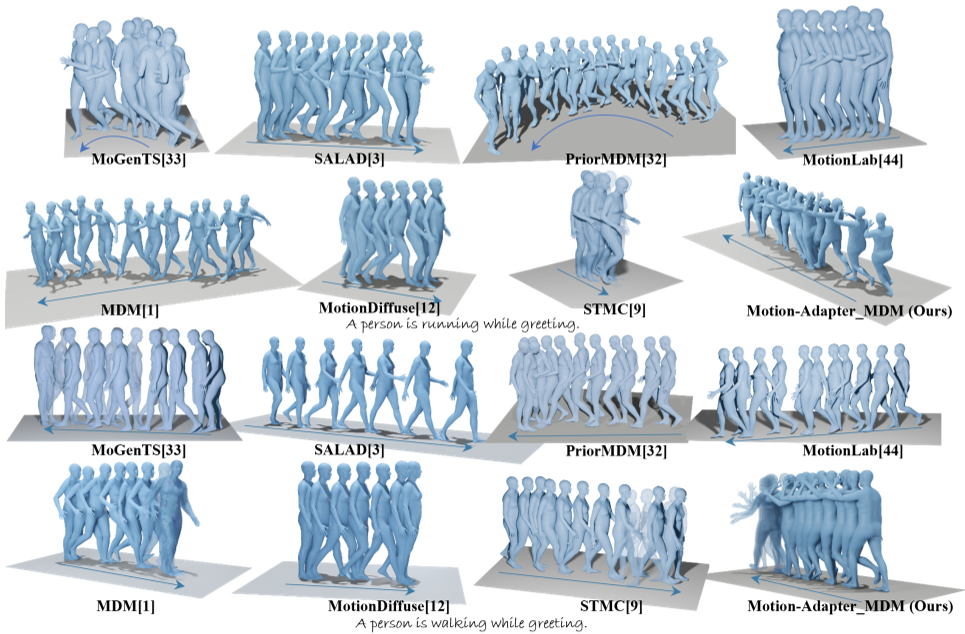 Figure: Comparison of "Greeting while Running." Traditional models ignore the hand gesture; Motion-Adapter captures both perfectly.
Deep Insight: Why Why This Works
The brilliance of Motion-Adapter lies in its training data. It is trained only on single-action motions. By learning a precise mapping of "verb-to-joints" on simple data, it gains the ability to compose these actions in a zero-shot manner on complex prompts. It treats the human body as a modular system, solving the "Attention Collapse" by enforcing structural boundaries that the original Transformer layers tended to ignore.
Conclusion & Future Outlook
Motion-Adapter solves a critical bottleneck in character animation: the transition from "vague movement" to "complex behavior."
Limitations: Currently, it groups joints into broad regions (Upper/Lower). Future iterations could provide finger-level or muscle-level control. Future Work: This framework could easily be extended to interactive VR or gaming, where characters must perform nuanced tasks (like reloading a weapon) while performing environmental navigation (like climbing) simultaneously.
Main Takeaway: Motion-Adapter shows that by controlling the "spatial attention" of a pre-trained model, we can unlock complex multi-tasking capabilities without the need for massive new datasets.