
MUA: Bringing Ultra-Detailed Animatable Avatars to Your VR Headset
MUA: Mobile Ultra-detailed Animatable Avatars
MUA (Mobile Ultra-detailed Animatable Avatars) is a novel framework for creating high-fidelity, animatable 3D human avatars optimized for mobile devices. It introduces "Wavelet-guided Multi-level Spatial Factorized Blendshapes" to achieve state-of-the-art visual quality with 2000x less computational cost and 10x smaller model size compared to previous ultra-high-quality teacher models.
TL;DR
MUA (Mobile Ultra-detailed Animatable Avatars) breaks the barrier between high-fidelity server-side rendering and lightweight mobile performance. By re-imagining Gaussian Splat textures through the lens of Wavelet Decomposition and Low-Rank Factorization, it delivers photorealistic, full-body digital humans that run at 24 FPS natively on Meta Quest 3, reducing computational overhead by a staggering 2000x.
The Fidelity-Efficiency Paradox
In the quest for realistic digital humans, researchers usually pick one:
- Fidelity: Using dense 2D UNets to predict Gaussian attributes (e.g., UMA), which captures every wrinkle but requires an NVIDIA H100.
- Efficiency: Using linear blendshapes or tiny MLPs (e.g., TaoAvatar), which runs on mobile but looks "baked" or blurry during movement.
The bottleneck is the 2D Convolution. Processing high-resolution (768x768) texture maps with multiple channels is a memory and energy killer. MUA’s core insight is that we don't need to process the whole image with heavy kernels; we need a more "surgical" way to represent surface details.
Methodology: The Power of Wavelets and Factorization
The secret sauce of MUA is Wavelet-guided Multi-level Spatial Factorized Blendshapes. Instead of attacking the high-res texture map directly, MUA breaks it down:
- Wavelet Decomposition: It splits the texture into different frequency bands (Low-frequency 'LL' and High-frequency details).
- Hybrid Representation:
- The Low-frequency bands (coarse shape) are small enough to be handled by traditional 2D blendshapes.
- The Mid-frequency bands (wrinkles/edges) are sparse. MUA uses 1D-Factorization, representing a 2D subband as an outer product of two 1D vectors (). This is mathematically similar to Low-Rank Adaptation (LoRA) for textures.
- The High-frequency bands (micro-noise) are often static; MUA treats them as precomputed offsets to save power.
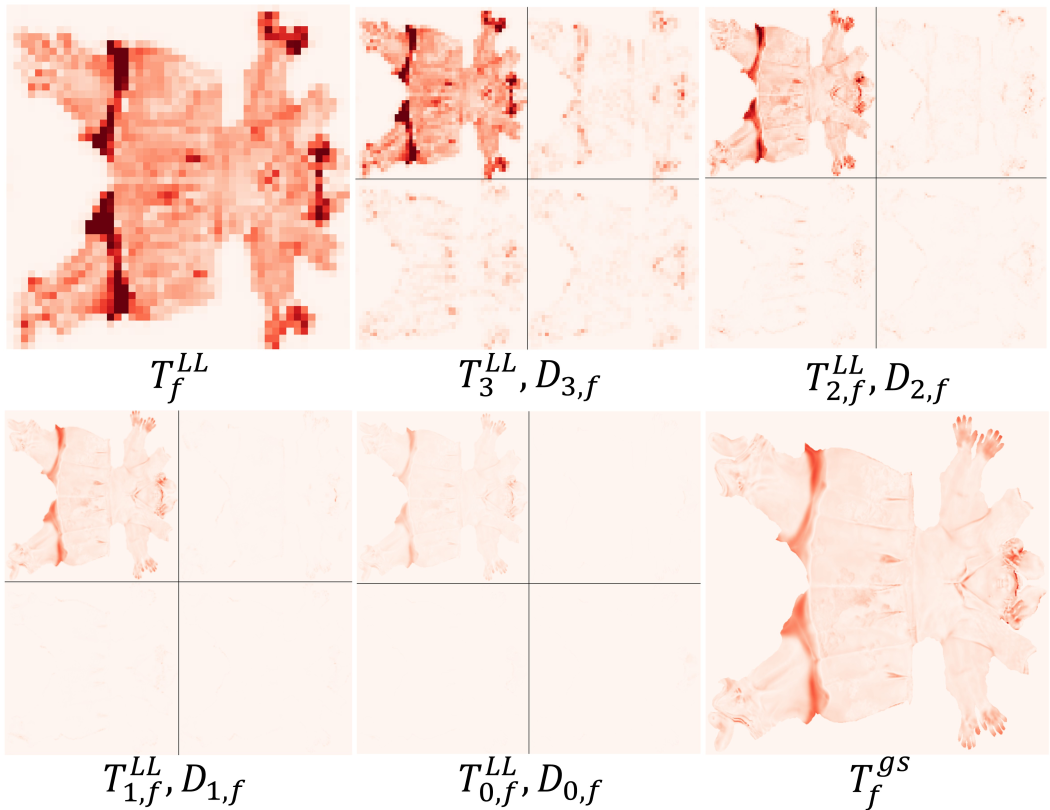 The MUA pipeline: From skeletal pose to multi-level wavelet subbands, culminating in a high-fidelity Gaussian Splat.
Experiments: Desktop Performance on a Mobile Chip
The results are nothing short of impressive. MUA was tested against "Server-based" titans and "Mobile-based" competitors.
- Computational Speed: It runs at 182 FPS on an RTX 3090, while the teacher model (UMA) barely hits 10 FPS.
- Resource Footprint: At 0.52 GFLOPs, it is light enough for the Snapdragon XR2 chip inside the Meta Quest 3.
- Visual Quality: Unlike previous mobile methods that lose wrinkle dynamics, MUA preserves the swaying of skirts and the folding of sleeves through its motion-aware blendshape coefficients.
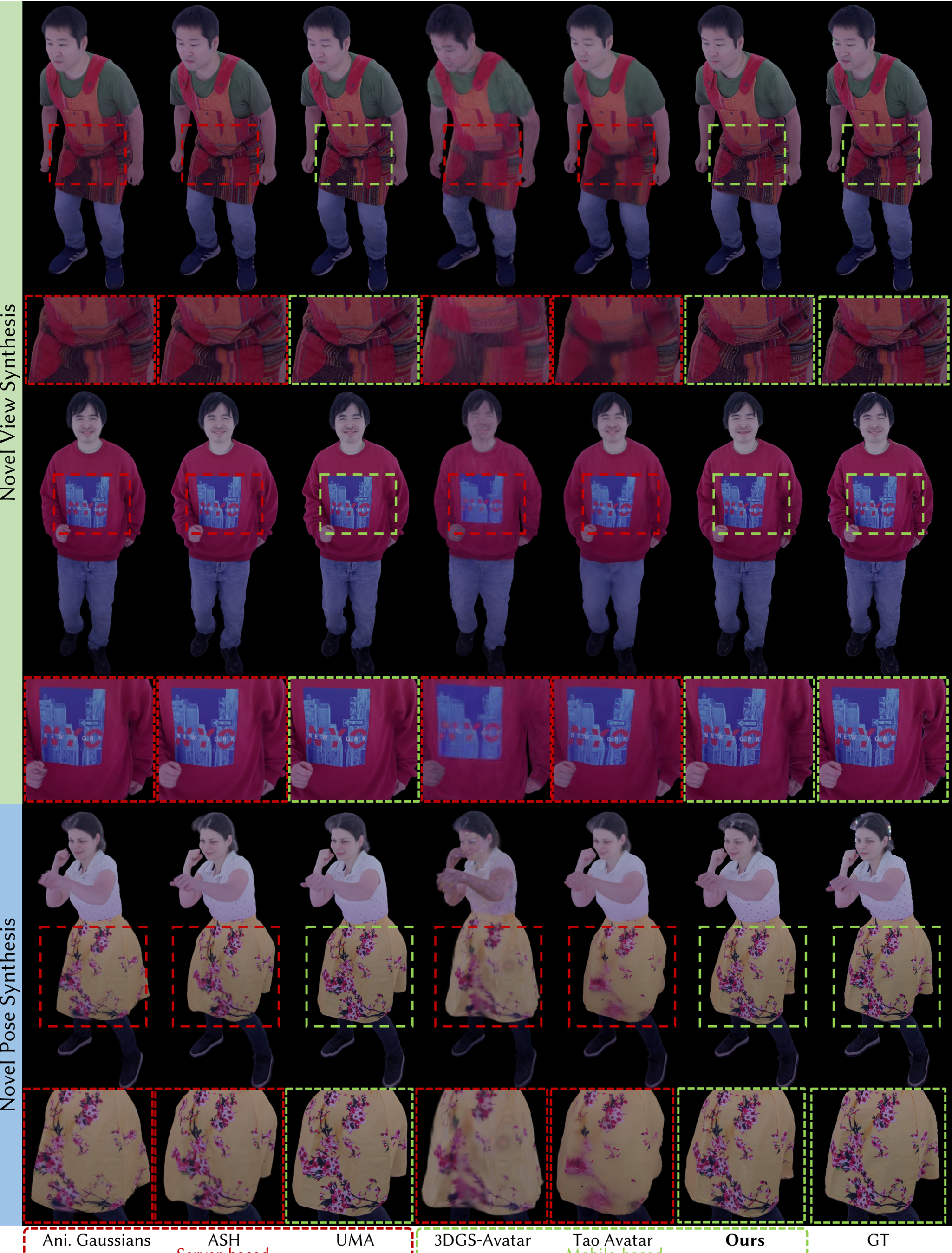 Qualitative comparison showing MUA (ours) maintaining high-frequency clothing details that are lost in other mobile-ready methods like TaoAvatar.
Critical Analysis & Conclusion
MUA is a significant "engineering-meets-theory" win. By identifying that 2D textures are low-rank in the wavelet domain, the authors found a way to "cheat" the massive computational requirements of 3D Gaussian Splatting.
Limitations:
- It is a distillation method, meaning it still needs a "heavy" teacher model to be trained first.
- It doesn't yet support outfit swapping because the clothing is baked into the Gaussian representation.
Future Impact: This work sets a new standard for VR social apps and digital twins. The ability to run high-fidelity humans natively on-device—without a PC link—is the "holy grail" for mass-market XR adoption.
For more technical details, check out the project page at: https://vcai.mpi-inf.mpg.de/projects/MUA