
NaijaS2ST: Bridging the Linguistic Divide in Nigerian Speech Translation
NaijaS2ST: A Multi-Accent Benchmark for Speech-to-Speech Translation in Low-Resource Nigerian Languages
The paper introduces NaijaS2ST, the first high-quality parallel speech-to-speech translation (S2ST) benchmark for five major Nigerian languages (Hausa, Igbo, Yorùbá, Nigerian Pidgin, and English). It provides 50 hours of diverse audio per language and establishes a performance baseline across cascaded, end-to-end, and AudioLLM paradigms, with Gemini 3.1 setting new SOTA results in low-resource settings.
TL;DR
NaijaS2ST is a groundbreaking benchmark for Speech-to-Speech Translation (S2ST) covering Igbo, Hausa, Yorùbá, Nigerian Pidgin, and English. The study reveals that while AudioLLMs (like Gemini 3.1) are currently the strongest performers for text-based outputs, the path to seamless, high-quality speech-to-speech translation for African languages still requires overcoming significant bottlenecks in translation accuracy and accent robustness.
The Problem: The "African Gap" in Speech Tech
Despite the global surge in AI, African languages—spoken by hundreds of millions—represent less than 1% of the data in major benchmarks like Flores-101. Existing speech datasets are often restricted to Automatic Speech Recognition (ASR) or Text-to-Speech (TTS), leaving Speech-to-Speech Translation (S2ST) in a void. Without parallel audio data that captures authentic accents and bidirectional nuances, current SOTA models suffer from "multimodal hallucinations" or extreme performance degradation when facing Nigerian linguistic structures.
Methodology: High-Fidelity Data Meets Modern Paradigms
The authors didn't just scrape the web; they recruited 72 local volunteers to record 50 hours of speech per language, capturing diverse accents such as the Kano dialect (Hausa) and both Northern/Southern Nigerian English.
The Benchmarking Framework
The researchers tested three distinct technical architectures:
- Cascaded Systems: A modular pipeline of Omnilingual-ASR → MT (NLLB/TinyAya) → Gemini TTS.
- End-to-End (E2E): Fine-tuning SeamlessM4T-v2 to map speech directly to text or speech.
- AudioLLMs: Leveraging the "native hearing" capabilities of Gemini 3.1 and GPT-Audio via few-shot prompting.

Core Insights: LLMs vs. Specialized Models
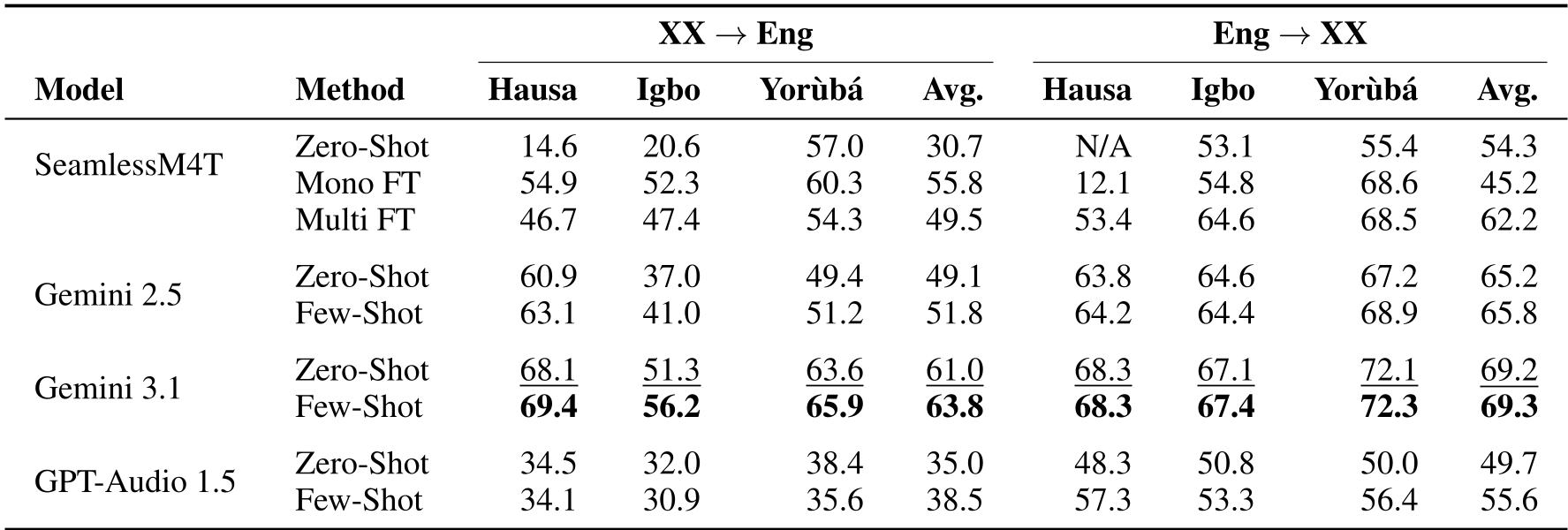
The results from the S2TT (Speech-to-Text) experiments show a clear hierarchy. Gemini 3.1 emerged as the leader, proving that large-scale pre-training on diverse audio allows LLMs to "reason" through low-resource translations more effectively than small-scale fine-tuning on specialized E2E models.
However, a critical nuance surfaced in the S2ST (Speech-to-Speech) results. While LLMs excel at understanding speech and generating text, the final audio-to-audio quality of cascaded systems (ASR + MT + TTS) was surprisingly comparable to the best LLM pipelines. This suggests that for languages like Yorùbá, which are highly tonal and Isolating, the translation engine remains the weakest link, regardless of how "fancy" the audio generator is.
The "Accent Trap" in Evaluation
A fascinating finding in the paper is the bias in evaluation metrics. The authors discovered that standard ASR models used for evaluation (like Omnilingual-ASR) often struggle with Nigerian accents. To solve this, they created Naija-Omni, an ASR system specifically tuned to Nigerian English, to ensure the evaluation was fair. This highlights a meta-problem in the field: If your "judge" model (the ASR metric) is biased toward British/American accents, it will unfairly penalize models that produce perfectly natural West African speech.
Conclusion and Future Outlook
NaijaS2ST is more than just a dataset; it’s a reality check for the AI community. It proves that:
- Fine-tuning is non-negotiable: E2E models like SeamlessM4T need specific Monolingual or Multilingual adaptation to handle languages they weren't natively built for.
- Translation is the Bottle-neck: Moving forward, the focus should shift from improving "audio quality" to improving the semantic accuracy of the translation core.
- Inclusivity is Technical: Real-world utility requires models that understand the 121 million speakers of Nigerian Pidgin, not just standardized "clean" English.
By providing this foundation, the authors have cleared the path for future researchers to build speech tools that truly sound and think like the communities they serve.