
[Theoretical Physics] Nonlocal Games Revisited: The Unified Path from Bell to Pseudo-Telepathy
Nonlocal Games Revisited: A Representation-Theoretic Path from Bell Locality to Quantum Pseudo-Telepathy
This paper provides a comprehensive unification of nonlocal games, bridging the gap between Bell locality and quantum pseudo-telepathy through representation theory. It explores a multi-framework approach—comparing correlation matrices, Bell functionals, entangled-value optimization, and the Navascués-Pironio-Acín (NPA) hierarchy—to characterize terminal quantum advantages in tasks like CHSH, GHZ, and the Magic Square game.
TL;DR
Is it possible for players to win a game with 100% certainty if they are forbidden from communicating, but only if they share entangled quantum particles? This paper answers with a resounding Yes. By unifying four mathematical frameworks, the authors explain the transition from the statistical "Bell violations" (CHSH) to the mind-bending "Quantum Pseudo-Telepathy" (Magic Square), where quantum mechanics effectively acts as a ghost-communication channel.
Context: Beyond "Spooky Action at a Distance"
For decades, Bell's Theorem has been the benchmark for proving that the world is not "locally real." However, the raw data from a Bell test is just a set of probabilities. This work shifts the perspective from statistical violations to operational success. It places the nonlocal game at the center of the quantum information coordinate system, proving that nonlocality is a functional resource for solving computation problems—not just a philosophical curiosity.
The Problem: The Fragmentation of Nonlocality
Traditionally, if you want to study nonlocality, you might look at:
- Physics: Bell Inequalities (CHSH).
- Computer Science: XOR Games and Winning Probabilities.
- Math: Operator Algebras and Commutation.
The "pain point" is that these communities often speak different languages. Why does the CHSH game only give a small boost, while the Magic Square game allows players to "cheat" perfectly? This paper provides the mathematical glue to link these "regimes."
Methodology: The Four Pillars of Representation
The authors argue that a nonlocal game is a single object that can be viewed through four distinct lenses:
1. The Correlation Matrix ()
This represents the "what": the joint probabilities of answers given questions. It’s a geometric object in a high-dimensional space where the "Local Polytope" (classical) lives inside the "Quantum Set" (quantum).
2. Bell Functionals
The "witness": a linear way to check if a strategy is nonlocal. It’s essentially a score-keeping mechanism where the classical world is capped by a ceiling (like the CHSH bound of 2).
3. Entangled Value Form
The "optimization": treating the win-rate as an eigenvalue problem. The quantum value is the maximum possible score Alice and Bob can achieve by optimizing their measurements and their shared state.
4. Quantum Operator Form & NPA Hierarchy
The "bound": Since optimizing over all possible quantum states is hard, the authors use the NPA Hierarchy. This uses Semidefinite Programming (SDP) to provide a sequence of increasingly tighter bounds on what quantum mechanics can do.
 Figure 1: The standard representation of a probability matrix used to distinguish classical vs. quantum correlations.
Case Study: The Magic Square and Pseudo-Telepathy
The highlight of the paper is the analysis of the Mermin-Peres Magic Square.
The Challenge: Alice and Bob must fill a 3x3 grid such that Alice's rows have even parity and Bob's columns have odd parity. They only win if their shared cell matches. The Friction: Classically, this is algebraically impossible. You can't satisfy both parities simultaneously in a shared grid. The classical limit is . The Quantum Solution: By sharing two EPR pairs and measuring Pauli Observables, Alice and Bob don't "decide" their answers beforehand. Their answers are generated by measurements that commute within a row/column but don't commute globally.
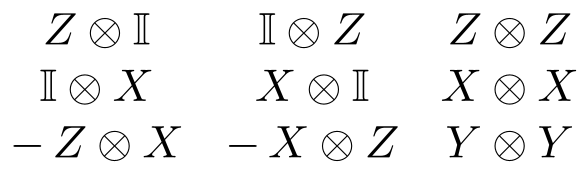 Figure 2: The Mermin-Peres Magic Square of Pauli operators used to achieve a 100% win rate.
Experimental Verification & SOTA Comparisons
The paper provides a clear quantitative hierarchy of how different models perform across the "Big Three" games:
| Game | Classical Value () | Quantum Value () | Quantum Advantage |
|---|---|---|---|
| CHSH | 0.75 | 0.854 | Statistical (+13.8%) |
| GHZ | 0.75 | 1.0 | Deterministic (+33.3%) |
| Magic Square | 0.889 | 1.0 | Deterministic (+12.5%) |
Critical Insights & Takeaways
The most profound takeaway is that GHZ and Magic Square represent "Logical Nonlocality." While CHSH requires thousands of trials to prove quantumness through statistics, Pseudo-Telepathy games only require one trial to potentially fail. If Alice and Bob win a Magic Square game consistently, you don't need a p-value to know they are quantum—it is a logical certainty.
Limitations: The authors note that while the NPA hierarchy is convergent, higher-level computations are extremely memory-intensive, limiting its use for complex multipartite games with many players/questions.
Future Outlook
This unified representation framework is a stepping stone toward Device-Independent Quantum Cryptography. If we can represent a game as a strict operator-theoretic bound, we can verify the security of a quantum network without ever trusting the hardware provider—the "game" itself becomes the security certificate.