
OFlow: Robust Robotic Manipulation via Object-Aware Temporal Flow Matching
OFlow: Injecting Object-Aware Temporal Flow Matching for Robust Robotic Manipulation
OFlow is a novel Vision-Language-Action (VLA) framework that integrates Object-Aware Temporal Flow Matching to improve robotic manipulation. By unifying semantic foresight and hierarchical object factorization in a shared DINOv2 latent space, it achieves SOTA performance on LIBERO (+2.1% overall) and robustly handles distribution shifts in complex real-world tasks.
TL;DR
OFlow is a breakthrough VLA (Vision-Language-Action) framework that shifts robot learning from "reactive" to "predictive." By forecasting future semantic states and clustering them into object-aware prototypes, it enables robots to "see into the future" of task-relevant objects. It achieves a 96.6% success rate on the LIBERO benchmark and shows massive gains in real-world robustness.
Background & Motivation: The Limits of Reactivity
Modern VLA models like RT-2 or OpenVLA have shown impressive grounding, but they typically act like a driver looking only at the 5 meters directly in front of their bumper. They make decisions based on the current frame. In the real world, manipulation is dynamic: objects move, hands block views, and tasks unfold over time.
To solve this, researchers tried "foresight" (predicting future video frames), but generating raw pixels is computationally heavy and often fixates on irrelevant background noise. The authors of OFlow argue that robots don't need to imagine every pixel; they need to understand how semantic objects will evolve.
The Core Innovation: Semantic Foresight
OFlow introduces two critical components into the VLA pipeline:
- Temporal Flow Matching in Latent Space: Instead of predicting RGB images, OFlow predicts the future in DINOv2's feature space. This space is inherently semantic and more robust to lighting or texture changes.
- Object-Aware Scene Factorization: The model uses an unsupervised clustering strategy (K-Means on DINOv2 features) to group latent tokens into "object prototypes." This forces the model to ignore the background and focus on physically relevant entities (e.g., the cabbage, the microwave door).
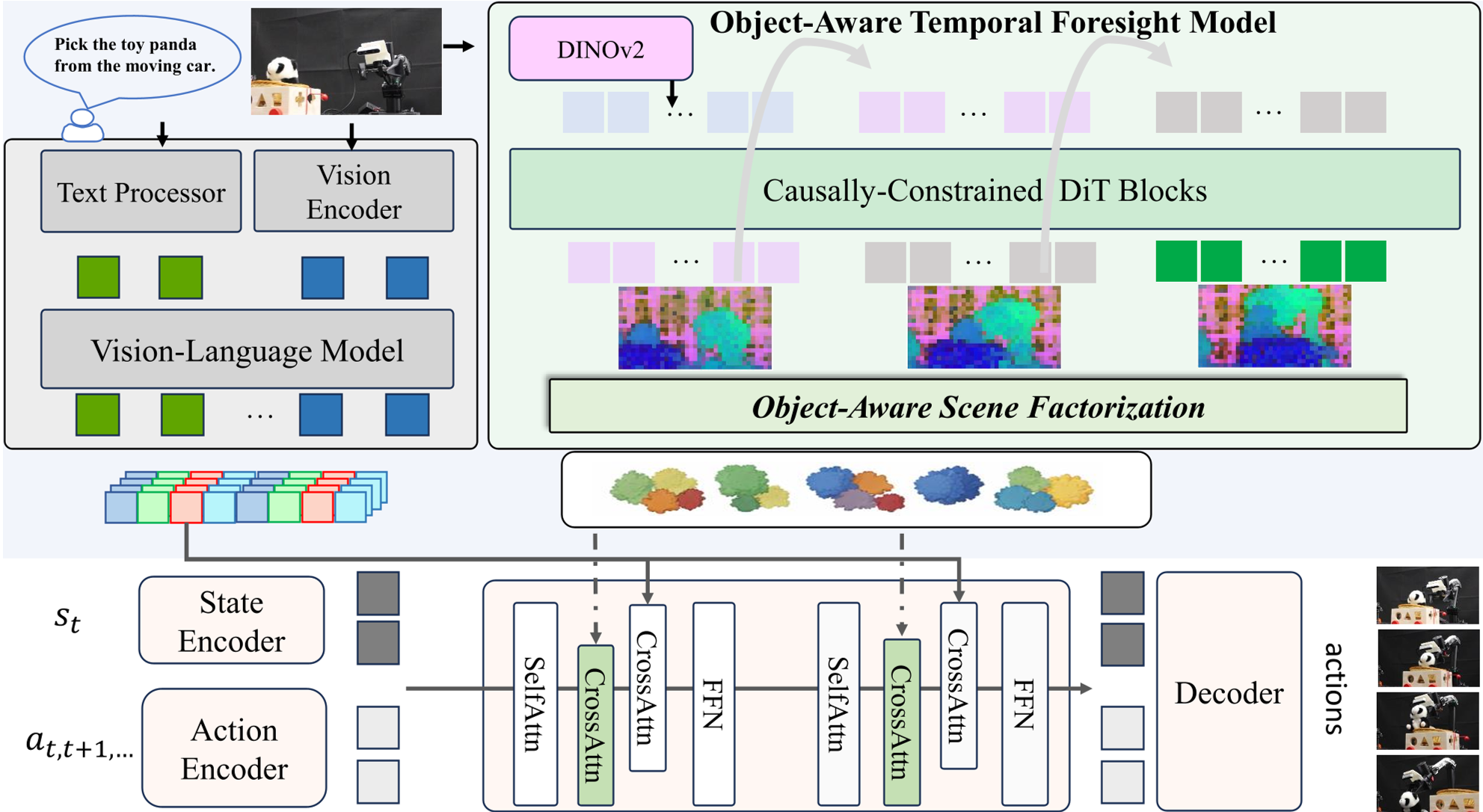 Figure 1: The OFlow pipeline. Note the integration of "Semantic Foresight" and "Object-Aware Factorization" into the action generation head via Cross-Attention.
The Methodological "Secret Sauce"
The framework adopts a two-level rollout:
- Global: Frame-level autoregression (predicting frame given ).
- Local: Diffusion-based (Flow Matching) sampling within each frame to refine the latent representation.
To keep the VLA backbone's knowledge intact, these object-aware features are injected using a ControlNet-style Zero-initialized Cross Attention mechanism. This allows the model to "peek" at the future without breaking the pretrained visual-language alignment.
Performance: Crushing the Baselines
OFlow was tested against heavyweights like and GR00T-N1.5 across multiple benchmarks.
1. Simulation Accuracy
On LIBERO-Long (tasks requiring long-term planning), OFlow achieved 94.5%, significantly higher than -FAST’s 60.2%. This proves that foresight is essential for tasks that aren't just one-step "pick and place."
2. Robustness to Perturbations
The LIBERO-Plus benchmark tests models under "stress"—changing camera angles, adding layout noise, or altering lighting.
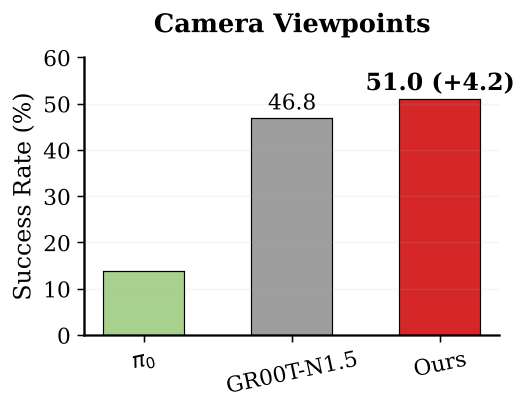 Figure 2: Success counts under perturbations. OFlow consistently outperforms the backbone (red bars represent the absolute gain).
3. Real-World Dynamic Interaction
The most impressive result came from the "Panda-Car" task, where the robot must grab a toy from a moving vehicle.
- : 25% Success
- OFlow: 70% Success Why? Because OFlow predicts where the car will be, allowing for temporal coordination rather than chasing the object's tail.
Visualizing the "Future"
While the model works in latent space, we can reconstruct what it "sees" using a Representation Autoencoder (RAE).
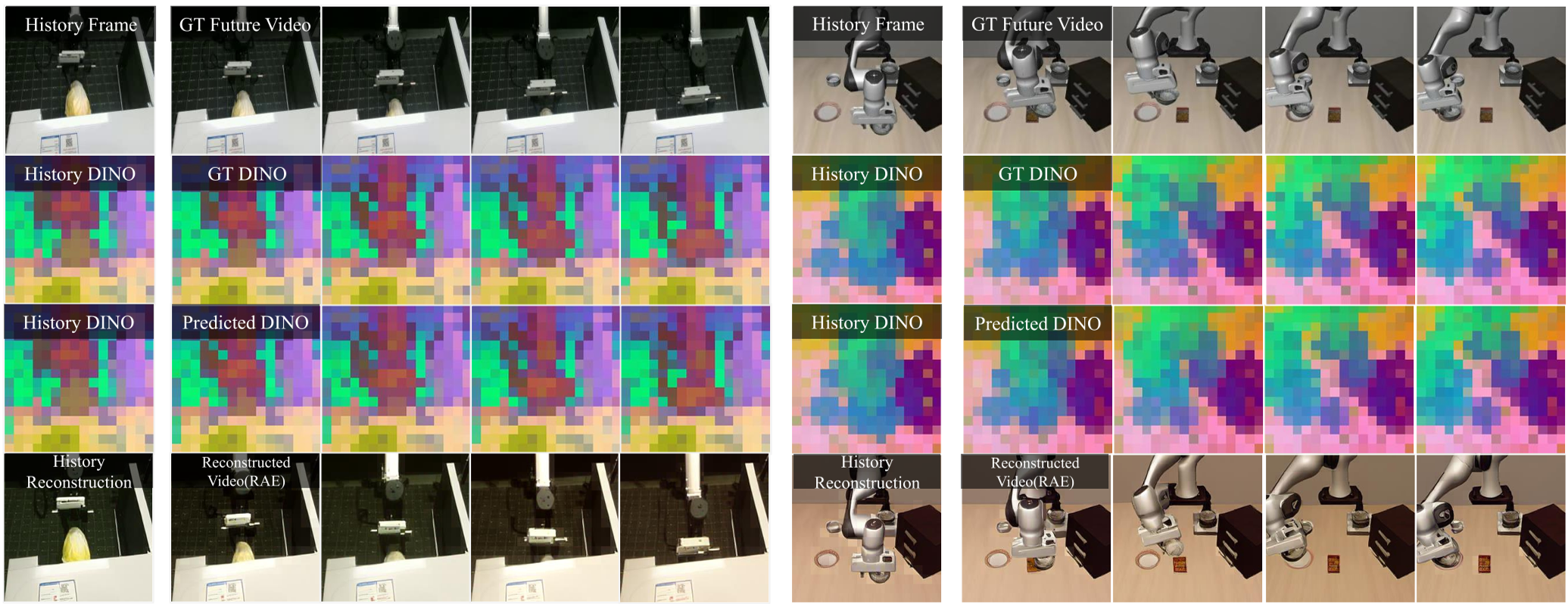 Figure 3: Top to bottom: History GT Future Predicted Latents (PCA) Reconstructed RGB. The model accurately captures the cabbage moving toward the microwave.
Critical Insight & Conclusion
OFlow proves that object-centricity is the missing link in current VLA models. By ignoring pixel-level noise and focusing on the "flow" of objects in a semantic space, the robot gains a form of "common sense" about physics and task progression.
Limitations: The model currently relies on a fixed prediction horizon (typically 4 frames). Future work could explore dynamic horizons based on task complexity.
Takeaway: Semantic foresight is more efficient than video generation and more robust than reactive clicking. This is a significant step toward robots that can handle the unpredictable "messiness" of human environments.