
[CVPR 2026] OpenSpatial: Bridging the "Spatial Gap" with a Principled 3D Data Engine
OpenSpatial: A Principled Data Engine for Empowering Spatial Intelligence
OpenSpatial is a principled open-source data engine designed to empower Vision-Language Models (VLMs) with high-quality 3D spatial intelligence. By introducing a 3D box-centric data hierarchy and curating the OpenSpatial-3M dataset, it achieves state-of-the-art performance across multiple spatial reasoning benchmarks, including a significant 19% relative improvement over strong baselines.
TL;DR
OpenSpatial is an open-source data engine that transforms raw video and image data into high-fidelity 3D spatial supervision. By moving beyond 2D projections to a 3D box-centric representation, it provides the metrics needed for VLMs to truly "understand" space. The accompanying OpenSpatial-3M dataset has set new SOTA records across 8+ benchmarks, pushing the boundaries of what MLLMs can perceive in 3D environments.
Problem & Motivation: The "Spatial Myopia" of Modern AI
Despite the success of models like GPT-4o or Qwen-VL in semantic tasks, they remain "spatially blind" in many aspects. They can describe a room but struggle to tell you the exact distance between two chairs or maintain consistency when the camera rotates. This "spatial myopia" stems from:
- Data Scarcity: Lack of diverse, real-world 3D annotated data.
- Proprietary Pipelines: Existing spatial data engines are often "black boxes," making it impossible for the community to scale or audit the data quality.
- Inductive Bias Gaps: 2D-based labels lack the viewpoint invariance required for stable 3D reasoning.
Methodology: The 3D Box-Centric Revolution
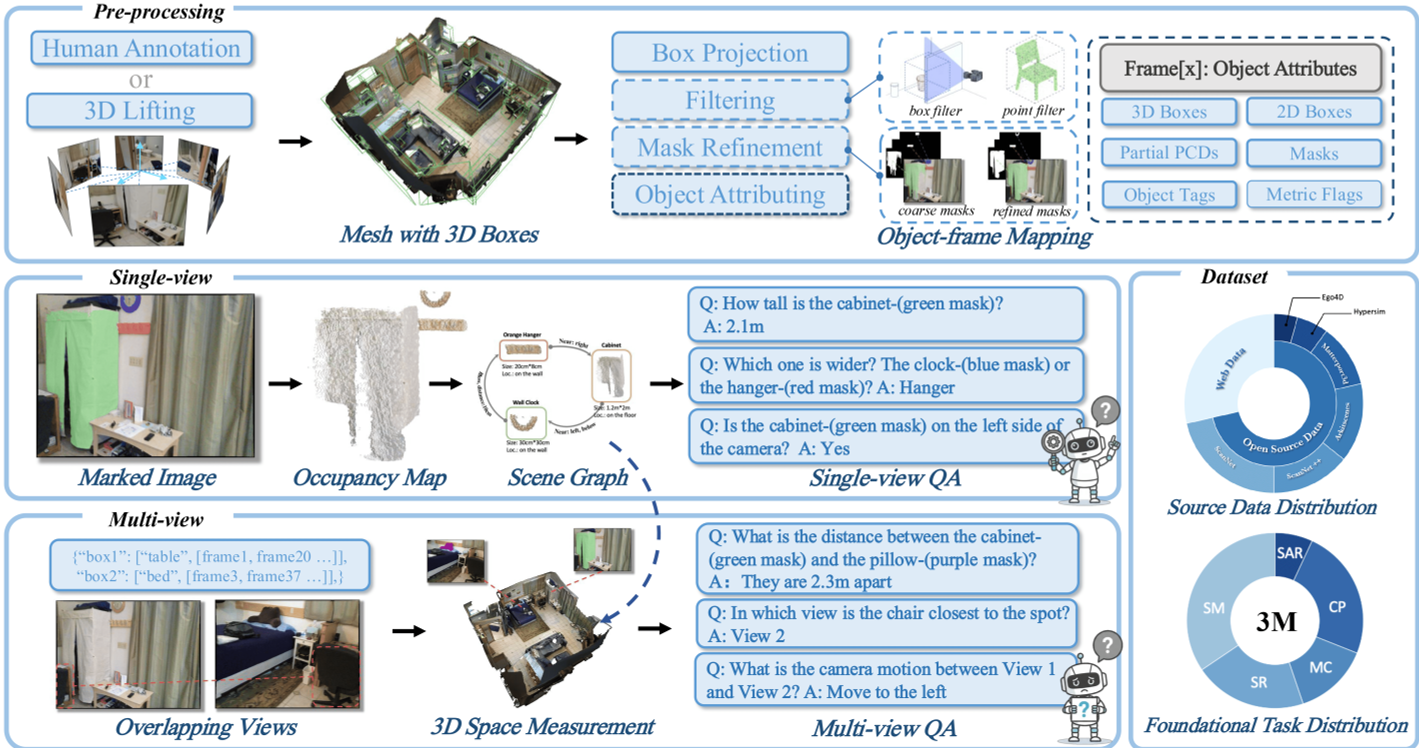
OpenSpatial's core innovation lies in its data hierarchy, which uses Oriented Bounding Boxes (OBBs) as the source of truth. Unlike 2D boxes, OBBs capture the object's height, width, depth, and orientation in a global world coordinate system.
The Data Pipeline
The engine follows a sophisticated three-stage process:
- 3D Reconstruction & Lifting: Using a combination of SAM (Segment Anything) and Gemini-level reasoning, the engine "lifts" sparse 2D pixels into 3D OBBs, even from unconstrained web videos.
- Attribute Mapping: It projects these 3D anchors back to 2D frames, performing occupancy checks to handle occlusions—ensuring the model doesn't "hallucinate" invisible objects.
- Scene-Graph QA Synthesis: It programmatically generates complex questions across five key pillars:
- Spatial Measurement (SM): "What is the height of this cylinder?"
- Multi-view Consistency (MC): "Is the sink in View 1 the same as in View 2?"
- Camera Perception (CP): Estimating ego-motion and camera layout.
Experiments & Results: Quantifying the Leap
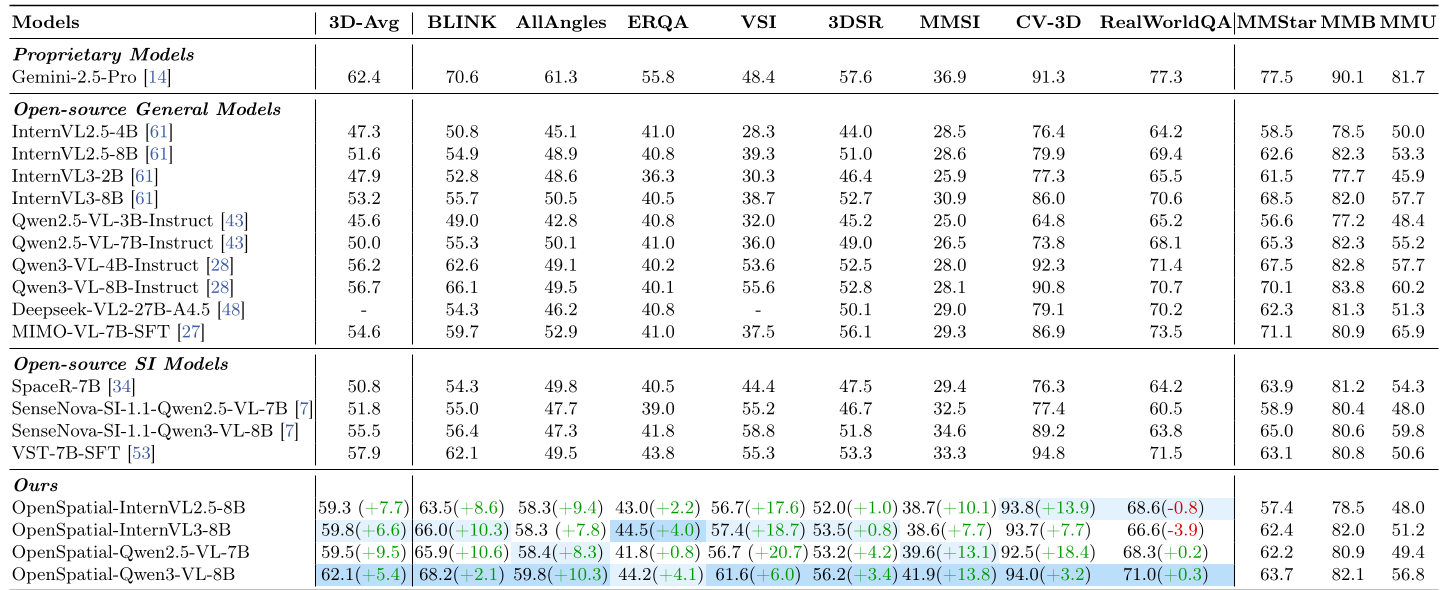
The authors fine-tuned several base models (InternVL, Qwen) using the OpenSpatial-3M suite. The results are nothing short of impressive:
- SOTA Performance: Their best model achieved a 62.1 average score across 3D benchmarks, rivaling or exceeding proprietary models like Gemini-2.5-Pro in specific spatial tasks.
- Relative Gains: On the BLINK benchmark, they saw a jump from 55.3 to 65.9 (+10.6 points).
- Scaling Laws: The research confirms that spatial intelligence follows a predictable scaling path—both more data and larger models (3B -> 32B) continue to yield accuracy returns without saturation.
Ablation Insights: Why Boxes Matter
The research found that Box-Centric supervision is far superior to Point-Cloud-Centric approaches. Point clouds are often noisy and incomplete due to sensor limits, whereas OBBs provide a clean, complete geometric prior that forces the model to learn the underlying 3D structure rather than just matching pixel patterns.
Critical Analysis & Conclusion
OpenSpatial marks a transition in AI research from "Image-to-Text" to "Space-to-Reasoning." By open-sourcing the engine, the authors have democratized the ability to create "spatialized" models.
Takeaway: The bottleneck for embodied AI isn't just the model architecture; it's the lack of structured 3D knowledge in the training loop. OpenSpatial-3M provides that missing link.
Limitations: The authors acknowledge a slight performance bottleneck in outdoor and complex desktop scenarios due to current data skew. Future work will involve expanding the 3D lifting pipeline to more diverse "in-the-wild" environments.
For those interested in the future of robotics and embodied AI, OpenSpatial is a foundational framework worth watching.