
PLaMo 2.1-VL: Bridging the Gap Between Edge Intelligence and Industrial Visual Grounding
PLaMo 2.1-VL Technical Report
Preferred Networks (PFN) introduces PLaMo 2.1-VL, a suite of lightweight Vision Language Models (8B and 2B variants) optimized for edge deployment and Japanese-language operation. It utilizes a LLaVA-style architecture with SigLIP2 encoders and achieves SOTA performance on Japanese VQA and Visual Grounding benchmarks.
TL;DR
PLaMo 2.1-VL is a specialized Vision Language Model (VLM) family (8B and 2B) developed by Preferred Networks (PFN) for autonomous edge devices. By focusing on Visual Question Answering (VQA) and Visual Grounding, it transforms raw sensory data into actionable, grounded insights. It notably outperforms larger models on Japanese benchmarks and introduces a robust pipeline for infrastructure anomaly detection.
Problem & Motivation: The "Edge-Cloud" Dilemma
In the world of autonomous drones and factory robots, the "Cloud-First" AI model is failing. High-resolution sensors generate massive data overhead, while real-time safety requirements demand zero-latency decision-making.
The authors identify three critical gaps in current open-source VLMs:
- Spatial Blindness: Most models can "see" a dog but cannot "ground" (localize) specific industrial tools or anomalies accurately.
- Language Barriers: Reliable Japanese-language operation in industrial fields is underserved by English-centric models.
- Hardware Constraints: Large models (>30B) cannot run on the limited VRAM of edge-computing hardware found in cars or drones.
Methodology: Precision Through Synthesis
PLaMo 2.1-VL adopts a standard but highly optimized architecture: a PLaMo 2.1 LLM backbone, a SigLIP2 image encoder, and a simple MLP adapter. The real "secret sauce" lies in the Data Synthesis Pipeline.
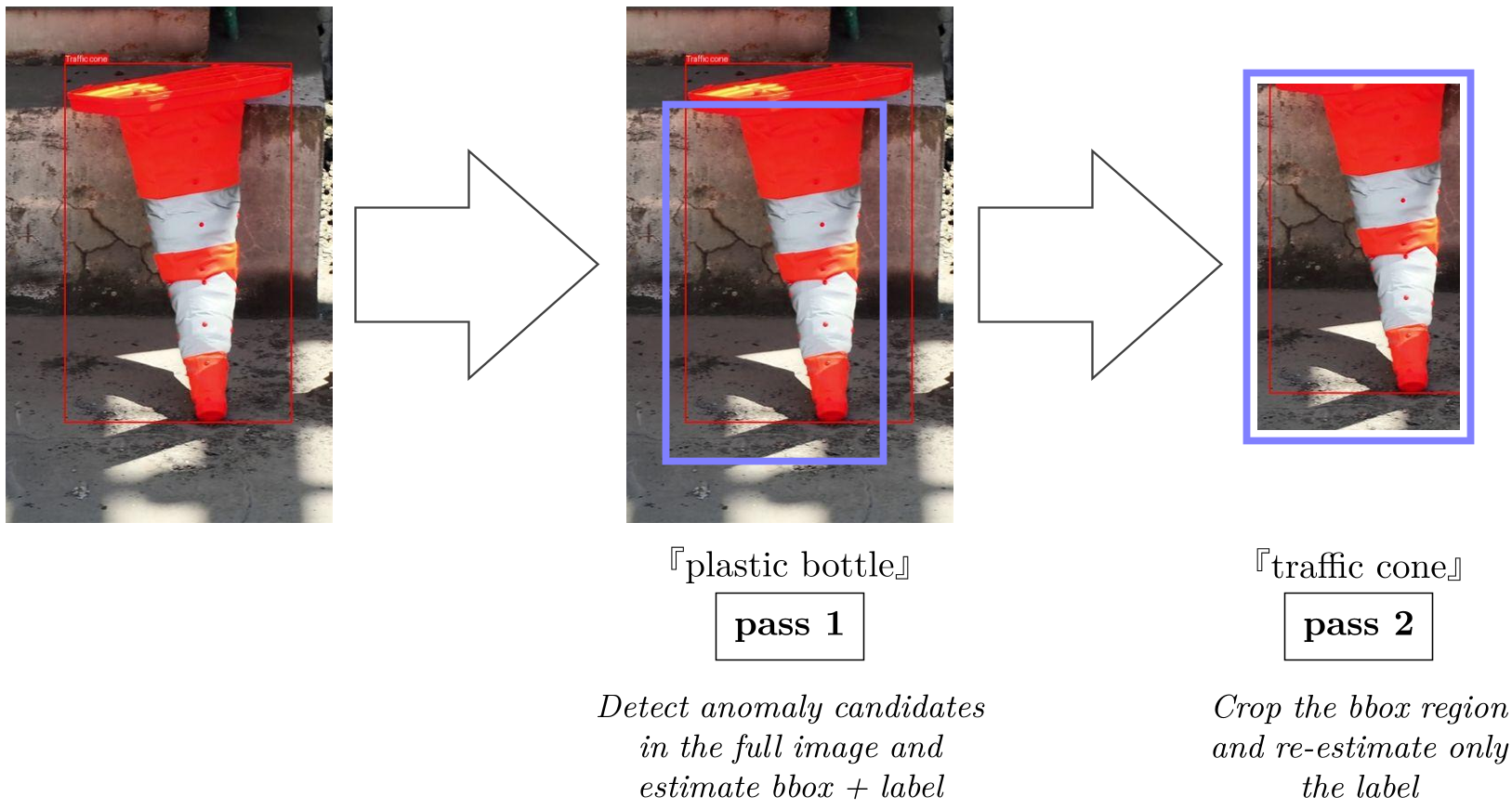
The Two-Pass Inference Strategy
For tasks like infrastructure anomaly detection, PLaMo uses a "Two-Pass" approach to handle the "small object problem":
- Pass 1: The model scans the full image to identify potential bounding boxes (candidates).
- Pass 2: The model "zooms in" and crops the candidate region to perform high-fidelity label re-estimation.
Advanced Synthetic Data Generation
PFN developed several "gates" to ensure synthetic data quality:
- Dual-Estimation Agreement Gate: For counting tasks, they only keep data where a flagship VLM (like Qwen3-235B) and a segmentation model (SAM3) arrive at the exact same count.
- Self-Consistency Filter: For tool recognition, the model predicts a box, generates a caption, then predicts the box again from the caption. If the IoU isn't high, the data is discarded.
Experiments: Dominating the 8B Class
The evaluations focus on two primary real-world scenarios: Factory Task Analysis and Infrastructure Anomaly Detection.
Performance Highlights
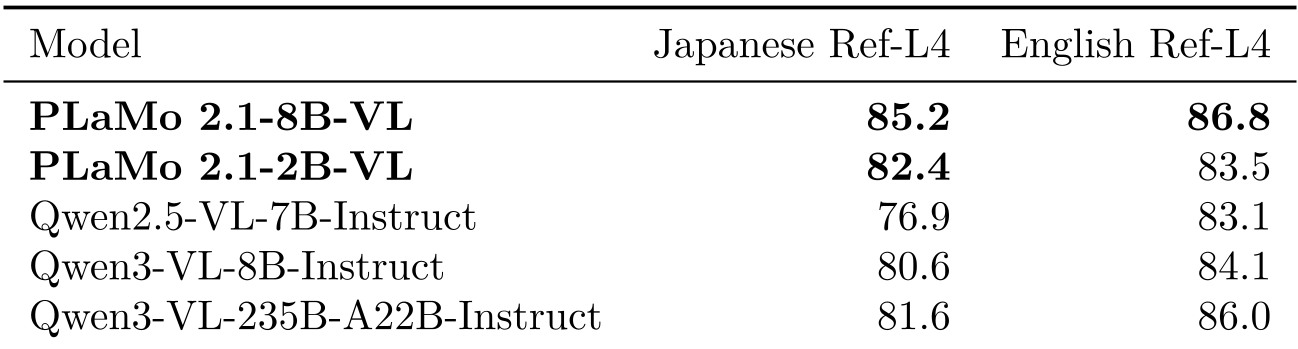
- Japanese Ref-L4 (Grounding): PLaMo 2.1-8B achieved 85.2%, beating Qwen3-VL-235B (81.6%)—a model nearly 30 times its size.
- Factory Task Analysis: Achieved 53.9% zero-shot accuracy, significantly higher than the 38.3% of Qwen3-8B.
The Impact of Fine-Tuning
The study proves that while zero-shot performance is excellent for localization (finding where), fine-tuning on site-specific data is still vital for semantic labeling (identifying what). In power plant tests, fine-tuning boosted the "bbox + label" F1-score from 39.7 to 64.9.
Critical Analysis & Conclusion
Takeaway
PLaMo 2.1-VL demonstrates that "small" models can punch far above their weight class if the training data is filtered for spatial consistency and multi-instance support. The shift from "Natural Language only" to "Visual Grounding + Natural Language" is a prerequisite for safety in autonomous systems.
Limitations
- Domain Expertise: The model lacks "expert knowledge" (it might recognize a pipe but not the specific mechanical code of the valve).
- OCR limitations: It is not optimized for document parsing or complex chart reading.
- Single-Image focus: It currently lacks temporal video reasoning, which PFN notes as a future direction for tackling occlusion in factories.
Future Outlook: PFN plans to deploy PLaMo 2.1-VL in constrained "Proof-of-Concept" (PoC) environments, using operational logs to iteratively close the gap between general AI and specialized industrial reliability.