
PortraitDirector: Mastering Facial Composition for High-Fidelity Real-time Reenactment
PortraitDirector: A Hierarchical Disentanglement Framework for Controllable and Real-time Facial Reenactment
PortraitDirector is a hierarchical facial reenactment framework that achieves high-fidelity, real-time (20 FPS) performance with fine-grained control over individual facial components. By decomposing facial motion into distinct spatial and semantic layers, it allows independent manipulation of head pose, eyes, mouth, and emotional expression.
Executive Summary
PortraitDirector represents a significant shift in facial reenactment research, moving away from "monolithic" motion signals towards a hierarchical composition strategy. Traditionally, models have struggled to balance the raw expressiveness of end-to-end learning with the surgical precision required for professional editing. PortraitDirector solves this by deconstructing facial dynamics into independent layers—Spatial, Semantic, and Composite—allowing users to mix and match head poses from one source, mouth movements from another, and emotions from a third. Achieving 20 FPS at 512px on a 5090 GPU, it sets a new bar for real-time controllable digital humans.
The Core Challenge: The Entanglement Trap
Why is it so hard to change just the mouth shape in a video without affecting the person's eyes or overall mood? Most current SOTA models (like XPortrait2 or LivePortrait) treat facial motion as a single latent vector. While this captures subtle nuances perfectly, the features become "entangled." If the driving video shows someone shouting angrily, it is nearly impossible to make the source identity say the same words but with a "happy" emotion. The "shouting" motion is physically and semantically glued to the "anger."
Methodology: Deconstruct to Reconstruct
The authors' primary insight is that facial animation is a layered phenomenon. They introduce two primary layers of disentanglement:
1. The Spatial Layer (Physical Decoupling)
Instead of letting the model figure out where the head is, the authors use a dedicated PoseAdapter. They extract explicit parameters (rotation, translation, scale) using tools like MediaPipe. More importantly, they physically crop the eyes and mouth regions. By feeding these "Regional-of-Interest" (ROI) crops into separate encoders, they guarantee that information cannot leak between components.
2. The Semantic Layer and the Emotion-Filtering Module (EFM)
This is where the real "magic" happens. Even if you crop just the mouth, that mouth still carries emotional "tension." To solve this, the authors introduce the Emotion-Filtering Module.
- The Information Bottleneck: It acts as a narrow pipe that forces the mouth latent to shed "extrapolative" info (the emotion) while retaining "essential" info (the basic physical opening/closing).
- Global Emotion Pooling: Emotion is treated as a low-frequency, temporally smooth signal extracted across multiple frames.
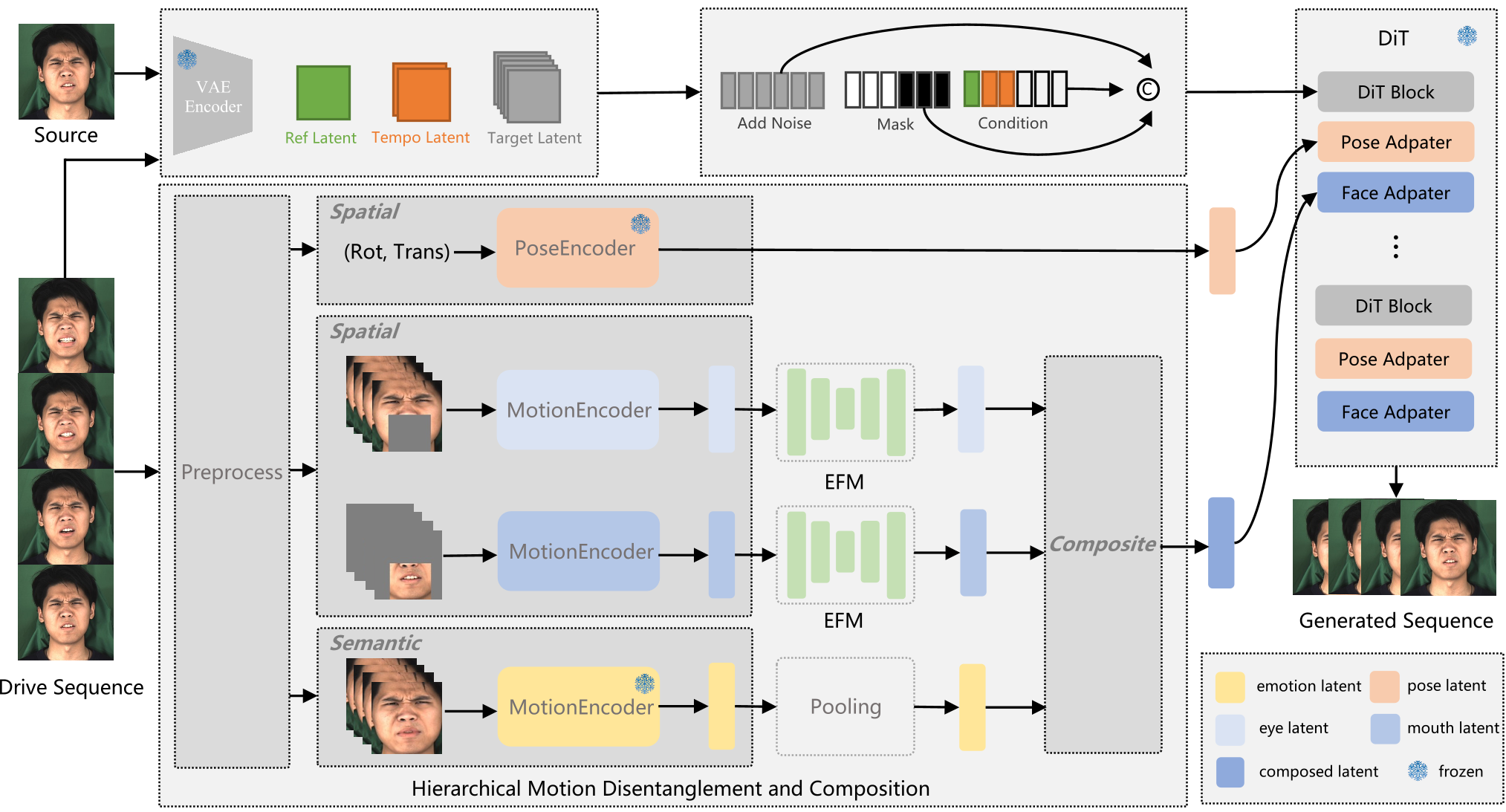 Figure 1: PortraitDirector workflow, showing how ROI crops and pose are processed separately before being fused in the Composite Layer.
Real-time Performance Engineering
To make this practical for streaming and live avatars, the authors implemented three critical optimizations:
- DMD Distillation: Reducing diffusion sampling from 20 steps down to just 4.
- Causal Attention: Redesigning the Attention blocks to work in a "streaming" fashion (using KV-caching) rather than looking at the whole video at once.
- VAE Acceleration: They reduced the width of the VAE decoder to 1/4 of its original size, resulting in a 4x speedup with minimal loss in visual quality.
Experimental Validation
In head-to-head comparisons (Table 1), PortraitDirector outperforms recent heavyweights like AniPortrait and HunyuanPortrait in reconstruction fidelity.
| Method | MSE ↓ | SSIM ↑ | Identity Sim ↑ |
|---|---|---|---|
| XPortrait2 | 0.046 | 0.540 | 0.823 |
| Ours | 0.018 | 0.654 | 0.880 |
The Ablation Studies (Figure 6) prove the necessity of the EFM. Without it, the model cannot suppress the "source bias"—meaning if the driver is smiling, the result will always smile regardless of the target emotion. With EFM, the control is absolute.
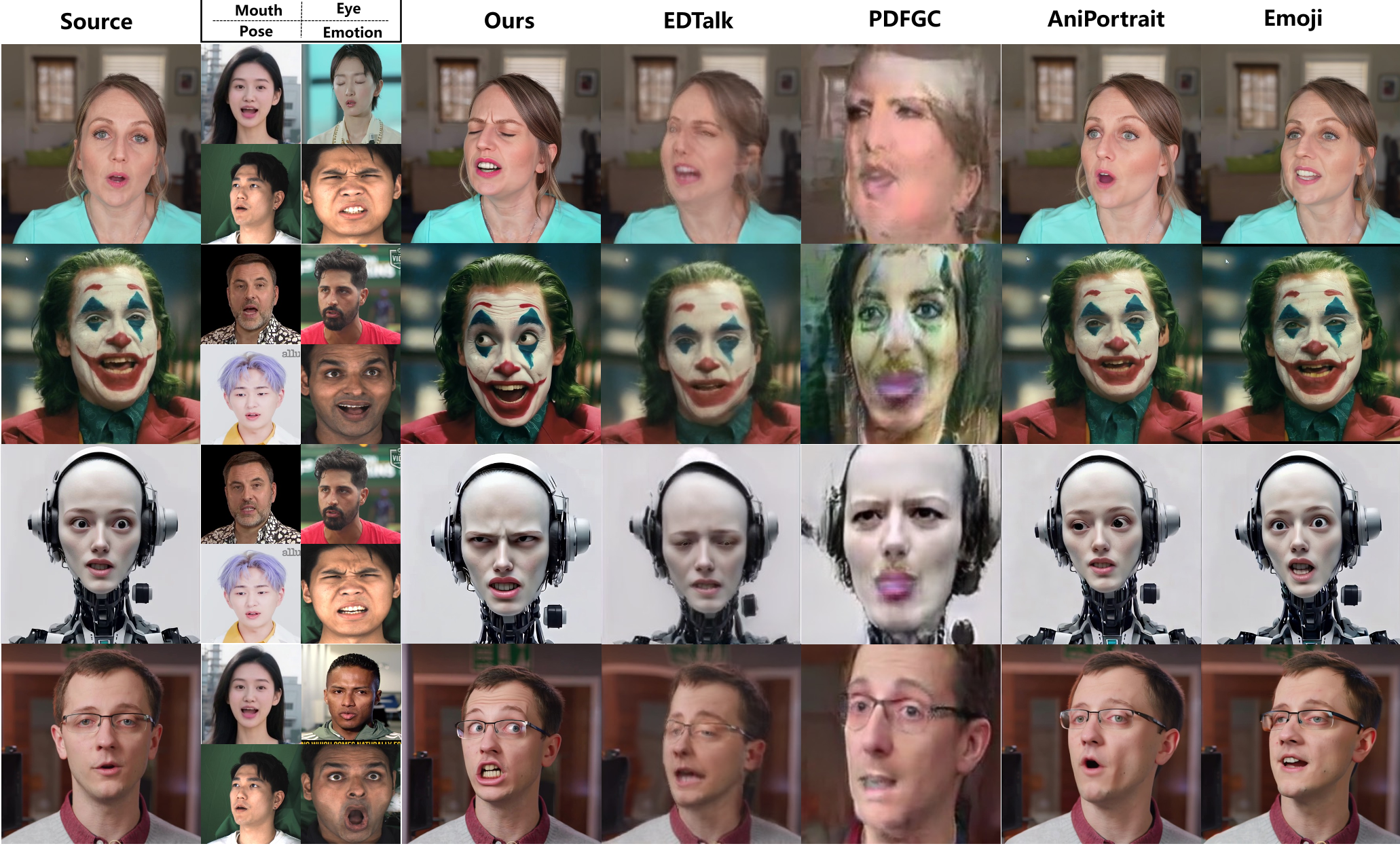 Figure 2: Qualitative comparison showing fine-grained control over individual facial attributes compared to other SOTA methods.
Critical Insight & Conclusion
PortraitDirector succeeds because it acknowledges a physical truth: humans understand faces as a sum of parts and expressions. By forcing the neural network to follow this hierarchical structure—rather than learning a black-box latent space—the researchers have unlocked a level of "Director-level" control that was previously only available in heavy CGI pipelines.
Takeaway: Future real-time AI avatars will likely abandon monolithic end-to-end training in favor of these modular, compositional architectures to meet the demands of high-precision interactive applications.