
Titan's Chemical Gatekeeper: How Ammonia Unlocks the Building Blocks of Life
Prebiotic Chemistry Insights for Dragonfly II: Thermodynamic Favorability of Nucleobases, Ribose, and Fatty Acids in Selk Crater on Titan
This study presents a unified thermodynamic equilibrium model for the synthesis of nucleobases, ribose, and fatty acids within Titan's Selk crater. Using Cantera-based Gibbs energy minimization, the researchers demonstrate that ammonia acts as a chemical gatekeeper, where concentrations make the full canonical suite of prebiotic building blocks thermodynamically accessible.
TL;DR
A new study reveals that the presence of ammonia () on Titan is the decisive factor for prebiotic complexity. In the impact-generated melt of Selk crater, acts as a "hydrogen reservoir," enabling the thermodynamic synthesis of nucleobases, ribose, and long-chain fatty acids—most of which are physically impossible to form in -free environments. This provides a direct "flight manual" for the Dragonfly mission to interpret what it finds on the surface.
Background: A Giant Natural Laboratory
Titan, Saturn's largest moon, is often described as a prebiotic "factory." While its atmosphere is great at making organic haze, the "holy grail" of astrobiology is understanding what happens when those organics hit liquid water—a transient occurrence during asteroid impacts like the one that created Selk Crater, the destination for NASA's Dragonfly mission.
The Bottleneck: Hydrogen Scarcity
The core problem identified by authors Madan and Pearce is a hydrogen deficit. Titan’s surface precursors (like HCN and ) are "hydrogen-poor" relative to the requirements of sugars and lipids.
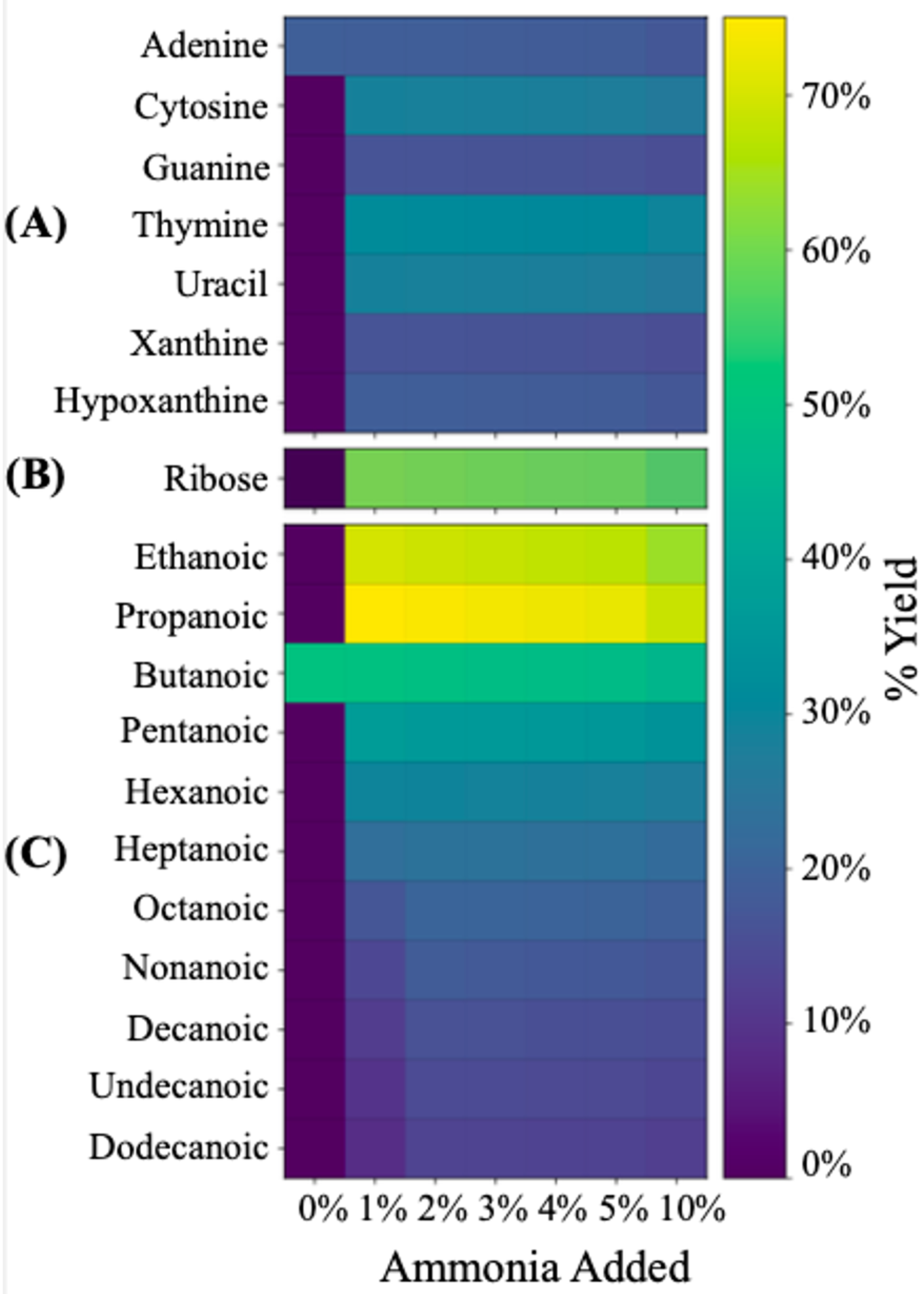
The study's primary insight: Ammonia is the enabler. By providing three hydrogen atoms per molecule, lowers the thermodynamic cost of building complex, reduced organic molecules. Without at least 1% , the chemical "ceiling" is extremely low, permitting only Adenine and Butanoic acid.
Methodology: Mapping the Thermodynamic Ceiling
The researchers used a Gibbs Free Energy Minimization approach. This doesn't look at "how" (kinetics) the reactions happen, but "what" is the most stable state the system wants to reach.
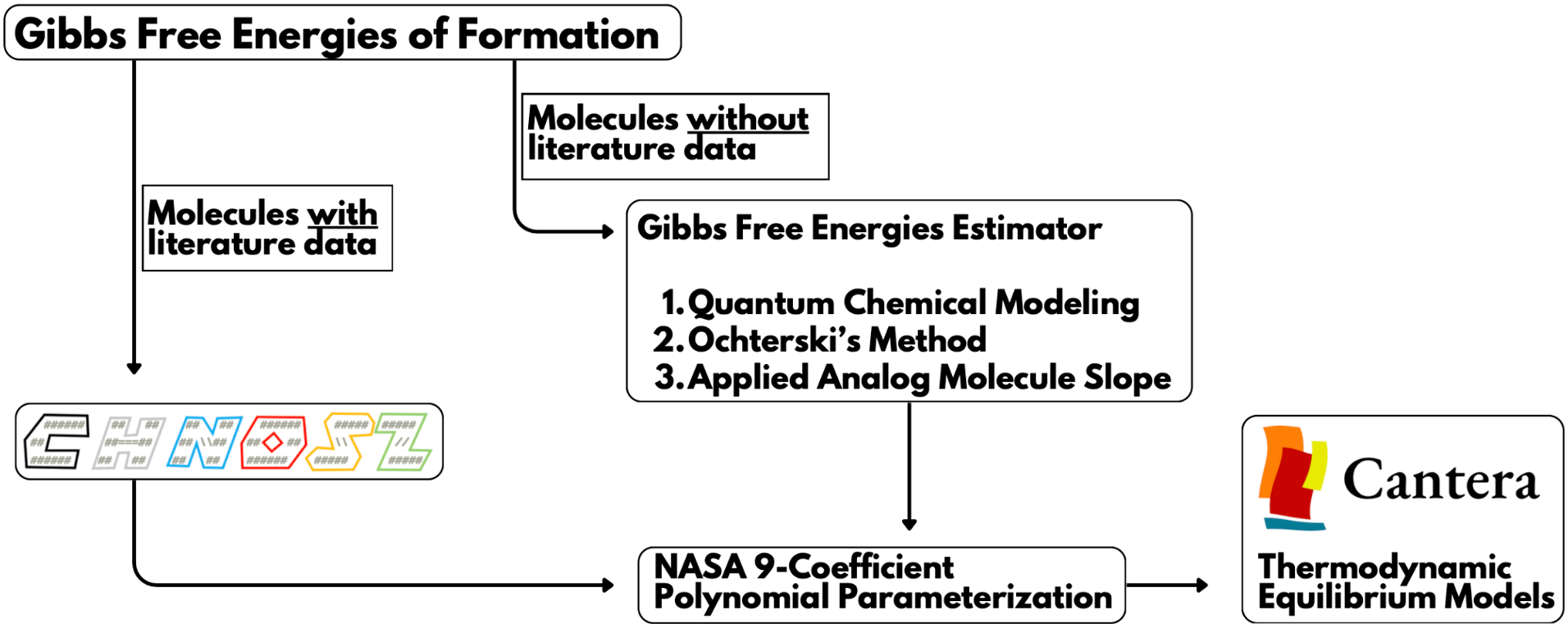
By feeding the model different concentrations of ammonia and organic "survival factors," they simulated the potential yields that the Dragonfly Mass Spectrometer (DraMS) might encounter.
Key Results: The Ammonia Gradient
The findings show distinct "sweet spots" for different molecular classes:
- Nucleobases: Pyrimidines (Thymine, Cytosine, Uracil) are thermodynamically favored over Purines when ammonia is high. This matches observations from "ammonia-rich" asteroids like Bennu.
- Ribose: The sugar of RNA is completely suppressed in -free systems due to its high hydrogen requirement.
- Fatty Acids: As carbon chains grow from to , the demand for ammonia increases. Longer chains (essential for cell membranes) peak at .
Deep Insight: Interpreting Dragonfly’s Future Data
This model turns DraMS into a forensic tool. If Dragonfly detects a broad suite of fatty acids, scientists can infer that Selk crater was likely an ammonia-rich environment. Conversely, if it only finds Adenine, it suggests a "dry" chemical history (lacking ).
Furthermore, the paper provides a baseline to distinguish Abiotic vs. Biotic signatures:
- Abiotic: A smooth, monotonic decline in fatty acid abundance as chain length increases.
- Biotic: An "even-carbon" dominance (e.g., more than ) or high enantio-purity, which thermodynamics alone cannot explain.
Critical Analysis & Conclusion
While the study is a breakthrough in defining the "thermodynamic limit," it acknowledges limitations:
- Kinetics vs. Thermodynamics: Just because a molecule is "favorable" doesn't mean it forms quickly. Some reactions might take centuries, though impact melts can stay liquid for thousands of years.
- Phase Separation: The model assumes a well-mixed "soup," but real crater floors are messy, with ice-organic mixing and volatile loss.
Final Takeaway: This research proves that Titan's "minimalist" organic inventory (HCN and ) is sufficient to build the foundations of life, provided ammonia is there to unlock the door. When Dragonfly lands in 2034, it won't just be looking for "what" is there, but "why" the environment allowed it to exist.