
Hunting for Dark Matter with Fast Radio Bursts: A Global Radio Telescope Forecast
Probing Primordial Black Holes with upcoming Radio Telescopes: a case study for LOFAR2.0, FAST Core Array and BINGO
This paper forecasts the constraints on Primordial Black Holes (PBHs) as a fraction of dark matter () using the gravitational lensing of Fast Radio Bursts (FRBs) observed by upcoming radio telescopes. By analyzing the design specifications of LOFAR2.0, FAST Core Array, and BINGO, the study predicts that a null detection of lensed FRBs could constrain to values between 0.16 and 0.39 across different mass ranges ( to ).
TL;DR
Primordial Black Holes (PBHs) remain one of the most fascinating candidates for Dark Matter (DM). A new study evaluates how the next generation of radio telescopes—LOFAR2.0, FAST Core Array, and BINGO—can use gravitational lensing of Fast Radio Bursts (FRBs) to "weigh" the dark matter content of our universe. By 2030, these instruments could provide independent proof that PBHs constitute less than 16-39% of dark matter in the to mass range.
Problem & Motivation: The Gap in the Dark Matter Map
Despite decades of searching, the nature of dark matter remains elusive. PBHs—black holes formed in the high-density primordial plasma of the early universe—are unique because they don't require new particle physics. However, "seeing" them requires indirect methods like gravitational lensing.
Standard microlensing (stars in the Magellanic Clouds) and CMB distortions have narrowed the search, but there is a need for independent, cosmological probes. Fast Radio Bursts (FRBs) are perfect for this: they are extremely short ( to ), distant (extragalactic), and bright. If an FRB passes near a PBH, the gravity of the black hole splits the signal, creating a time-delayed "echo." The problem? Current telescopes haven't detected enough FRBs with high enough resolution to make this a definitive test—until now.
Methodology: Resolving the Gravitational "Echo"
The study focuses on the optical depth (), which represents the probability that any given FRB will be lensed. This depends on three critical factors:
- Time Resolution (): To detect a lens of mass , the telescope must be able to resolve a time delay proportional to that mass.
- Signal-to-Noise Ratio (SNR): Higher SNR allows for wider "impact parameters," meaning the telescope can see lensing even when the alignment isn't perfect.
- Total Count (): Lensing is rare; you need thousands of bursts to find a handful of lensed events.
The authors specifically modeled the capability of three upcoming facilities:
- LOFAR2.0: Doubling observation speed and adding tied-array beams.
- FAST Core Array: Adding 24 auxiliary dishes to the world's largest single-dish telescope.
- BINGO: A new transit telescope in Brazil dedicated to 21cm intensity mapping but highly capable of FRB detection.
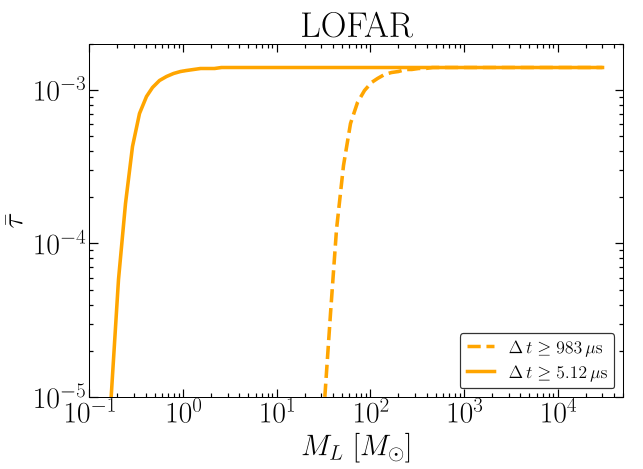 Above: The integrated optical depth grows with PBH mass, showing where different telescopes become sensitive.
Experiments & Results: Setting the Bounds
The authors performed a forecast assuming a null detection (i.e., if we observe bursts and none are lensed). Their results indicate a significant improvement in our ability to exclude PBHs as the sole source of dark matter.
- LOFAR2.0 is the powerhouse here. With an expected bursts, it could set a bound of for PBHs around 1 solar mass.
- BINGO/FAST joint operations (BINGO-ABDUS) will be particularly effective at higher masses (), restricting the fraction to roughly .
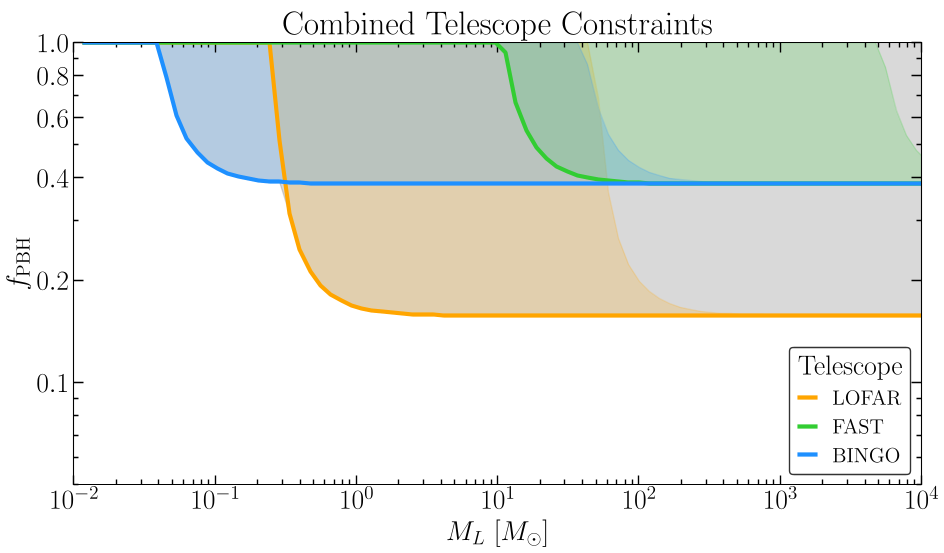 Above: The forecasted exclusion regions (shaded) compared to current constraints from other astrophysical sources.
Critical Analysis & Conclusion
This work demonstrates that while radio telescopes might not yet beat the ultra-strict limits from the Cosmic Microwave Background (which restricts to at very high masses), they provide a cleaner, local measurement that is less dependent on complex early-universe physics.
Takeaway: The future of dark matter research is increasingly multi-messenger. By combining data from hydrogen mapping (BINGO) and deep surveys (FAST/LOFAR), we are creating a "radio net" that PBHs can no longer hide in.
Limitations: The study assumes a "monochromatic" mass function (all PBHs have the same mass). In reality, PBHs likely have a distribution of masses, which might smear the signal. Additionally, the "plasma screen" effect of the intergalactic medium could potentially interfere with the lensing signal, a factor the authors suggest for future more detailed exploration.