
Real-Time Nash Equilibrium: Accelerating Game-Theoretic AV Planning via Time-Distributed Iterations
Real-Time Solution-Seeking for Game-Theoretic Autonomous Driving via Time-Distributed Iterations
This paper introduces time-distributed Newton and Newton–Kantorovich methods for Game-Theoretic Model Predictive Control (GT-MPC) in autonomous driving. By distributing Nash Equilibrium (NE) seeking iterations across sampling instants, the authors achieve real-time decision-making in complex multi-agent scenarios like intersection crossing.
TL;DR
To enable autonomous vehicles (AVs) to negotiate complex intersections in real-time, researchers from Virginia Tech have developed a game-theoretic approach that doesn't wait for a perfect solution. By using time-distributed Newton and Newton–Kantorovich methods, the system approximates a Nash Equilibrium across successive time steps, slashing computational overhead while maintaining safety and performance.
Problem & Motivation: The Real-Time Game Dilemma
In dense traffic, an AV's optimal move depends on the actions of others, and vice versa. Game-Theoretic Model Predictive Control (GT-MPC) is the gold standard for modeling these interactions. However, GT-MPC is notoriously expensive because it essentially requires solving a complex optimization problem for every agent at every fraction of a second.
The core bottleneck in previous SOTA works is the demand for "full convergence" at each sampling instant. The authors observe that since the traffic environment changes continuously, we don't need to resolve the game from scratch; we can spread the effort over time.
Methodology: Spreading the Hard Work
The paper utilizes two primary strategies to solve the game efficiently:
1. The Potential Game Framework
Instead of tackling arbitrary (and potentially non-convergent) games, the authors formulate the AV interaction as a Potential Game. This ensures that seeking a Nash Equilibrium is equivalent to minimizing a single "Potential Function" (), which captures tracking errors (speed) and interaction penalties (collision avoidance).
2. Time-Distributed Newton-Type Solvers
Instead of running a solver to completion, the authors perform just iterations per step.
- Newton Method: Linearizes the stationarity conditions at each iteration. It is accurate but requires recomputing the Jacobian matrix frequently.
- Newton–Kantorovich (N-K) Method: Reuses the Jacobian from the first iteration of each step. This "inexact" approach significantly speeds up computation by avoiding the heavy lifting of matrix updates.
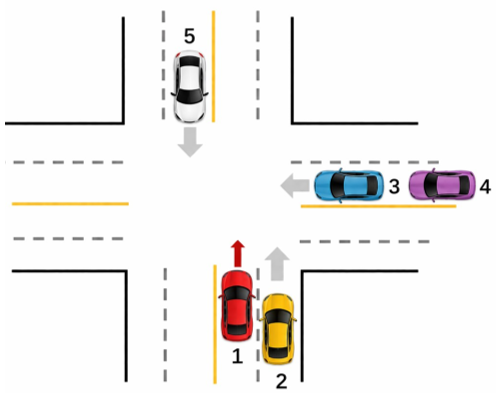 Fig 1: The 5-vehicle intersection scenario used to validate the real-time solvers.
Experiments & Results: Accuracy vs. Speed
The proposed methods were tested in a 5-vehicle intersection scenario. The team compared two NE-seeking algorithms: Potential Function Optimization and Best Response Dynamics.
Key Insights from Experiments:
- Convergence: Both Newton and N-K methods show that as the number of iterations () increases, the approximation error relative to a global solver decreases.
- The N-K Advantage: While the N-K method requires slightly more iterations to reach the same error floor as the standard Newton method, its per-iteration cost is much lower.
- Efficiency: Both proposed methods are orders of magnitude faster than standard global search solvers, making them suitable for hardware deployment.
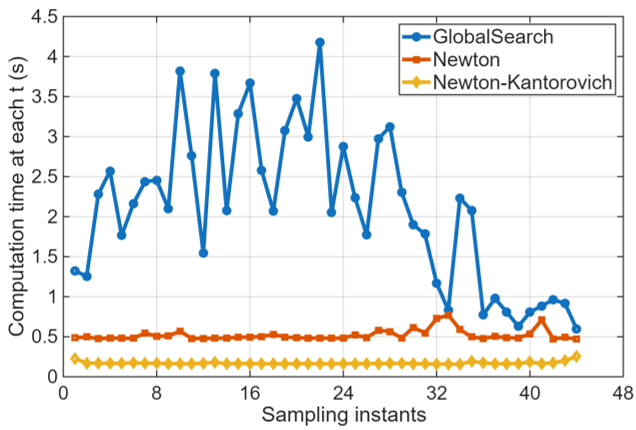 Fig 2: Computational time comparison. Both Newton-type methods (especially N-K) drastically reduce the time to find an NE compared to GlobalSearch.
Critical Analysis & Takeaways
The beauty of this work lies in its temporal continuity. By warm-starting the solver with the solution from the previous time step, the AV effectively "carries its thoughts forward," allowing it to navigate complex social interactions without the lag typically associated with game theory.
Limitations: The current approach assumes a linear dynamics model for the vehicles. In highly non-linear or high-slip regimes (e.g., emergency swerving), the approximation error of the constant Jacobian in the N-K method might grow significantly.
Future Outlook: This research paves the way for scaling GT-MPC to dozens of agents. The transition from "exact solvers" to "time-distributed inexact solvers" is a critical step for bringing game-theoretic intelligence out of simulations and onto the actual road.
Takeaway for Practitioners: If your MPC is too slow, don't just look for a faster solver—look for a way to distribute your iterations across the time horizon.